மீண்டும் முனகல் ஒலி கேட்டுத் திரும்பிப் பார்த்தேன். எதோ புதுப் பட பாடலில் வரும் கீச் கீச் சத்தமாகத்தான் இருக்க வேண்டும். காரின் பின்பக்க ஸ்பீக்கரிலிருந்து வந்ததால் கொஞ்சம் தடுமாறித்தான் போனேன். மழைத் தூறலாயிருந்தது. ஏற்கனவே ஹைவே இல்லாத வழியாக ஜீபிஎஸ்ஸில் தேர்ந்தெடுத்திருந்ததால், வீட்டிலிருந்து ட்யூவால் சென்று, நாவல்டி வழியாக கார்னேஷனை கடந்து ஸ்னோக்குவாமி நோக்கி பிரயாணம். கிட்டத்தட்ட சென்னையிலிருந்து திருப்பதி செல்ல கும்மிடிப்பூண்டி கடந்து, காலஹஸ்தி போய் திருப்பிக்கொண்டு திருப்பதி வருவது போலத்தான். வழியெல்லாம் பாசி படர்ந்த மரங்கள், வளைந்து செல்லும் உள்ளூர்த் தெருக்கள், பனி மறைத்துக் கொண்டிருக்கும் மலைகள். பாட்டை மாற்றி ராஜாவுக்கு கொண்டு வந்தேன் – “மலர்கள் தோறும் நடந்து போகும் சிறிய ஜீவனே, உந்தன் மனதைக் கொஞ்சம் இரவல் கேட்கும் எனது ஜீவனே…”
நண்பர் ஷங்கர் பிரதாப் (சமீபத்தில் முதல் கதை எழுதியிருக்கிறார், வாழ்த்துக்கள்!) இலக்கிய மதியமொன்றை ஏற்பாடு செய்திருந்தார். அருகாமையில் இடம் கிடைக்காததால் ஸ்னோக்குவாமி நூலகத்தில் நடத்துவதாய் ஏற்பாடு.
இலக்கிய கூட்டமென்றாலே எனக்கு வயிறு இளகிக் கொள்ளும் என்பதால் அவைகளில் கலந்து கொள்வதில்லை. ஆனால் ஷங்கருடன் பேசியபோது, “இலக்கிய கூட்டமென்றால் இறுக்கமாய் இருக்க வேண்டும் என்றெல்லாம் இல்லை; ஆனாலும் கொஞ்சம் தீவிரமாக இருந்தால் மட்டும் போதும்” என்றதால், போகலாம் என்று நினைத்திருந்தேன்.
சென்னையில் இருந்த போது பல்வேறு இலக்கிய கூட்டங்களுக்கு சென்று நொந்து போயிருந்ததை சொன்னேன். “கொஞ்சம் மாறுதலாய் இருக்கும், வந்து பாருங்கள். இம்மாத தலைப்பு அசோகமித்திரன். அந்த தலைப்பில் ஏதாவது பேச முடியுமா?” என்றார்.
“அசோகமித்திரனின் இயற்பெயர் தியாகராஜன். இவர் செக்கந்தராபாத்தில் பிறந்தார். இவர் இதுவரை 9 நாவல்களும்…” இப்படி எல்லாம் “My name is Kaveri, like the river Kaveri…” போல கூட்டத்திற்கு வருகிறவர்களை எட்டாம் வகுப்பு மாணவர்கள் போல நடத்த எனக்கு இஷ்டமில்லை. முதலில் அசோகமித்திரன் எழுதிய ஒரே ஒரு வாக்கியத்தையோ ஒரு பத்தியையோ கொண்டு நிறுவ முடியுமா என்று நினைத்தேன். அவரெழுதிய கரைந்த நிழல்களையும், தண்ணீரையும் தேடிப்பார்த்தேன். சரியான பத்தி அமையாததினால், ஒரு கூட்டு வாசிப்பு போல செய்யலாம் என்று நினைத்திருந்தேன். அதற்காக தேர்ந்தெடுத்திருந்தது, அரை நூற்றாண்டுக்கு முன், 1969-ல் அசோகமித்திரன் எழுதியிருந்த சிறுகதை – பிரயாணம். இது அந்த வருடம் சுதேசமித்ரனின் தீபாவளி மலரில் இடம் பெற்றது. பிறகு, அவரது முதல் சிறுகதை தொகுப்பான “வாழ்விலே ஒரு முறை” (காலச்சுவடு) தொகுக்கப்பட்டது.
அசோகமித்திரன் எழுதிய அனைத்தையும் (கிட்டத்தட்ட) படித்திருந்தாலும், பிரயாணம் சிறுகதை தான் அவரின் உச்சம் என்பது என் தனி அபிப்பிராயம். இத்தகைய உச்சக் கதையிலும் கூட முதல் டிராஃப்ட் சங்கடங்கள் இருக்கத்தான் செய்கின்றன. இருந்தும் கூட அவர் எழுத்தாளர்களின் எழுத்தாளர் தான். அவர் எழுத்தின் பிரதான அம்சமே எளிமைதான். பிரயாணம் மேலளவில் மிக எளிமையாகத் தெரிந்தாலும், அதனுள் ஒளிந்திருக்கும் பல பரிமாணங்கள் எனக்கு இன்னமும் பிடிபடவில்லை. அதனால்தான், அக்கதையை எப்பொழுதுமே என்னால் விளக்க முடிந்ததில்லை.
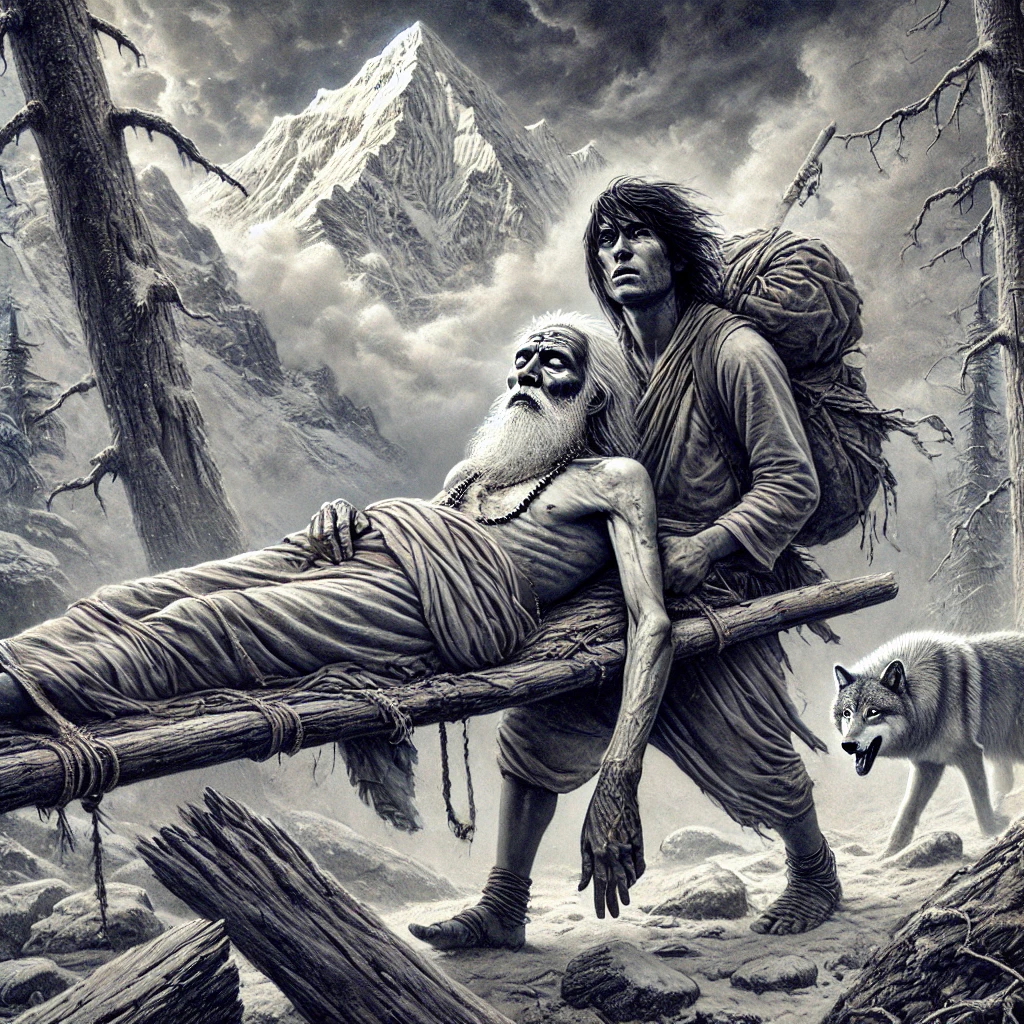
ஒரு சீடன், உடம்புக்கு முடியாத ஒரு யோகி குரு, இமய மலைச்சாரல், விட்டால் கடித்து தின்றுவிடக்கூடிய ஓநாய்கள், கொஞ்சம் அமானுஷ்யம், கொஞ்சம் ஆக்ஷன், திடுக்கிடும் திருப்பம் – டிவிட்டர் வேகத்தில் சொல்லிவிடக்கூடிய கதையாயிருந்தாலும், அது தான் கதையா?
எடுத்துப் போயிருந்த ஐபேட்டிலிருந்து அக்கதையை முழுவதுமாக சத்தமாக படித்து முடிக்க அரைமணி நேரமானது. வந்திருந்த நால்வருமே இக்கதையை முன்னமே படித்திருந்தாலும், நான் படிக்க, ஃபோன் பார்க்காமல் பொறுமையாக கேட்டுக் கொண்டிருந்தார்கள். படித்து முடித்தவுடன், “இதை நான் படிக்கும் போது சட்டென உங்களுக்குச் தோன்றிய எண்ணங்கள் என்ன?” என கேட்டேன். ஒவ்வொருவரும் வெவ்வேறு கோணங்களில் பதிலளித்தார்கள்.
ஜெயமோகன், இரண்டொரு வருடங்களுக்கு முன்பு சியாட்டல் வந்த போது இதே பிரயாணம் கதையை அலசியதாக ஷங்கரும், மதனும், ஶ்ரீனியும் சொன்னார்கள். மதன் – ஜெயமோகன் சொன்ன மூன்று விதமான பார்வைகளை பற்றிச் சொன்னார்.
அசோகமித்திரன்
இக்கதையை பற்றி என் எண்ணங்கள் என்ன என்று சொல்வதற்கு பதிலாக, 2009-ல் அசோகமித்திரனை சந்தித்த போது, அவரிடமே இக்கதை பற்றியும் இன்று நாவலில் வந்த ஒரு பகுதியை பற்றியும் விவாதித்ததை சொன்னேன்.
“அந்தக் கதை எழுதி ஒரு பதினேழு பதினெட்டு வருஷங்களுக்கு பிறகு, ஏன் அந்தக் கதையை எழுதினேன்னு நானே ஒரு கட்டுரை எழுதிப் பார்த்தேன். அப்போ தான் எனக்கே கூட எதை நினைச்சு எழுதினேன்னு புரிஞ்சது. அதை படிச்சிருக்கியா பா?” என்றார்.
இல்லை என்று தலையாட்டினேன்.
“அந்த கதை எழுதின சூட்டோடு அதை மறந்தே போயிட்டேன். அப்பப்போ யாராவது சிலாகிச்சு சொல்லும் போது அதை திருப்பி படிக்கணும்னு தோணும். கொஞ்ச வருஷம் கழிச்சு அத படிச்சப்ப தான் எனக்கே இது நானா எழதினேன்னு தோணிச்சு” என்றார்.
அன்றே தேடிப்போய் அந்த கட்டுரை வெளியான என் பயணம் (நற்றிணை பதிப்பகம்) என்ற அந்த நூலை வாங்கிப் படித்துப் பார்த்தேன். முக்கியமான பத்தி இது தான் –
இப்படி பல கேள்விகளை உள்ளடக்கிய கதையாக பிரயாணம் அமைந்தது. நான் திட்டமிட்டதின் பயனாக என்று கூற முடியாது. ஒரு பாத்திரம் – உறைபனி சூழந்த மலைகளில் தனியாக வாழும் ஒரு மனிதன் – இது தான் என் திட்டமும் துவக்கமும். பிற பின்னல்கள், நிகழ்ச்சிகள், செய்திகள் யாவும் கதையை எழுதும் போது மனம் எனும் புதை மணலில் இருந்து வெளிக்கிளம்பிக் கதையில் பொருத்திக் கொண்டவை.
இக்கதையை எழுதத் தூண்டியவை அன்று என் முன் என் கைக்கெட்டும் தூரத்திலேயே இருந்தன. ஆனால் நான் தாகூர் அனுபவத்தைப் படித்ததன் காரணமாகத்தான் பிரயாணம் எழுதினேன் என்று நினைத்துக் கொண்டிருந்தேன். இன்று தெளிவாகத் தெரிகிறது, அது ஒன்று தான் காரணம் என்று சொல்வதற்கு இல்லையென்று.
– அசோகமித்திரன், என் பயணம், 1988.
இப்படிப் போகும் அந்தக் கட்டுரை ஒரு அரிதான meta commentary. எழுத்தாளன் தான் எழுதிய கதையை கிட்டத்தட்ட இருபது ஆண்டுகள் கழித்து அதன் ரிஷிமூலம் நதிமூலத்தை தேடி தனக்குத் தெரிந்ததை தாண்டி இன்னொன்றை கண்டறியும் தருணம். உங்களுக்கு பிரயாணம் பிடித்த கதையாயிருந்தால், அந்தக் கட்டுரை கிடைக்குமானால், படித்துப் பாருங்கள்.
இந்த meta commentary கட்டுரையையும் அன்று முழுவதுமாக உரக்க வாசித்தேன். அன்று வந்தவர்களுக்கு, அசோகமித்திரன் மூலம் நான் முன்வைக்க நினைத்த கேள்வி இதுதான் – “ஒரு எழுத்தாளன் எழுத நினைத்த உட்பொருள் முக்கியமா, அல்லது அதை மற்றொரு நாள் வாசிக்கக்கூடிய வாசகனுக்கு தன் மனதில் புரிவது தான் அந்த படைப்பின் பயனா?”
வேறு மாதிரி சொல்வதானால் –
“The birth of the reader must be at the cost of the death of the author.”
இது ரொலான் பார்த் (Roland Barthes) என்ற இலக்கிய ஆய்வாளரின் கருத்து. எழுத்தாளரின் நோக்கம் இறுதி உண்மை அல்ல. வாசிப்பவரின் அனுபவமும் அதில் முக்கியமானது. எனவே, வாசிப்பவர் ‘பிறக்க’ வேண்டும் என்றால், எழுத்தாளரின் கருத்து மட்டும் முக்கியம் என்று நினைக்கும் மனநிலை ‘இறக்க’ வேண்டும். இது எழுத்தின் சுதந்திரத்தையும் வாசிப்பின் சக்தியையும் வெளிப்படுத்தும் ஒரு எண்ணமே.
டீ, பிஸ்கெட், இலக்கிய கிசுகிசு என வழக்கமான இலக்கிய கூட்ட கடமைகளுக்குப் பின் கிளம்பினேன். கூட்டத்திற்கு வந்தவர்களுக்கு சகல சௌபாக்கியங்களும் சௌகர்யங்களும், கிழக்கு திசையில் இருந்து புதுத்துணியும் லாட்டரி லாபமும் கிடைக்கட்டும்.
கார் ஓட்டிக்கொண்டு வீடு திரும்பும் போது, பனி போர்த்திய மலைகளின் இடையே இருந்து சூரிய ஒளி கண்ணைக் கூசியது. அசோகமித்திரனை நினைத்துக் கொண்டேன்.
Dhanush’s NEEK (Nilavuku Enmel Ennadi Kobam) is, as the tagline suggests, a very usual love story. Which is to say, it’s about young people falling in love, misunderstanding each other, and learning something about themselves in the process. The question is not whether we’ve seen this before. We have, many times. The real question is whether the film makes it feel like something worth watching again.
And, for the most part, it does.
Dhanush’s third directorial effort doesn’t really come in with a lot of noise. It’s not a film that’s trying to announce itself with grand statements. The whole thing just kind of plays out in front of you, and you either go with it or you don’t. The film works with a lot of restraint. Not the kind where you feel like the director is overthinking every moment, but the kind that feels instinctive. It’s like Dhanush just trusts his material enough to let it breathe. UnlikeRaayan, which leaned into heightened drama, NEEK moves with a sort of casual looseness. The young ensemble, who drink in every third scene because that’s just what they do, move through a world that feels immediate, contemporary, and lived-in.
But NEEK isn’t meandering or unfocused. It’s sharp. The conversations feel completely unpolished in the best way possible, with Tamil and English switching back and forth like how people actually talk. Some movies try way too hard to make this kind of thing sound ‘natural,’ and you can always tell. But here, it just works. The best moments come out of this—the way relationships unfold and how friendships hold space for grief and laughter at the same time.
This is, in many ways, a deceptively simple film. The cinematography does its job without ever trying to be flashy. The music by G.V. Prakash is vibrant without overpowering the film. And then, for a brief moment, NEEK steps away from its whole realism thing and does something spectacular. The Pulla song sequence is honestly great. I loved it. And I liked that the movie, at least here, decided to embrace the big screen for what it is. G.V. Prakash not only composes one of the film’s best tracks but also appears on screen, and for those few minutes, the film completely gives in. The lighting, the staging, the visual rhythm – it’s all just electric. And yeah, maybe it doesn’t fully belong in the movie’s otherwise stripped-down world, but who cares? It works. It’s the one sequence that really leans into the magic of the big screen, and I was happy it was there.
And then, there’s the breakup scene.
This is where I felt like the movie kind of lost me for a bit. It arrives with the force of an old cliché: a misunderstanding that escalates far beyond what seems reasonable in an era where people have about ten different ways to text each other. This is the kind of plot twist that worked in the 80s or 90s, but now? Not so much. Raayan had a similar thing, a narrative shortcut from the 80s, and I remember feeling the same way about it. Dhanush, for all his restraint, still seems drawn to the kind of emotional twists that belong to an older era of Tamil cinema. In a film that otherwise sticks so hard to realism, this moment sticks out. Not because it’s badly done. The actors do their part, some better than others. But it’s a contrivance the movie didn’t need.
Still, NEEK is engaging. And there are moments where you just can’t help but appreciate what Dhanush is doing here. Take the scene at the beach, where a gang of rowdies tries to rob the group and harass the women. Believe me, I wanted the film to use this moment. I wanted the hero to rise up, to tap into something primal, to own this scene. I wanted a Run-style transformation, or even better, a Baasha moment—one punch sending a guy flying, the whole audience losing their minds. Any self-respecting Tamil movie fan would have expected it. But nope. Dhanush doesn’t give you that. Instead of a grand, slow-motion sequence, we get one quick punch, and then the hero just runs. I won’t lie—I felt a little cheated in that moment. But the more I thought about it, the more I realized that’s the whole point. This is a movie that’s refusing to bend to convention. And honestly? That’s kind of cool.
Some performances stand out more than others. Priya Varrier and Ramya Ranganathan are great. Their characters feel textured and real in a way that makes them easy to connect with. Some of the others? Not so much. There are moments where the acting slips, and you suddenly become aware that you’re watching actors act. That’s not always a deal-breaker, but in a film like this, where so much depends on immersion, it’s noticeable. The weeping scene, in particular, completely took me out of the movie. Instead of feeling the heartbreak, I found myself thinking, yeah, that’s an actor trying really hard to cry.
For all its restraint, NEEK still fits into a very familiar formula. But Dhanush’s approach makes a difference. The film isn’t trying to be a grand, sweeping romance. It’s not trying to redefine the genre. It just wants to be a story about a group of people, in a particular moment, feeling things that, to them, seem huge.
In a genre that so often amplifies emotion, NEEK instead asks: What if we just sit with it?
No one had consulted him when they changed the name. Not a single government official had sought his opinion, no minister had sent him a courteous letter of inquiry—Dear Sir, do let us know at your earliest convenience if we may proceed with this renaming business?—nothing. One fine day, the newspapers simply declared that Madras, his Madras, had been quietly replaced with a more domesticated, government-approved, slightly less colonial Chennai. And just like that, without his permission, without even the basic courtesy of a memo, the city of his childhood, of his movie posters and second-hand bookstores, of his grandmother’s whispered stories, had been edited out of existence.
He took personal offense to this. Not the kind of offense that leads men to the streets in protest, no—he was far too lazy for that—but the kind that settles deep into the bones, the way a misplaced childhood grudge lingers against a long-forgotten teacher. He still called it Madras, stubbornly, gleefully, his own little act of defiance, as though by sheer force of habit, he could will the old name back into currency.
And so, on that humid July morning when Madras—betrayed, rebranded, and wholly unconsulted—woke up to find itself answering to the name Chennai, he kick-started his Hero Puch, the engine sputtering to life like an old man grumbling about a world that no longer made sense. Clad in worn jeans and unassuming sandals, his khadi kurta—a handcrafted jibba—fluttered slightly, an oddity amidst the tide of tight T-shirts and denim. His jolna bag, slung cross-body, sagged against his hip, a rumpled, overburdened companion, making him look less like a college student and more like a prematurely middle-aged poet who had misplaced his first book deal.
The roads of KK Nagar were already alive with the day’s theatrics. Newspaper stands shouted of politics—Jayalalithaa’s latest triumphs and tribulations, Rajinikanth’s upcoming cinematic revolution, DMK and AIADMK still locked in their eternal, operatic war. The scent of fresh agarbathis mixed with that of jasmine garlands, sold by flower vendors who sat cross-legged on the pavement, their hands moving faster than time itself.
MGR Nagar unfolded before him in a riot of color and sound—fruit sellers stacking their pyramids of mangoes with architectural precision, tea shops clinking with glass cups, auto drivers arguing over fares with the aggressive diplomacy of international negotiators. He turned into the ESI Hospital parking lot, nodding at the parking attendant with the easy familiarity of a man who had been handing over two-rupee coins in exchange for a safe spot for his moped since the beginning of time.
From there, a short walk took him to the Udayam Theatre bus stop, where Kamal Hassan’s larger-than-life gaze peered down at him from freshly pasted posters of the movie Indian. The D70 arrived, overflowing with passengers in the way only Madras—Chennai!—buses could manage, an alchemy of space and human elasticity. Inside, men clung to the overhead bars with one hand while flipping newspapers with the other. The air was thick with unspoken rules—who must move for whom, how far an elbow could be tolerated before it became an offense, the strategic placement of feet to minimize unwanted entanglements.
Through Ashok Nagar, Guindy, past the never-ending bridge construction that had taken on an almost mythical quality—like some ancient project abandoned by the gods—he finally reached Velachery. The SPIC stop expelled a gaggle of Chellamaal college girls in cotton dupattas, their bangles jingling as they disappeared into the crowd.
Just before Velacheri, he stepped off the bus and into the welcoming aroma of the Honest Tea Stall. His friends were already there, cigarettes dangling, single chaaya cups in hand, debating the day’s irrelevancies. He waved but did not stop. Hunger dictated his next move.
The college canteen, a temple of cheap idlis and indifferent sambar, greeted him with the clatter of steel plates. He ate in silence, washing it all down with a cup of tea so thin it could have doubled as dishwater.
And then, at last, came the first period. He sat through it, as was expected of him, endured the lecture like a soldier endures war—stoically, with a touch of exaggerated suffering. But the real story of the day, the only one that mattered, began when he emerged from the classroom, stepping into the corridor, leaning against the balcony, humming under his breath.
It was the second week of college, a morning already humid with the sun’s early insistence. The day sprawled ahead like a yawning field of endless periods and half-hearted lessons, the kind he imagined might blur into one another until only the tedium remained.
He lingered outside his classroom on the second floor, leaning against the railing of an open balcony, waiting for Professor Sukanya Mam to arrive and begin the dance of microeconomics. He wasn’t sure why he was alone—his friends were usually nearby, filling the spaces between classes with laughter and petty arguments about nothing in particular. But today, the silence belonged to him.
He was humming softly under his breath, the notes of a melody that had lodged itself in his soul. “Enai Kaana Vilaiye”—I’ve been missing since yesterday—a line that seemed to embody the wistful romance of A R Rahman’s genius. It was a song about searching, about absence and longing, though at the time, he had no one to long for. Or so he thought.
The songs of Kadhal Desam had already become a part of his life, like an old habit. The movie itself was just a month away from release, waiting to take its place in the world. And now, humming a tune from this new film, he had no idea that life was about to shift beneath his feet. In just moments, everything would change.
And then, the world held its breath. Something—he would never be able to explain what—shifted in the air. The silence around him, once comfortable, now felt different, weighted, as if the day itself had stopped to take notice. The heat, the hum of distant voices, the rhythmic clang of a metal shutter being pulled down—all of it dulled, receded.
He straightened slightly, his humming faltering. A strange, inexplicable awareness prickled at the edge of his senses.
And then—
The spiral staircase, an outdoor structure that twisted its way up like a giant’s idle doodle, came into view at the edge of his peripheral vision.
He turned his head, and there she was.
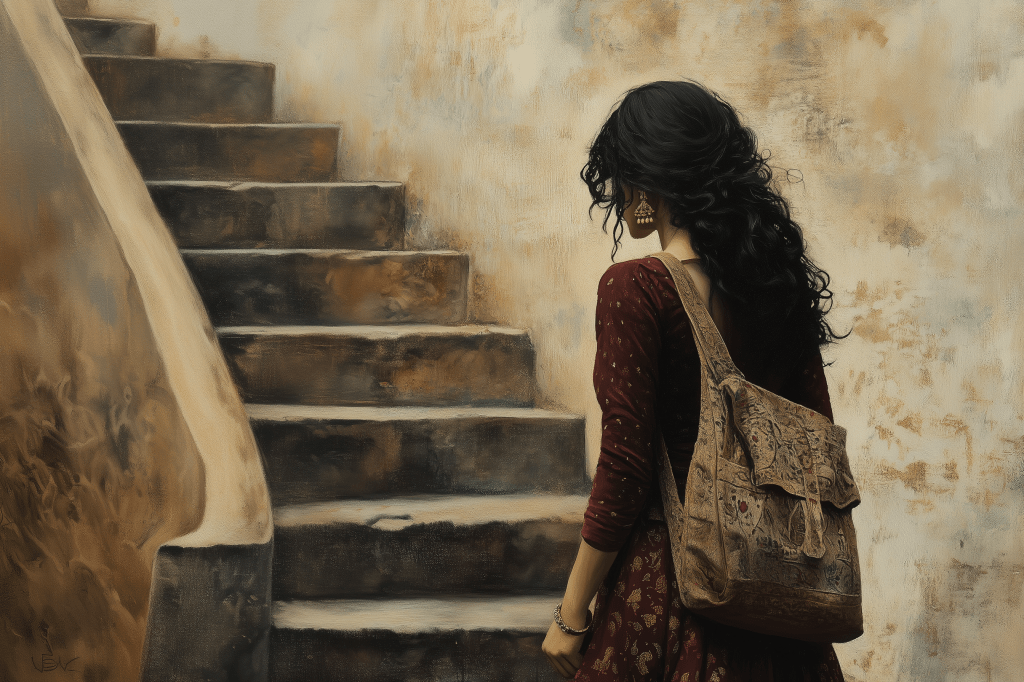
She emerged from the final turn of the stairs as if conjured by some capricious deity, her steps neither hurried nor hesitant. Her hair, oh, her hair. A glorious rebellion of black curls, caught the light in such a way that it seemed less a collection of strands and more a declaration of war against order itself. A single clip held it at bay for a brief moment before surrendering to the chaos that unfolded beneath it.
She wore a printed maroon churidar, its colors and patterns chosen with a deliberateness that hinted at both elegance and restraint. Her earrings swung with each step, oversized and gleaming, like tiny golden pendulums marking the passage of time that had now slowed to a crawl.
In her hand, she carried a Rajasthani cloth backpack slung casually over one shoulder. It was not remarkable, yet it captivated him in its utility, as though it held not books or pens but pieces of her personality, fragments of a life he would never know but desperately wanted to. She walked with the poise of someone accustomed to being observed yet blissfully unaware of the spell she cast on him.
He had no belief in love at first sight. If someone had asked him just moments earlier, he would have laughed at the absurdity of it. And yet, in those six seconds—perhaps eight, no more than ten—his world tilted. He could not explain it, then or now, but something in her—her elegance, her ease, the quiet poetry of her presence—spoke to a part of him he had not known existed.
It wasn’t her beauty, though she was undoubtedly beautiful; it was the way she seemed to belong entirely to herself, carrying her being as if it were a rare and fragile artifact she alone had the right to hold.
She reached the landing, her steps bringing her closer to the doorway of her classroom, which was directly opposite his. Perhaps she glanced at him—he couldn’t say for certain.
All he knew was that in those moments, as she crossed the threshold of her classroom and disappeared from view, he felt a certainty so profound it frightened him. She was his. Or he was hers. The distinction blurred into irrelevance.
The day went on. He sat through Sukanya Mam’s lecture, the words of microeconomics bouncing off him like pebbles skimming the surface of a lake. He did not speak of her to anyone; the experience felt too sacred, too fragile to share.
After class, he took the D70 again, the old warhorse of the Pallavan Transport Corporation, its metal body groaning under the weight of a hundred impatient passengers. The bus weaved through Ashok Nagar, where outside Udayam Theatre, the restless tide of moviegoers surged, desperate for Indian tickets. Men craned their necks over counters, black-ticket sellers whispered sweet illicit deals, and posters of Kamal Haasan loomed over the chaos, his mustached revolution gazing sternly down upon them all.
He stepped off and walked back to the ESI Hospital parking lot, where his Hero Puch sat in the scorching sun, waiting with the unwavering patience of an old, underappreciated friend. He swung a leg over, kick-started it with a practiced flick, and decided—home could wait.
Ramesh and Senthil will be at Woodlands Drive-In, where a good filter coffee awaited, a place where afternoons stretched long beneath the canopy of ancient trees. But then he remembered the books—those accursed, overdue books from British Council Library.
So he charted a new path: lunch first, library later.
From Ashok Nagar, he took the Arya Gowda Road of West Mambalam, which was never silent, never still. Midday brought with it the fervor of devotion at Ayodhya Mandapam, where a harikatha was underway—some saintly man in ochre robes narrating Krishna’s escapades to a rapturous audience, their voices rising in collective chants. The loudspeakers crackled, broadcasting divinity to everyone, including unsuspecting commuters like him. He rode past, and still, the city sang Krishna’s name.
Then came the Doraiswamy Bridge, where the world narrowed, where the old bridge grumbled under the weight of Madras’ eternal traffic. And just beyond it—T. Nagar.
There was no logic to T. Nagar—only instinct. The streets bulged with saree-clad shoppers, gold-seekers headed toward GRT and Saravana Stores, men haggling, women balancing bags heavier than their patience, auto-rickshaws zigzagging in suicide pacts. Today, however, something was different.
No, not different—transformed.
Somewhere between Ayodhya Mandapam and this sea of humanity, Madras had become pink. The sky, the buildings, the faces—everything was softer, warmer, bathed in some rose-tinted light that existed only in fever dreams and bad romantic films.
Pondy Bazaar, that eternal battlefield of consumerism, now looked like a parade of happy, grinning people—not the usual tired, irritable, elbow-throwing masses. Had the world suddenly acquired a background score? Enai Kaana Vilaiye played somewhere—no, wait, he was humming it again.
Through Teynampet, he rode on, the city still aglow in its strange, lovestruck haze. And then—Gemini Flyover.
Wide open.
Impossible.
This was Chennai, a city where roads did not exist without traffic, where red signals were decorative suggestions, where every square foot was occupied by someone going somewhere. And yet, the bridge was his alone.
He sang—loudly—as he sped up the incline. The sun blazed overhead, and yet, he did not feel its heat. The world had become a film set, the bridge a runway leading to destiny.
Enai Kaana Vilaiye—he bellowed, as though the song itself would summon the universe’s secrets.
And then, the descent.
The road curled toward Woodlands Drive-In, that oasis of slow afternoons. As he entered, the world saturated itself—the green of the trees deepened, the air thickened with the sacred perfume of filter coffee, the dull hum of conversation blending with the occasional clink of stainless steel tumblers.
He had never believed in destiny, in Tamil astrology or cosmic alignments, but he wondered—was this the universe’s way of laughing at him? To orchestrate such a collision, only to leave him standing there, mute and powerless, with no plan, no path forward?
He could still see her in his mind’s eye: her hair, wild and untamable; her churidar, modest yet enchanting; her stride, steady and self-assured. He thought about her eyes—eyes he could not possibly have seen in such detail from a distance of twenty feet. And yet he swore he had glimpsed something in them, something infinite.
Years later, he would ask himself if it had all been invented, a fiction spun by a mind desperate for significance. Had she really glanced at him? Was she even as poised, as magnetic, as he remembered?
It didn’t matter.
The truth, as he had come to understand it, was not in the details but in the moment’s power. He had stood there, humming a song about longing, and in the span of a heartbeat, he had found something he didn’t know he had been searching for. He would never know if it was love at first sight, or if he had simply collided with a moment that refused to let him go. But something had shifted. A center of gravity had moved.
The world had tilted, imperceptibly but irreversibly, and he—whether he realized it or not—had begun to fall.
A fall without end. Without a bottom. Without permission.
It was a truth universally acknowledged, at least by the teachers and half the student body, that his stomach had a mind of its own. On most days, it operated within acceptable parameters—growling at lunch, bubbling during chemistry—but occasionally, it would declare mutiny. This was one of those days. The ache had arrived in full force, twisting and churning in ways that suggested no mere dosa could have caused such treachery. No, this was a stomach destined for something greater, something more mysterious than a simple half-day escape from school. And though he couldn’t have known it just yet, it would take nothing less than the supernatural—perhaps even a man with snakes and a wicked gleam in his eye—to set things right. But that was for later. For now, the only thing that mattered was securing that precious outpass, the piece of paper that would grant him early release from school and enlisting the most unreliable of friends to get him home.
Algebra, it had to be said, was his natural enemy. If there was one subject capable of turning a mild, ignorable stomachache into a full-blown emergency, it was the moment Mr. Sridhar stood at the front of the class, chalk in hand, and declared with unmistakable glee, “Today, we tackle quadratic equations!” Those words alone sent a ripple through his digestive system, but things escalated when Sridhar sir, with the precision of a surgeon, began to explain a problem involving two trains, both of which seemed determined to meet on the same track, at some hypothetical speed. As Sridhar sir detailed how “x” represented something vital (though it was never quite clear what), his stomach gave an ominous rumble. And then the clincher: “And don’t forget, we have a test on this chapter in two days!”
That proclamation ratcheted up the stomachache from a gentle discomfort to a full-blown emergency. There was no way he could remain in class. If quadratic equations didn’t finish him off, the impending test surely would. The room spun slightly as Sridhar sir moved on to a second problem involving some hapless farmer attempting to divide his apples among his ungrateful cousins. Enough was enough. He would go home, take some rest, and of course, begin his revision tomorrow.
Except, naturally, he wouldn’t. That much he knew with an almost philosophical certainty as he slowly raised his hand, preparing to enact his escape plan.
Sridhar sir, deep in the throes of explaining the joys of factoring, paused mid-equation, chalk hovering like a guillotine. The class turned to look at him as he rose from his seat, clutching his side with the gravity of a man declaring his last will. He shuffled towards the front, his hand pressed against his abdomen, his face a picture of martyrdom.
“Sir, I have a stomach ache,” he whispered, contorting his features into a grimace for dramatic effect.
Sridhar sir, a veteran of many student ailments ranging from headaches to mysterious allergies, peered over his spectacles with a blend of skepticism and fatigue. “What happened?”
“I don’t know, sir,” he mumbled, his voice taking on the tone of someone revealing deep existential uncertainty. “It’s just… since last night… my tummy…”
The teacher’s eyebrow twitched. “Yes, yes, since last night. What happened?”
“I don’t know, sir,” he repeated, clearly rehearsing for a career in avoiding direct answers. “But it’s been very bad… my tummy… since last night.”
By now, the whole class was staring, and Sridhar sir, evidently realizing that no further useful information was forthcoming, sighed deeply. “Alright, alright. Go. Get to the principal’s office and… do whatever it is you need to do.”
Victory. He suppressed a grin and turned on his heel. Freedom at last—from algebra!
As he stepped into the hallway, a rush of freedom hit him—freedom from the tyranny of algebra! His hand still clutched his side for show, and he quickened his pace. The principal’s office was now the only thing standing between him and the rest of the day spent doing anything but math.
But alas, his victory was not yet assured. The outpass, tantalizingly close, was still just out of reach. There remained one final obstacle—an obstacle as formidable as any quadratic equation, perhaps even more so. The principal, Mrs. Aruna, was not a woman easily swayed by vague stomach complaints. She was a figure of towering authority, known for her no-nonsense demeanor and the way she could, with a single raised eyebrow, cause even the most confident student to rethink their entire life’s decisions. To call her strict would be an understatement—Mrs. Aruna operated by rules as rigid as a protractor, and her patience for feeble excuses was thinner than a geometry textbook.
If his performance with Mr. Sridhar had been a warm-up, this was the real test. To secure that coveted outpass, he would need every ounce of his stomach ache performance, delivered with just the right amount of pitiful desperation.
The outpass was almost his… but first, he had to face Mrs. Aruna.
The journey from the fourth floor to the principal’s office was not just a matter of walking down a staircase—it was a journey filled with existential questions, particularly when one was holding their stomach like a wounded soldier. Now, the school building had its own set of quirks. You see, in India, there’s this thing about floors. Technically, the ground floor is the first floor, but the first floor is actually the second floor, which is never not confusing. So, here he was, descending from what was technically the fourth floor but, in some strange cosmic joke, was actually the fifth floor, depending on who you asked.
As he started down the familiar square-patterned staircase, winding his way down past kids rushing up with their usual energy and teachers in saris carrying stacks of test papers, his hand firmly pressed against his perceived stomachache, he knew he had to stay in character. A grimace here, a slight stumble there—it was all part of the act. A couple of younger kids looked up at him in awe as if he was embarking on a dangerous mission. He rushed past them, his mind singularly focused on the principal’s office on the first (or second, depending on who was talking) floor.
But as he neared the gates of Mrs. Aruna’s domain, doubt crept in. Should he really go through with this? Was this going to work? After all, he had history with Mrs. Aruna. His dad had told him the tale many times: the day he got admitted to the school, back in kindergarten, the first person his dad encountered was none other than Mrs. Aruna herself—standing on these very stairs, twisting a poor student’s ear like it was a volume knob on an old radio. The kid had let out a yelp that still echoed in his dad’s mind, followed by a slap that seemed to reverberate through generations. It was an image that had stayed with him, filling his young heart with an odd combination of respect and sheer terror.
And then there were his own encounters. Speaking in Tamil during recess instead of English had cost him two whole rupees—a princely sum for a child, considering it could buy a whopping 40 lemon drops at five paisa each. “Forty lemon drops!” he thought to himself with a pang of injustice. Mrs. Aruna, as far as he was concerned, was the gatekeeper of all things cruel, unfair, and lemon-drop-depriving.
Yet, here he was again, standing on the precipice of yet another encounter with her. His stomach, which had been the star of the show until now, seemed to be second-guessing itself. Was this a good idea? Should he turn back, or was it too late? After all, he had already walked down those endless winding stairs—whether from the fourth or fifth floor, no one could be entirely sure—and there was no turning back now.
There were only two rooms in the entire school that could churn his stomach more than algebra—one was the principal’s office, and the other was the superintendent’s. The superintendent, Mr. Kalai Mani, was the “lesser principal,” the ruler of all things elementary, from kindergarten to fifth grade. After fifth grade, you graduated to the real boss—Mrs. Aruna. Both their offices had those peculiar flip-flop doors, the kind that started at hip level and sometimes at shoulder level, depending on how tall you were. They swung open with a kind of flip, like saloon doors from a western, and if you weren’t careful, you’d smack right into someone coming the other way. Fun under normal circumstances, perhaps, but these doors were located in what he liked to think of as the Yamaloka of the school—places where joy was sent for judgment and never returned.
As he entered the office, he saw Shekar sir, the school clerk, lounging behind his desk. Shekar sir, a man of few words but a master of collecting fines, looked up with an eyebrow raised.
“Why are you here?”
“Sir, I need an outpass. I have a bad stomach ache.”
His stomach, which had been hovering at a six on the pain scale, shot up to one thousand. Clutching his stomach, eyes wide, he repeated with newfound intensity, “Sir… stomach ache.”
Shekar sir blinked, unimpressed. The performance was lost on him.
“Well, shouldn’t have wasted that on him,” he thought. “That was for Mrs. Aruna.”
Shekar sir , clearly enjoying the slow pace of the day, waved a hand lazily. “The principal’s not in today. She’s on leave.”
“What?” he stammered, half-relieved, half-panicked. Mrs. Aruna wasn’t there? Good news.
“So if you need an outpass,” Shekar sir continued, “you’ll have to go to the superintendent’s room. Kalai Mani sir is in.”
His stomach flipped again—out of the frying pan, into the fire.
Sure, he didn’t have to face Mrs. Aruna today, but now he had to deal with her junior counterpart. Still, with a grimace worthy of the best Tamil cinema, he thanked Mr. Shekar and headed off towards the superintendent’s room, mentally preparing for Round Two.
Luck, it seemed, was on his side after all. As he reached Mr. Kalai Mani’s office, pushing open the familiar flip-flop door, he saw the superintendent just about to leave—likely for lunch, judging by the determined stride and the slight impatience in his eyes.
Mr. Kalai Mani paused, glanced at him with mild curiosity, and asked, “What do you want?”
Summoning every ounce of acting skill, channeling Kamal Haasan and Sivaji Ganesan in one swift performance, he said, “Sir, I’ve had a bad stomach ache since last night. I can’t sit in class. I really need to go home and rest. I think I need my parents to take me to the doctor. Please, sir, I really need to go.”
Mr. Kalai Mani, clearly weighing whether he could be bothered with this during his pre-lunch hour, raised an eyebrow. “Have you tried eating lunch?”
“Sir,” he responded quickly, “if I even think about lunch, I feel like throwing up.” A slight gagging motion accompanied the words, which seemed to hit the mark.
Not one to linger on the thought of vomiting right before his meal, Kalai Mani sir sighed. “Alright,” he muttered, glancing around the empty office for his assistant. “Ms. Bhuvi?” No answer.
With a resigned shake of his head, he reached for his trusty green ink pen—a sure sign things were getting official—and pulled out the outpass book. “Which class are you in now?” he asked, pen poised.
“7B, sir.”
“7B,” he repeated, scrawling the details onto the slip. Under ‘Reason,’ he wrote simply, “stomach ache.” There was no flourish, no elaboration—just the brutal efficiency of a man who had heard enough stomach-related complaints for one day. He tore the green pass from the book with a decisive rip and handed it over.
But just as the pass touched his fingers, Kalai Mani sir stopped. “How are you getting home?” he asked, clearly not letting the moment pass without one final interrogation.
“Oh, sir, my house is just on Vellala Street. It’s only a kilometer from here. I can walk or maybe take the bus.”
“Take the bus,” Mr. Kalai Mani said firmly, waving him off with a flick of his hand, already halfway out the door and likely thinking about his lunch.
He stood there, holding the outpass like a winning lottery ticket, his heart swelling with triumph. The green slip in his hand was more than just a piece of paper—it was his escape from the cruel clutches of algebra and quadratic equations.
“That’s it, Algebra,” he thought with a gleam in his eye, “you’re done for.”
He hurried back towards the classroom, just as the bell rang, signaling the end of the period. Algebra was officially over, both in the timetable and in his immediate future. The timing couldn’t have been more perfect.
As he reached the classroom, something curious began to happen—his stomach ache, which had been the star of the show all morning, was starting to fade. Perhaps it was the sight of freedom so close, or maybe it was the relief of holding the outpass in his hand like a golden ticket. Either way, he felt a sense of lightness as his classmates began packing up for lunch.
One of them, Raghu, spotted him and grinned. “What? You got an outpass? Man, you’re lucky. This afternoon we’ve got physics. You escaped, but don’t worry—there’s another physics class tomorrow,” he said with a dramatic roll of his eyes.
A few others chimed in, “Lucky guy! Physics is going to be a nightmare. Enjoy your rest!” The envy was unmistakable. Everyone hated physics, and an outpass was as good as winning the lottery on a day like this.
He was just about to pick up his bag when he felt a firm grip stop him. A hand, gripping the strap of his schoolbag, preventing him from leaving. He looked down at the hand, then followed it up to the face of none other than K.C. Anand.
Now, K.C. Anand was a character all his own. Rumor had it he was in the seventh grade for the second time, and not because of any academic brilliance, that was for sure. He had mastered the art of acting like a complete simpleton in front of teachers, throwing them off with his blank expressions and slow responses. But with his friends, he was a whole other person—brave, boisterous, and always up to some kind of mischief. The truth of K.C. Anand’s character was one of the great mysteries of the school. Was he truly clueless, or was this all part of his elaborate performance? No one could tell for sure.
What was certain was that K.C. had an uncanny knack for getting into adventures—funny, crazy, weird, and downright bizarre. If something odd happened at school, you could bet K.C. was somehow involved. The teachers, wise to his antics, warned everyone: “Don’t sit with K.C. in algebra. Don’t partner with K.C. for physics projects. K.C. Anand is a one-man circus, and it’s best to keep a safe distance.” As a result, K.C. always ended up sitting alone, a legend in his own right, creating chaos from the farthest corner of the classroom.
Now, standing there, gripping his bag, K.C. Anand grinned mischievously. “Outpass, huh? So, where do you think you’re going?”
K.C. Anand, without so much as a polite nod, snatched the outpass right from his hand. “Well, my friend,” he said, squinting at the slip as if analyzing ancient scripture, “you look positively dreadful. In fact, I’d say you’re a walking disaster. If you even think about taking the bus, you’ll collapse before the conductor asks for your fare. No, no, no—you need someone to take care of you, someone responsible, trustworthy. And since I happen to live a mere 200 meters from your house, it’s only logical that I be the one to escort you home. What do you say?”
He stood there, momentarily speechless, a situation that rarely happened when K.C. was involved. “But… I can go myself…” he began, though without much confidence.
K.C., of course, was having none of that. Without missing a beat, he reached over and pinched him sharply on the arm. “No, you can’t.”
“Yes, I cannot,” he quickly agreed, mostly out of self-preservation. And just like that, the partnership was sealed.
“I’ll just pop down to the principal’s office and get my name added to this,” K.C. said, already halfway out the door, practically skipping with enthusiasm.
“Wait, wait—Mrs. Aruna’s not here today!” he called after him, hoping that this small detail might halt the steamroller of a plan. No such luck.
K.C. spun around, eyes gleaming. “Even better. I’ll head to the superintendent’s office—ground floor!”
“Superintendent’s out for lunch,” he added, quite certain that this would be the end of it. But of course, this was K.C. Anand he was dealing with, a force of nature immune to the mundane logistics of school schedules.
K.C.’s eyes sparkled with mischief. “That’s my problem,” he said with a wink, and like a whirlwind in school uniform, he was gone.
Now, anyone else would’ve taken at least ten minutes to accomplish this highly dubious task, maybe more if they stopped for some water or a quick chat. Not K.C. In what felt like the blink of an eye—two minutes at best—he came dashing back, looking positively victorious.
“All set!” K.C. declared, waving the outpass in the air like a conquering hero. “My name’s on it! We’re good to go!”
He blinked, utterly flabbergasted. “Who… who signed it?”
K.C. leaned in, smirking like the cat that not only got the cream but also the whole dairy farm. “None of your business. Now, shall we?”
And just like that, they were off. K.C., bag miraculously packed and ready as though he’d never bothered to unpack it in the first place, led the charge down the hallway. As they passed by the classroom, their remaining classmates looked on, half in envy, half in pity. Envy for the escape, pity for the fact that any escape involving K.C. Anand usually meant you were headed straight for some kind of adventure—an adventure that might or might not leave you in one piece.
He clutched the outpass tightly, half in disbelief, half in resignation. He’d gotten his ticket to freedom all right. The only question now was what sort of chaos K.C. Anand was about to drag him into.
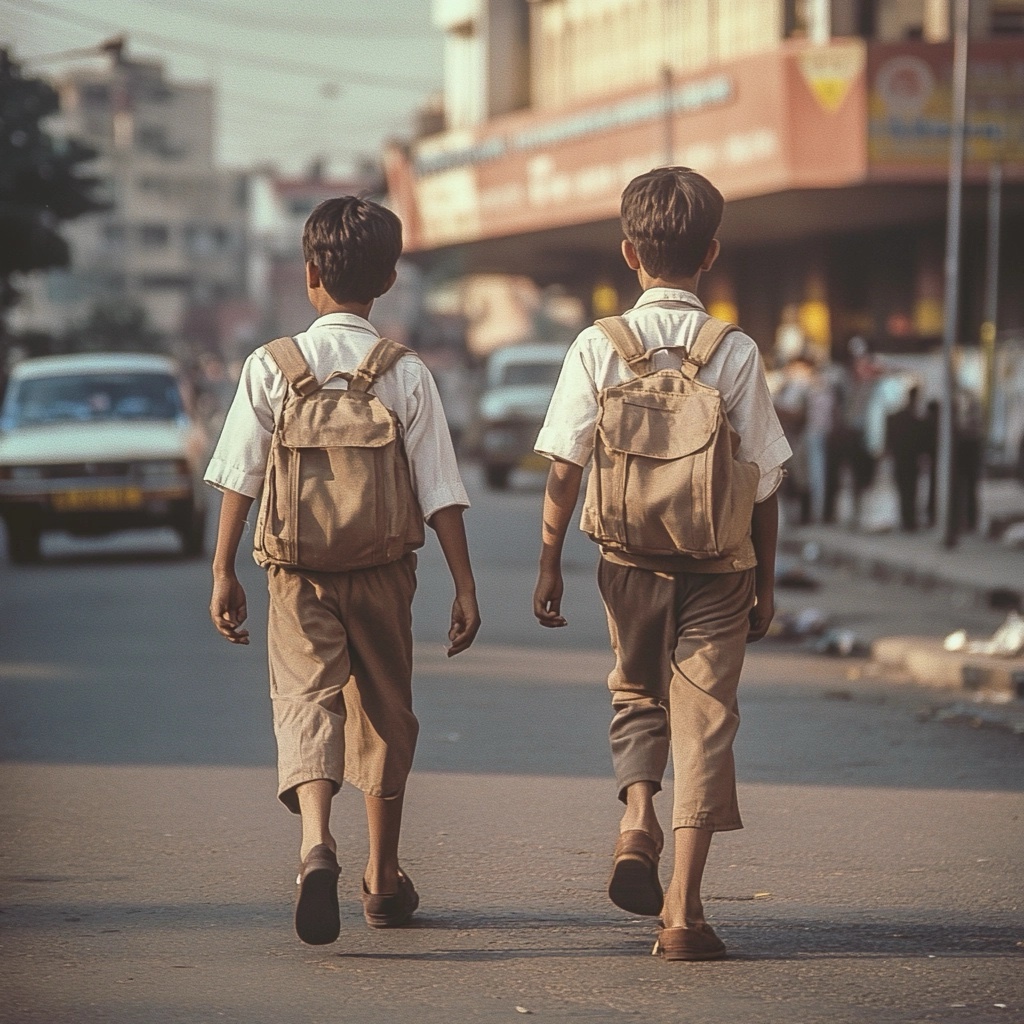
With their bags slung over their shoulders and a triumphant air about them, they made their way towards the school gate, where freedom beckoned just beyond the reach of the watchman, a stern fellow who guarded the entrance as if it were the gates of some ancient fortress. As they approached, they noticed a small cluster of younger students lingering near the gate, their eyes darting eagerly from passerby to passerby. These kids were not just hanging around for the sake of fresh air; they had a mission—one that involved convincing any willing stranger to buy them lemon drops or orange drops from the auntie’s shop across the street. The shop, so named because the lady running it was everyone’s “auntie,” was famous for its stash of candies and other minor contraband that weren’t exactly approved by the school’s healthy diet policy.
No sooner had they neared the gate than four of these young hopefuls sprang into action, crowding around them like an impromptu welcoming committee. “Hey, can you get us some lemon drops? Please?” one of them asked, pushing a handful of coins into K.C.’s palm. Another chimed in, “And some eclairs too!” In a matter of seconds, they had acquired a respectable sum of five rupees.
K.C. took one look at the money and flashed a grin that suggested he had more ambitious plans for it than a candy run. However, before he could make a dash for it, they had to deal with the watchman, who was eyeing them with the suspicion of a man who had seen many a seventh grader try to pull a fast one.
“Where do you think you’re going?” the watchman asked, his voice carrying the tone of someone who was prepared to listen to precisely zero excuses.
K.C., undeterred, handed over the outpass with a flourish. The watchman looked at it, then back at the two boys, his brows knitting together. “One outpass for two of you? They didn’t give separate outpasses?”
K.C. launched into an elaborate explanation, weaving a tale so convoluted it involved a miscommunication at the office, an emergency situation, and even a vague reference to the superintendent’s lunch schedule. “You see, sir, it’s a bit of an odd circumstance,” he began, his voice dropping to a confidential whisper. “The superintendent was just about to sign the second outpass when, wouldn’t you know it, he was called away for an urgent matter. Lunch-related, I’m afraid. Very pressing business. You understand.”
The watchman’s expression suggested he understood about as much as a fish understands trigonometry, but he was too tired to argue. “Go, go,” he said, shaking his head as if to rid himself of the entire bewildering episode.
Having successfully secured their passage, they crossed the street and made a beeline for the auntie’s shop, where they fulfilled their duties, handing over the money and receiving a modest assortment of lemon drops, eclairs, and strong mint candies in return. In gratitude, the young patrons threw in a few extra lemon drops as a kind of tip. K.C. pocketed these with a grin, distributing some to his companion with the air of a generous benefactor.
And so, armed with a small supply of sugary loot, they set off towards the bus stand, munching contentedly on the candy and savoring the sweet taste of temporary freedom.
As they made their way towards the bus stand, K.C. was already hatching a plan. Of course, he always had a plan—it was one of his most predictable qualities. “Hey, listen,” he said, turning to him with a glint in his eye, “why don’t we skip the bus and walk instead? It might be better for your tummy, you know. The fresh air, a little movement… probably do you more good than a bumpy bus ride. I mean, it’s just one stop, right? Walking would be A, faster, and B, way less churning for your stomach.”
He opened his mouth to respond, but K.C. had already taken off, striding down the road with a speed that suggested he was late for an appointment with destiny. He hesitated for a moment, stomachache forgotten in the urgency to keep up. Was this a good idea? He was fairly certain it wasn’t. In fact, it was almost guaranteed to be a terrible idea. But with K.C., plans didn’t need approval; they simply required participation. And so, he found himself hurrying along, half-jogging to catch up as they passed the bus stand, heading in the direction of Vellala Street.
As they walked, the prospect of passing the theaters ahead loomed large in his mind. The Abhirami complex was a magical place, an oasis of entertainment situated right between school and home. There were four theaters in the cluster: Abhirami, of course, along with the others whose names he could never quite remember because they were less important than the giant posters that adorned the walls. For him, this was the real attraction. The afternoon sun might have chased most people indoors, but it was the perfect time to see the massive banners without the usual throng of moviegoers blocking the view.
The posters were nothing short of spectacular, plastered across every available surface in bold, eye-popping colors. Each was larger than life, featuring heroes with fists frozen mid-punch, heroines draped in chiffon, and villains with expressions so menacing that it was almost a shame when they inevitably got thrashed by the end of the movie. It was a rare treat—Abhirami was hosting not one, but two Kamal Haasan films alongside a Rajinikanth movie, all at once.
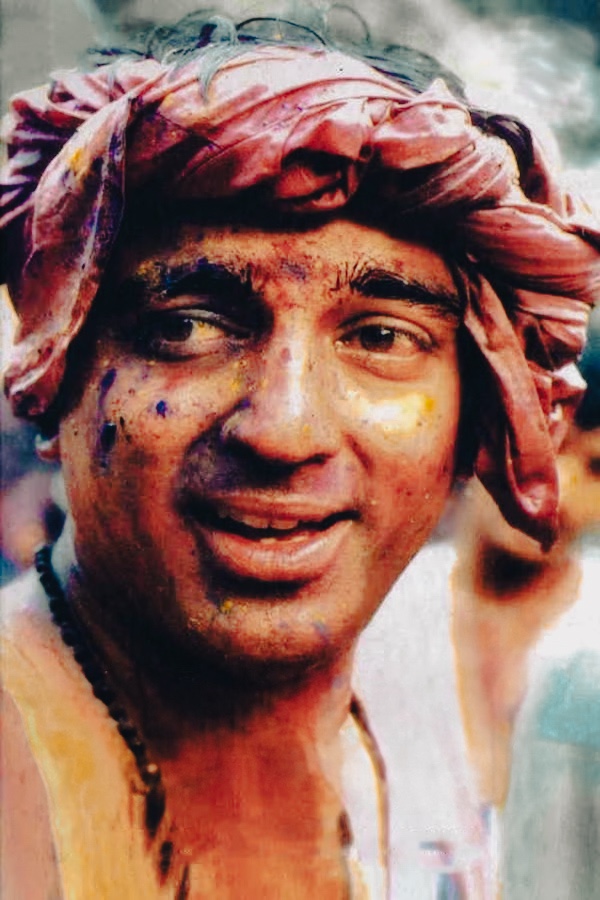
Kamalhassan in Nayakan
The first was Nayakan, with a poster that showed Kamal Haasan sporting a cloth around his head that seemed stained with blood. It added a gritty, mysterious edge to the image, but he’d later learn that it was merely smeared with colors from a Holi scene, a detail revealed when he finally watched the film. His uncle had already declared Nayakan to be a masterpiece, and the poster’s fierce intensity only heightened the anticipation.
The second Kamal film, Pesumpadam, was even more intriguing. It was a comedy that contained no dialogue—a bold experiment that was already gaining acclaim from Vikatan just a week into its release. He hadn’t seen it yet, but he certainly wanted to. Meanwhile, his eyes kept drifting back to Manithan, the Rajinikanth movie he had already seen and thoroughly enjoyed. He had watched it already and loved every over-the-top action sequence, Rajinikanth’s punches landing as if choreographed by the gods themselves. The energy of that movie seemed to leap off the poster, pulling him closer. The fourth movie, Anand, starring Prabhu, rounded off the list, though it didn’t hold quite the same allure for him.
Seeing two Kamal Haasan films and a Rajini film all playing successfully at the same time was a rare spectacle—a true clash of titans. But his lingering grin, as he gazed at the poster of Manithan, made it clear where his loyalties truly lay.
That’s when it happened. As they neared the theater, they noticed a small crowd gathered just outside the gates, off to the side where the shadow of the marquee didn’t quite reach. The air was different here, thick with a strange mix of sweat, incense, and something less definable—like the lingering odor of damp jute sacks. There was a group of about a dozen men, large fellows who could only be described as adults by the seventh-grade standard, wearing lungis hitched up to their knees, with the edges of their half-trousers peeking out beneath. The lungis flapped with every movement, giving the whole scene a sort of shabby, improvised air.
But that was precisely what K.C. liked about this place—the sense that something unusual, possibly even forbidden, was always just around the corner. He could sense the chaos even before he saw the source. As they moved closer, pushing their way to the edge of the crowd, they could see what the commotion was all about. A man sat in the middle of the huddle—not quite sitting, really, but squatting in that effortless way that only adults seemed to master. His wiry frame balanced precariously over a large wooden block in front of him.
To the side, just barely visible, were two or three roughly assembled boxes, the kind that looked like they’d been put together by hand from leftover materials, secured with twine and perhaps a few dried leaves for good measure. They weren’t much to look at, but something about the way the man kept glancing at them gave the boxes a kind of dark importance. The crowd murmured in anticipation, and he could make out the dull hiss of something stirring within. It didn’t take much to guess what the boxes contained.
K.C.’s eyes widened, a grin spreading across his face. He didn’t say a word, but the look he gave was unmistakable. This was exactly the kind of adventure he’d been hoping for.
K.C. reached the front first, of course. He always did. He had a way of slicing through a crowd like a hot knife through butter—or in this case, like a seventh grader who had no concept of personal space. Meanwhile, he lagged a few steps behind, a growing sense of dread bubbling up in his stomach, which was now churning far more violently than even the quadratic equations had managed. There was a heaviness in the air, like the kind that lingers just before a storm, and his gut instinct was to be anywhere but here. But K.C. kept glancing back at him, grinning and beckoning like a carnival barker. “Here! Here!” he kept calling out, pushing the onlookers aside as though he had some kind of VIP pass to this dubious show.
By the time he stumbled forward to join K.C. at the front, it was too late to back away without drawing attention. The man at the center of it all was now in plain sight, and he was a sight indeed. He wore a black cloth tied around his head—a ragged piece of fabric that looked as if it hadn’t been washed since Indian independence. His lungi hung loosely around his waist, and his shirt, oh, the shirt—it was a psychedelic explosion of colors that might have been considered fashionable two decades ago. The fabric shimmered in a way that suggested it had once been bright and bold but was now just vaguely unsettling.
The man was shouting in a voice that was equal parts menacing and incomprehensible. K.C., naturally, was standing there with his arms crossed, as if he were evaluating the quality of the performance, while he, standing beside K.C., felt every hair on his neck stand up. That was when it struck him—quite literally everyone else there was either a grown man or looked as though they had no pressing engagements besides participating in this shady roadside spectacle. In the glaring afternoon sun, with not a school uniform in sight apart from his and K.C.’s, he realized they were the only boys from the school, which was probably a good indication that they were exactly where they shouldn’t be.
Just then, as if on cue, the man at the center of this ragtag congregation made his next move. With a sudden flourish, he grabbed a long knife—if you could even call it that, given its sorry state—and struck it down onto the wooden block in front of him. The knife lodged itself in the wood with a loud thud, sending a collective shiver through the crowd. The blade was rusted and dull, but the man’s grip on the handle was firm, like he’d just announced his intention to start chopping vegetables, or perhaps, limbs.
“If anybody leaves from here,” he bellowed, his voice now carrying a harsh, almost theatrical edge, “let the evil eye be cast upon them!” His eyes darted around the circle, daring anyone to make a move. “Nobody move!” he added, raising his voice to a pitch that suggested he’d practiced this line many times before in front of a mirror. “If you move, the evil eye will follow you.”
He felt a strange pressure in his chest, a heaviness that seemed to spread from his stomach to his throat, like an invisible hand pressing down. He told himself it was fear—nothing more—but a nagging doubt crept in, an unease that made him hesitate before taking a breath.
The crowd tensed. One unfortunate soul—a man who looked like he had just remembered he was late for something important—began to inch away. The man with the knife shot him a look that could curdle milk. “That person,” he growled, pointing dramatically, “by the end of the day today, will throw up blood and suffer a hundred deaths.”
And with that, he froze. A hundred deaths? What did that even mean? How does one manage a hundred? His brain raced, but the only thought that stuck was that his stomach, which had only just started to settle, was now staging a full-scale rebellion. K.C., on the other hand, looked positively delighted.
The man, with a flourish, pulled open one of the round, makeshift boxes at his side, and there it was—a cobra, coiled and swaying, its hood flaring open like a ghastly fan. The sight of the snake sent a cold jolt down his spine, and just as he was processing that this was indeed a real, live cobra, the man reached for another box and flung it open to reveal a python—a much longer, thicker specimen, its scales glistening like wet stones. Two snakes: a cobra and a python. He could feel his knees weaken and his stomach, already staging a protest, now teetered on the brink of a full-scale revolt.
The man was saying something in Tamil, a strange, guttural slang that seemed to belong to no specific region. It was incomprehensible, but he caught the only phrases that mattered: “You will throw up blood,” “a hundred deaths,” “evil eye.” These words circled through his mind like a dark chant, growing louder and more menacing with each repetition. The snake charmer raised his voice, calling out instructions that sent a ripple through the crowd. “Close your eyes! Put your right hand forward and fold it downwards!” he commanded in a rhythmic tone that made his words sound almost like an incantation. One by one, the men around them complied, hands outstretched and trembling, and, without thinking, he found himself mimicking the crowd’s movements, his eyes squeezed shut, his right hand extended and folded downward.
Beside him, K.C. was doing the same, but when he dared a glance, he noticed K.C.’s hand was shaking more than a little. His face was pale, and even the resolute sandalwood dot on his forehead seemed to be sweating. That was when it hit him—K.C. was just as scared, if not more so. This realization did not offer any comfort. If K.C. was scared, then surely the situation had spiraled far beyond the usual harmless mischief.
The man slammed the knife down on the wooden block once more, the sharp thud making everyone flinch. “Now, the man who tried to run—come to me!” he barked. “Sit down here!” The crowd parted slightly, and a man, meek and shuffling, seemed to stumble forward as if dragged by an unseen force. His eyes rolled, and his body twitched in a way that was either a horrid performance or the real thing—he seemed possessed. He collapsed next to the snake charmer, half-squatting, half-falling, his limbs jerking in a grotesque dance that brought a fresh wave of terror crashing over him.
He was paralyzed with fear, his stomach now in full-on rebellion, twisting and knotting itself into shapes that defied biology. Sweat trickled down his back in a steady stream. He turned to K.C., who was now openly crying, tears spilling from his eyes as he trembled. He wanted to cry too—oh, how he wanted to—but the need to escape was stronger. He glanced around the crowd: some faces were locked in a trance-like state, others were clearly disturbed, but nobody seemed ready to bolt.
That’s when he made his decision. With a swift, desperate wink at K.C., he mouthed, “Let’s run.” K.C. shook his head vehemently, his face contorted in silent refusal. Then the knife struck the block again, and the man’s voice roared out the same dreadful litany: “A hundred deaths! Throwing up blood! Evil eye!” The words drummed into his ears like a relentless war chant.
He couldn’t take it any longer. His stomach clenched so tightly he thought he might collapse then and there. With one final look at K.C.—whose tears were flowing freely now—he spun on his heel, pushed through the crowd, and broke into a sprint, cutting straight through the throng like a wild animal making a bid for freedom. As he dashed past the theater, he could hear the snake charmer’s voice chasing him down the street, “A hundred deaths! Throwing up blood! Evil eye!”
And then he saw K.C., sprinting past him with the speed of a born athlete. Whatever terror had gripped K.C. had now transformed into raw adrenaline, propelling him forward as if his very life depended on it. And perhaps, in that moment, it did. Together, they tore down the road, side by side, fleeing the curses, the snakes, and the man with the knife. But most of all, they were fleeing that dreadful possibility of a hundred deaths.
They dashed past the Meenakshi Mandapam, the marriage hall beside the theater, their feet pounding the pavement as if a hundred deaths were hot on their heels. There was no question of slowing down. K.C. was still crying, tears streaking his cheeks like someone who’d just watched his pet puppy disappear down a well, while he was grappling with an urgent and highly inconvenient need to pee. His mind was a swirl of conflicting impulses: should he be scared, or should he just find the nearest wall and relieve himself? Neither seemed like a good option, so they kept running, not daring to look back.
The road rushed by in a blur of familiar sights and smells. They raced past the Sandhya restaurant, where the rich aroma of chai hung in the air like a tantalizing invitation, mocking them with the idea of a calm they couldn’t afford. They tore past Vivek’s, where television sets and tape recorders peered out from the glass displays as if curious about the commotion. Then came Madarsha, the textile shop, its faded signboard and bundles of fabric lined up like soldiers waiting for orders. But the boys didn’t stop to admire any of it. They could only think of one thing: getting as far away from that snake charmer as possible.
As they veered right onto Vellala Street, the world seemed to change. This was their territory, their zone of safety. The road was pockmarked with the usual potholes, decorated with faded chalk drawings from the neighborhood kids’ games, and cluttered with the occasional cow that had decided to claim the spot as its own. The familiar smell of samosas, kerosene, and jasmine lingered in the air, an odd comfort that reminded them they were no longer in the snake charmer’s realm.
K.C. glanced over at him, and he looked back at K.C., both of them still running. Then, out of nowhere, the two of them burst into laughter—a kind of wild, uncontrollable laughter that seemed to bubble up from the soles of their feet and erupt out of their mouths. It was the kind of laugh that said, “We just escaped a hundred deaths, or maybe we’re still in the middle of one.” Their legs nearly gave way, and they stumbled, half-expecting to roll down the street all the way to their front doors. It didn’t matter whether it was the shock of what had just happened or the sheer relief of having run away—they just laughed, letting the sound fill the dusty air.
By the time they reached G.K.N. Tailor’s shop, they could finally start to slow down. The tailor’s shop marked the perimeter of their world, the safe zone beyond which no evil eye, no snake charmer’s curse, could follow them. They came to a stop, gasping for breath, their sides aching not from a hundred deaths, but from the sprint.
K.C. turned to him, still catching his breath, and asked, “So, how’s your stomach ache?”
“What stomach ache?” he replied. “I feel absolutely perfect.”
They walked the last stretch home, the adrenaline wearing off and leaving them feeling almost giddy with relief. K.C.’s house was a few lanes before his own, a narrow lane lined with houses where children’s voices echoed, and bicycles leaned against walls like exhausted sentries. As they reached the fork in the road, K.C. looked at him, still chuckling, and then leaned closer, his face suddenly taking on the exaggerated solemnity of a street magician revealing a terrible secret. With wide, bulging eyes, and his lips pursed as if delivering the punchline of a ghost story, K.C. chanted in a dramatic, low voice, “Evil eye, a hundred deaths, throwing up blood.” His eyebrows wiggled for added emphasis, making him look like a cartoon villain caught mid-scheme.
It was so absurd that he couldn’t help it—he burst into a fit of uncontrollable laughter, doubling over right there at the fork, K.C. joining in until both of them were gasping for breath.
He laughed and waved K.C. off, then turned to head down his own lane. But just as he reached the gate of his house, he remembered something. With a sudden flourish, he clutched his left side and let out a dramatic groan, “Oh no, the stomach ache! I’m here today because of my terrible, terrible stomach ache!”
And with that, he stumbled into his house, clutching his side with all the drama of a wounded war hero who’d just returned from a battlefield filled with cobras, pythons, and possibly even a curse or two. His hair was askew, his shirt half-untucked, and his face painted with the exaggerated agony of a boy who had narrowly escaped a hundred deaths—or, more accurately, a very vigorous sprint home.
As he limped through the front door, his grandma’s voice rang out from the kitchen, “What happened to you?”
Without missing a beat, he collapsed theatrically onto the nearest bench, gasping out, “Stomach ache, Ammamma… very bad… since last night!”
And then, as he caught his reflection in the mirror—sweaty, disheveled, and still holding his side for effect—he realized the absurdity of it all. He was alive, unscathed, and had managed to outrun the most terrifying villain of all: K.C. Anand’s plans.
But in that moment, it struck him: if he really was going to die from something, it wasn’t going to be a snake charmer, evil eye, or even a hundred deaths. No, the only thing likely to finish him off was this—laughter.



 kirukkal.com