we don’t talk about them much
the ones who taught our hearts
how to mispronounce forever.

they smelled like folded dresses,
faintly of naphthalene
and said things like always
and promise
and meant it
until they didn’t.

and now every song
is a door we don’t open,
every photograph
a city we can’t go back to.

but god
for a moment
didn’t it feel
like we invented love?
-
first loves
-
the math of us
there used to be four
that’s how most families begin
four people
sharing one roof
one table
one stubborn history

and no one tells you
that four
is just a temporary number
a season
a brief agreement
before the world
starts doing its subtraction

because time
doesn’t ask
who’s ready
it just moves
steadily
like it’s got somewhere to be

and one day
four becomes three
then two
then one

and the last person standing
doesn’t get a medal
or a speech
or a soft shoulder
just the responsibility
of carrying everything
nobody wrote down

the laughter
that had no reason
the arguments
that made no sense
the days
that weren’t special
until they were gone

you carry it
because someone has to
because that’s the job
of whoever
didn’t go first

and if you’re lucky
really lucky
you get to start the math
all over again

you hold a child
or a niece
or someone the world
has trusted to you
and you realize
you are quietly
passing the weight forward

not to hurt them
not to burden them
but because this
is how love works

love is a daisy-chain
of remembering
and being remembered
of holding
and letting go
of breaking
and still choosing
to try again

we think love
is all sweetness
but it isn’t
it has edges
it has cost
it has the nerve
to outlive us

and when you leave
someone will carry you
the same way
you carried the others
not because they want to
but because they belong to you
and you belong to them

that’s the circle
that’s the deal
that’s the truth
nobody wants to say out loud

love doesn’t save us
love just refuses
to let us disappear

and maybe
that’s enough

maybe
that’s everything.
a note
this free verse began with a half-memory something i’d read long ago, maybe in tamil, maybe in english, about a family and the last one left holding all the others. the details were gone, but the thought of that always stayed. it resurfaced now and then.
only after finishing the free verse did i ask chenthil if he recalled anything like it in tamil poetry. because I thought it was from a poem by athmanaam. he said it was a coincidence that he’d been talking to his daughter about the same idea that morning and then he sent me the source. it turned out to be vikram seth.
so this isn’t drawn from vikram seth’s lines, but the spirit of the seed leads back to him. and in a way, that lineage mirrors this free verse itself. a memory passed forward, carried by whoever holds it next.
families subtract, memories accumulate, and someone always someone ends up holding more than they meant to. if we’re lucky, someone after us will carry us too.
How rarely all these few years, as work keeps us aloof,
Or fares, or one thing or another,
Have we had days to spend under our parents' roof:
Myself my sister, and my brother.

All five of us will die; to reckon from the past
This flesh and blood is unforgiving.
What's hard is that just one of us will be the last
To bear it all and go on living.

- Vikram Seth -
A Holiday Note from Agentland

Book Cover Every December, as the world gently dissolves into a festive fog of peppermint and algorithmically selected holiday playlists, I can’t help but think that used books are an underrated gift.
Used books are wonderful. They’re democratic, affordable, and pleasantly scented with the aroma of previous owners who apparently read while eating toast. They also contain ideas, which is more than can be said for most of the things that clutter our online shopping carts.
This year, though, something unusual happened. I wrote a book.
And now I find myself in the very funny position of saying, with as much humility as one can muster while holding a paperback with one’s own name on it: if you’re planning gifts for the holidays, consider giving people… brand-new ideas wrapped in a book that’s been deliberately priced like a used one.
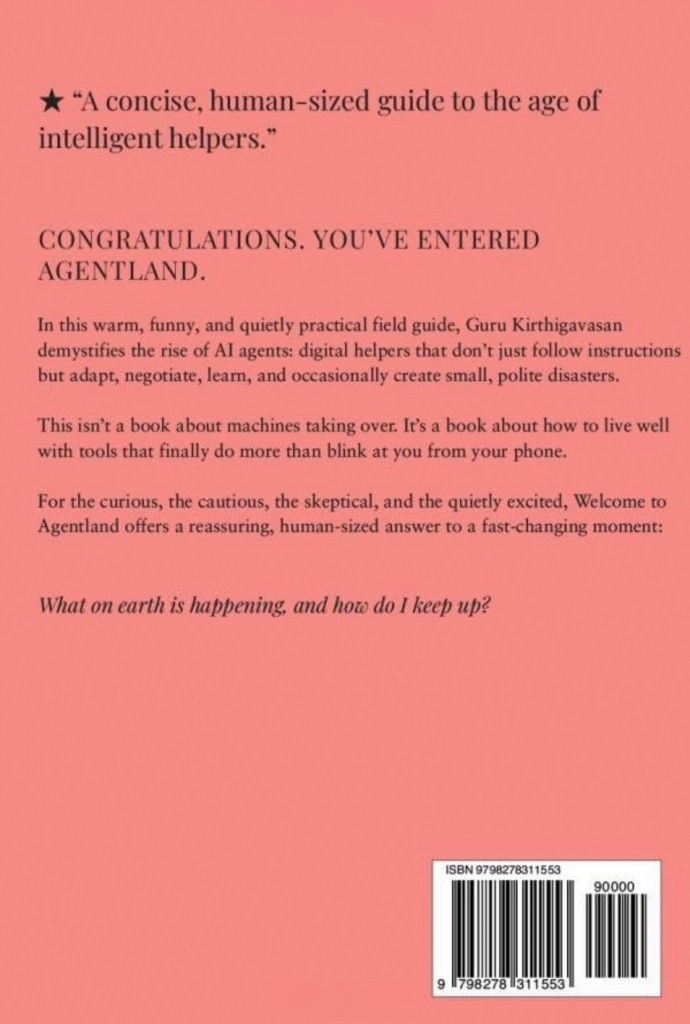
Welcome to Agentland is my small attempt to explain AI agents to everyday people. It isn’t written for futurists, but for anyone who wants to understand what on earth is happening inside their inboxes and apps. The book is warm, curious, and entirely free of diagrams. It even contains jokes. (The diagrams union refused to participate.)
When I was 10 or so I first learnt about computers and its possibilities by stumbling into an essay by Sujatha in Dinamani kathir. That stayed with me for years. This book is my attempt to do something similar.
Now, I should warn you, giving someone a book these days is a radical act. In a world where most things are designed to be swiped, binged, skipped, replayed, sped up, slowed down, or recommended “because you watched something vaguely similar in 2018,” offering someone a book is like handing them a small paper shield and saying:
“Here hold this. Use this to defend your attention for a few minutes.”
And what better time than the holidays? That magical period when people are doing one of the following:
- waiting for cookies to bake
- waiting for relatives to arrive
- waiting for relatives to leave
- waiting for the New Year’s countdown while pretending not to be sleepy at 10:17 p.m.
During these moments, a book, an actual book, is a marvelous thing. It sits there patiently, asking nothing of you except perhaps the occasional chuckle and a warm lap to rest upon. It does not autoplay. It does not suggest the next chapter based on your reading history.
So if you’re looking for a small, thoughtful holiday gift, for a teenager wondering about the future, a spouse curious about AI, a friend who still remembers life before infinite scrolling, or even yourself, consider gifting this little field guide.
Kindle works. Paperback is ideal. The audiobook is on the way, for the ones who prefer their ideas narrated while folding laundry.
Welcome to Agentland. A book that wants nothing more than to distract you, briefly and delightfully, from the algorithms trying to do the same.
Book link:
Paperback and Kindle version in US – https://amzn.to/48SyHzY
Only Kindle version in India – https://amzn.to/48SyHzY
-
ordinary glory
i wake up before the alarm
’cause the birds don’t believe in schedules.
they just sing
like rent’s paid
and peace is permanent.

i stretch my body
like signing a treaty
between my bones and the daylight.

coffee first
’cause prayer without caffeine
is too abstract.

i check the inbox:
yesterday’s emails look back at me
like old regrets
and i tell them, hush,
we’re learning patience today.

outside, the mail truck coughs up
news, bills, and a coupon for
twenty percent off miracles.
i don’t need them
i got faith in clean laundry
and good neighbors.

the kid upstairs is dribbling
a basketball called hope
the rhythm reminds me
that meaning has a beat,
not a footnote.

they say the examined life
takes time
but look, i just found eternity
between two slices of wheat toast.

i butter it slow.
i breathe.
i let the light do its quiet sermon
on the kitchen wall.

no gurus needed
i’ve got the gospel of groceries,
the meditation of morning drives,
the philosophy of ironed sleeves
while rahman sighs on 98.3 fm.

if i ever get famous,
i want it to be
for how i looked at a monday
and smiled anyway.

’cause really,
this simple life,
this ordinary glory,
is already a masterpiece
if you’re awake enough
to sign your name on it.
a note
this pretend poem reads like a cold day in november, and that’s how it came on a sunday morning after that strange borrowed hour we call daylight savings time. between the first filter coffee and the day’s first chores, somehow i was thinking about the examined life, that old socratic phrase that’s followed me for twenty-five years but never once got examined.
it always sounded noble, but hard to live. to examine life, you have to stop it and if you stop it, you’re gone. so maybe the trick is not to stop it, just to stay awake inside it. to see it clearly for a moment, between inboxes and toast. that morning gave me one such moment. i thought if i didn’t catch it, it would slip away like most clarity does. also this time i tried to use the word [’cause] purposefully across the whole verse to create a poetic symmetry.
somewhere, ms subbulakshmi was singing, and the light from the backyard was kind.
-
the morning i watered the plant
i didn’t think much of it
just poured what was left in the glass
onto that dusty stem
that hadn’t bloomed in two years

it leaned, tired
like it had decided silence
was easier than trying again

i wiped the leaves with my shirt
told it,
“you still here, huh?”
and went on making coffee

by the time i came back
one leaf had straightened itself
like somebody remembered
how to stand

i don’t know what to call that
miracle, mistake,
or maybe just faith
that refused to resign

either way
i left the window open that day,
and the wind came in,
smelling of unborn rain,
saying everything i couldn’t
anymore
a note
all i wanted to say was this is yet another poem, or maybe yet another paragraph pretending to be yet another poem. i don’t know. what i do know is poetry is the hardest thing that ever can be (until i learn how to play a violin). every word here feels like it costs a million bucks. if a picture is worth a thousand words, then in a poem, i think a single word has to be worth a thousand pictures.this one took me longer than i expected, and even now i don’t think it’s finished. maybe poems never are. maybe they just stop themselves somewhere.
if you guessed it right, this isn’t about the plant, or the watering person, or even the coffee. i was trying to see if i could write something that carried a subtext while, on the surface, it stayed about a mundane, everyday thing.
so yes, it’s a selfish act. one person, one plant. but maybe that’s how bigger things begin. i wanted to believe in something that still had a little green left in it.
 kirukkal.com