It is the first weekend of March, which means that sometime tonight the nation will once again participate in its biannual ritual of arguing with the clock.
On the East Coast, the last respectable piles of snow are receding into damp resignation. In Seattle, we have already endured the annual forecast that confidently predicted snow and then reconsidered. The light lingers a little longer in the evening. “Here Comes the Sun” begins to feel less like a Beatles classic and more like a scheduling suggestion.
And then, without consulting us, time will change.
Sometime between Saturday night and Sunday morning, millions of us will stand in kitchens squinting at ovens and performing mental arithmetic that would trouble a reasonably confident fifth grader. My phone will glide forward automatically, smug and luminous. The microwave will refuse to cooperate. The clock in the car will stage what can only be described as passive resistance. Somewhere in the house there is an analog clock whose only purpose, as far as I can tell, is to test whether I still remember how to move small plastic hands without snapping one off.
Twice a year we do this. We grumble. We miscalculate. We open search engines and ask, with impressive urgency, whether this is finally the year daylight saving time becomes permanent. We consult language models as though they might have insider access to the relevant timekeeping authorities. They do not. They are very polite about it.
What fascinates me is not that the clocks change. It is that they agree to change.
Noon, in particular, carries an effortless authority. It feels backed by a star. If someone suggests meeting at noon, no one asks which one.
Noon does not sound like a proposal. It sounds like physics.
This is a flattering assumption.
Because for most of human history, noon was not physics. It was opinion.
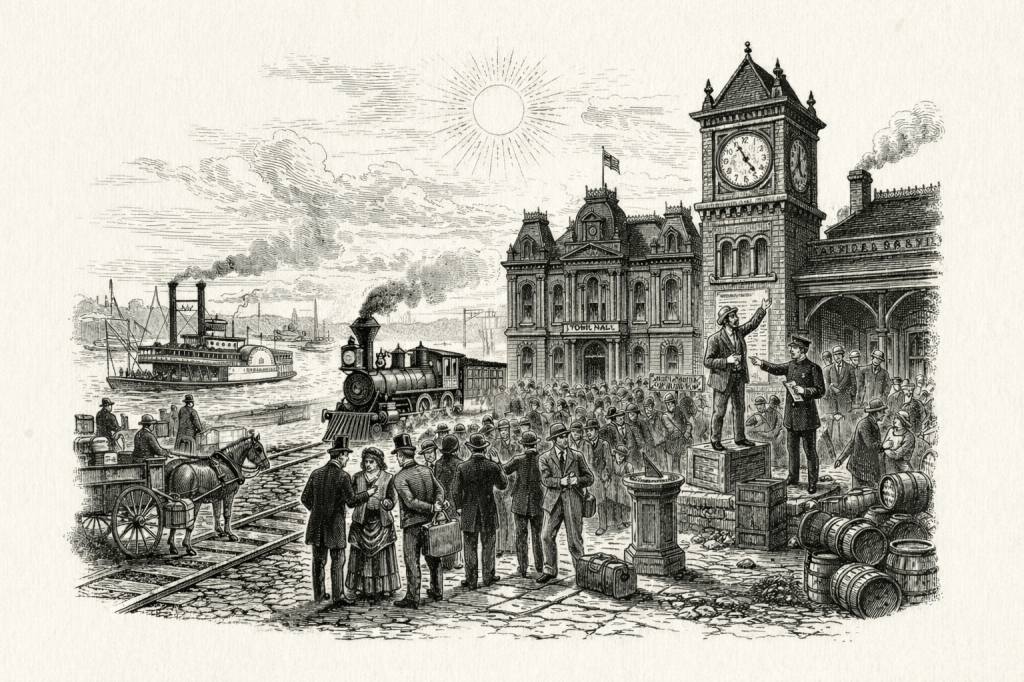
Imagine, for a moment, a stretch of railway somewhere in the United States in the late nineteenth century. A single track cuts across the countryside. A train is approaching from the east. Another is approaching from the west. They are scheduled to meet at a siding where one will politely step aside and allow the other to pass. This arrangement works beautifully provided both engineers agree on what time it is. Unfortunately, in the nineteenth century, they often did not.
By the middle of the century American railroads had already accumulated a respectable collection of mishaps. Between the 1830s and early 1850s there were dozens upon dozens of major train wrecks as rail traffic expanded across the country. In 1853, two passenger trains in Rhode Island collided head-on near Valley Falls after crews misread their timetable. Fourteen people died. The trains had followed the schedule as they understood it. The difficulty was that the schedule depended on time.
And time, in the 1880s, was something the country possessed in generous variety. At that moment the United States was operating on something like three hundred different local times. Every town set its clocks by the sun above it. When the sun reached its highest point, it was noon. Church bells rang. Shopkeepers adjusted their watches. The sky had spoken.
The difficulty was that the sky did not speak with a single voice. Louisville’s noon was not Cincinnati’s noon. The difference was only a handful of minutes, small enough that it hardly mattered to anyone traveling by horse or riverboat. A merchant leaving Louisville at eleven in the morning could arrive in Cincinnati in time for lunch even if Cincinnati insisted it was already eleven-oh-six.
For most of the nineteenth century this arrangement worked perfectly well. A horse does not particularly care if the next town believes it is six minutes later. A train does. Railroads ran largely on single-track lines, which meant trains traveling in opposite directions shared the same strip of steel. They passed one another at carefully scheduled sidings. If both crews agreed on the time, the choreography worked beautifully. One train would pull aside, the other would glide past, and everyone would continue their day. If the clocks disagreed by a few minutes, however, the choreography developed a rather unfortunate improvisational element.
Trains, it turns out, are magnificent machines but poor conversationalists. Once committed to a track they have no steering wheel, limited braking enthusiasm, and absolutely no interest in negotiating whose noon is correct. Time, in other words, had quietly become a safety system. This is not the sort of responsibility anyone originally imagined giving to a pocket watch. And safety systems are famously intolerant of six-minute disagreements.
The railroads attempted, at first, to solve the problem the way organizations often do: with paperwork. Conductors carried conversion tables. Station masters kept charts translating one town’s noon into another town’s almost-noon. Railroad companies adopted their own internal clocks, which sometimes disagreed cheerfully with the clock tower in the center of town. For a while the system limped along.
But railroads were expanding with the enthusiasm of a technology that had discovered it was useful. Tracks spread westward. Schedules thickened. More trains began sharing the same lines, each relying on clocks that were only approximately in agreement. And approximate agreement is not the ideal foundation for a safety protocol involving several hundred tons of moving steel. The country did not lack precision. It lacked agreement.
Railroad managers eventually arrived at the sort of conclusion that seems obvious only after someone has suffered through the alternative. If trains were going to move across an entire continent on coordinated schedules, the country could not continue operating on hundreds of local suns. The sky, as admirable as it was, had proven to be a somewhat unreliable administrator. So the railroads did something rather bold. They changed time.
On November 18, 1883, the major American railroads quietly adopted a new system dividing the country into four standardized zones: Eastern, Central, Mountain, and Pacific. At a predetermined moment that Sunday, clocks across the rail network were reset simultaneously. The day became known, with admirable understatement, as the Day of Two Noons.
In Louisville, Kentucky, the adjustment amounted to eighteen minutes. Eighteen minutes is not particularly dramatic until it is attached to the word noon.
On that morning, Louisville experienced noon once by the authority of the sun and then again by the authority of the railroad timetable. For centuries noon had been an observation. Now noon was a decision. Standard time later made daylight saving time possible, but the real revolution had already happened. Noon had quietly changed from observation into decision. And the decision held.
For a time, this new arrangement applied mainly to railroads. Trains ran on standardized time. Telegraph lines transmitted the official hour. Station clocks were adjusted with impressive seriousness. The rest of the country watched with mild curiosity. Cities, however, quickly discovered that the railroad clock was inconvenient to ignore. Businesses depended on train schedules. Newspapers reported arrival times. Court proceedings, market openings, shipping manifests, and the general choreography of commerce gradually began aligning themselves with the same hours the railroads were using.
It is one of the quieter revolutions in American history. No act of Congress imposed the change that Sunday morning. No national referendum was held. The railroads simply announced how time would work, and the country, after a brief moment of confusion, discovered that life was easier if it agreed.
Reality, at scale, often begins that way.
A practical inconvenience becomes a coordination problem. The coordination problem becomes a shared rule. And the rule, repeated often enough, begins to feel inevitable.
Within a few decades the federal government formalized what the railroads had already built. Time zones entered law. Telegraph signals synchronized clocks across cities. Noon, which had once belonged to whichever town square you happened to be standing in, now arrived simultaneously across hundreds of miles. Astronomically speaking, solar noon still drifts slightly from town to town. If you stand in western Indiana at the moment your clock declares noon, the sun will not necessarily be at its highest point. The sky has not adjusted itself to the timetable. We have adjusted ourselves to the timetable.
Sometime before dawn on Sunday, the country will quietly renegotiate the hour once again. Millions of clocks will shift within the span of a few hours. Offices will open. Markets will trade. Schools will ring bells. Trains will depart. Flights will leave runways at precisely scheduled minutes agreed upon by people who may never meet one another but who share a quiet assumption about the meaning of noon.
We will complain, as we do every March. But we will also comply. The argument about noon, in other words, ended a long time ago. It ended the day railroads decided that the sun was no longer the only authority on time. At the center of our solar system, hydrogen will continue fusing with majestic unconcern. And here on Earth, we will continue pretending that noon was inevitable.
இவ்வருடம் வாத்தியாரின் நினைவு நாளில் ஒரு விஞ்ஞானச் சிறுகதை எழுதி பதிப்பிக்கலாம் என்று நினைத்திருந்தேன். கிட்டத்தட்ட எழுதியும் முடித்துவிட்டேன். ஆனால் அதை கொஞ்சம் லாவகமாக எடிட் செய்து முடிக்க நேரம் ஆகிவிட்டது.
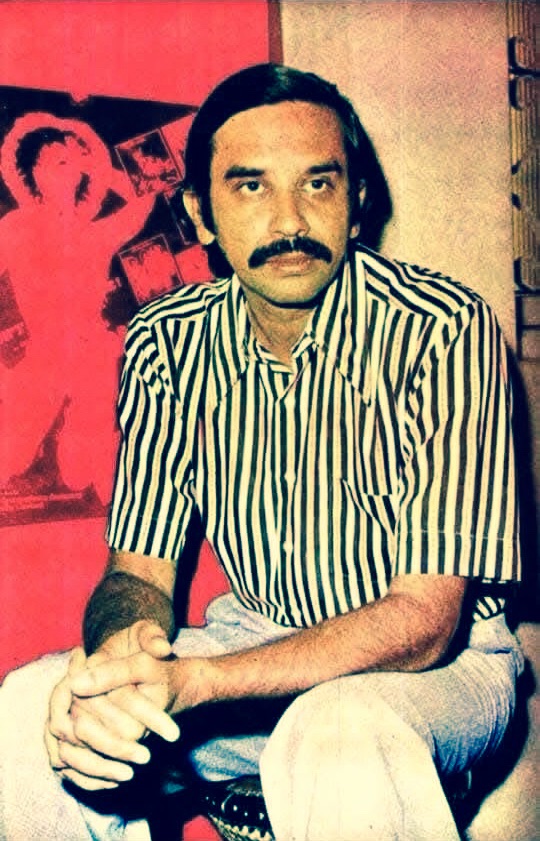
இன்றுடன் வாத்தியார் மறைந்து பதினெட்டு ஆண்டுகள். சுமார் நாற்பத்தி ஆறு ஆண்டுகளுக்கு முன்பு வாத்தியார் எழுதிய ஒரு விஞ்ஞான சிறுகதையில் இருந்து இரண்டு பத்திகளை படித்துக் கொண்டிருக்கிறேன். அன்றிருந்த ஒரு வியப்பு இதைப் படிக்கும் போது இன்றும் இருப்பது தான் சுஜாதா.
//
“நிலா வியப்புடன் ஜீனோவைப் பின்தொடர்ந்து நடந்தாள். ‘இயந்திரங்கள் தப்பு செய்யுமா, என்ன? நேற்று முன் தினம் இதே கட்டடத்துக்கு வந்து சிபியுடன் விவியில் கால் மணி பேசியிருக்கிறேன். இதே நம்பர்தான், இதே கட்டடம்தான். எப்படி சாத்தியம்? இதுவரை எந்த இயந்திரமும் தப்பு செய்து பார்த்ததே இல்லை. கோவாபரேட்டிவில் அரிசி பொறுக்கும் இயந்திரம் வார ரேஷன் ஒரு குந்துமணி அதிகப்படியாகக் கொடுக்காது. மின்சாரக் கட்டுப்பாட்டு இயந்திரம், கொடுக்கப்பட்ட யூனிட்டுகளுக்கு மேல் ஒரு செகண்டு தாமதிக்காது. ஃப்யூசைப் பிடுங்கிவிடும். மைக்ரோ சாகசங்கள் அத்தனையும் இதுவரை ஒன்றும் பிசகியதில்லை…’ நிலா ஜீனோவிடம் சொன்னாள்.
‘மனிதன் அமைத்த எதுவும் பழுதாகச் சாத்தியம் இருக்கிறது. கவலைப்படாதே. வீட்டுக்குப் போனால் சிபி இருப்பார் அல்லது அவர் எண் மாறியிருக்கும். இந்த நூற்றாண்டு முழுவதும் எண்கள்தானே. முன்னொரு காலத்தில் ஒரு சித்தர் பாடினார். ‘இறைச்சி தோல் எலும்பிலும் இலக்கமிட்டிருக்குமோ’ என்று. இந்த நாட்களில் எல்லாமே இலக்கம்தான்! சமூகப் பாதுகாப்பு எண்ணை மறந்தால் ஒரு ஆள் செத்தான்! உனக்கு நிச்சயமாகத் தெரியுமா, 11343 தானா? சிபிதானா? என்று கேட்டது ஜீனோ.” //
— என் இனிய இயந்திரா / En Eniya Eyainthira by சுஜாதா
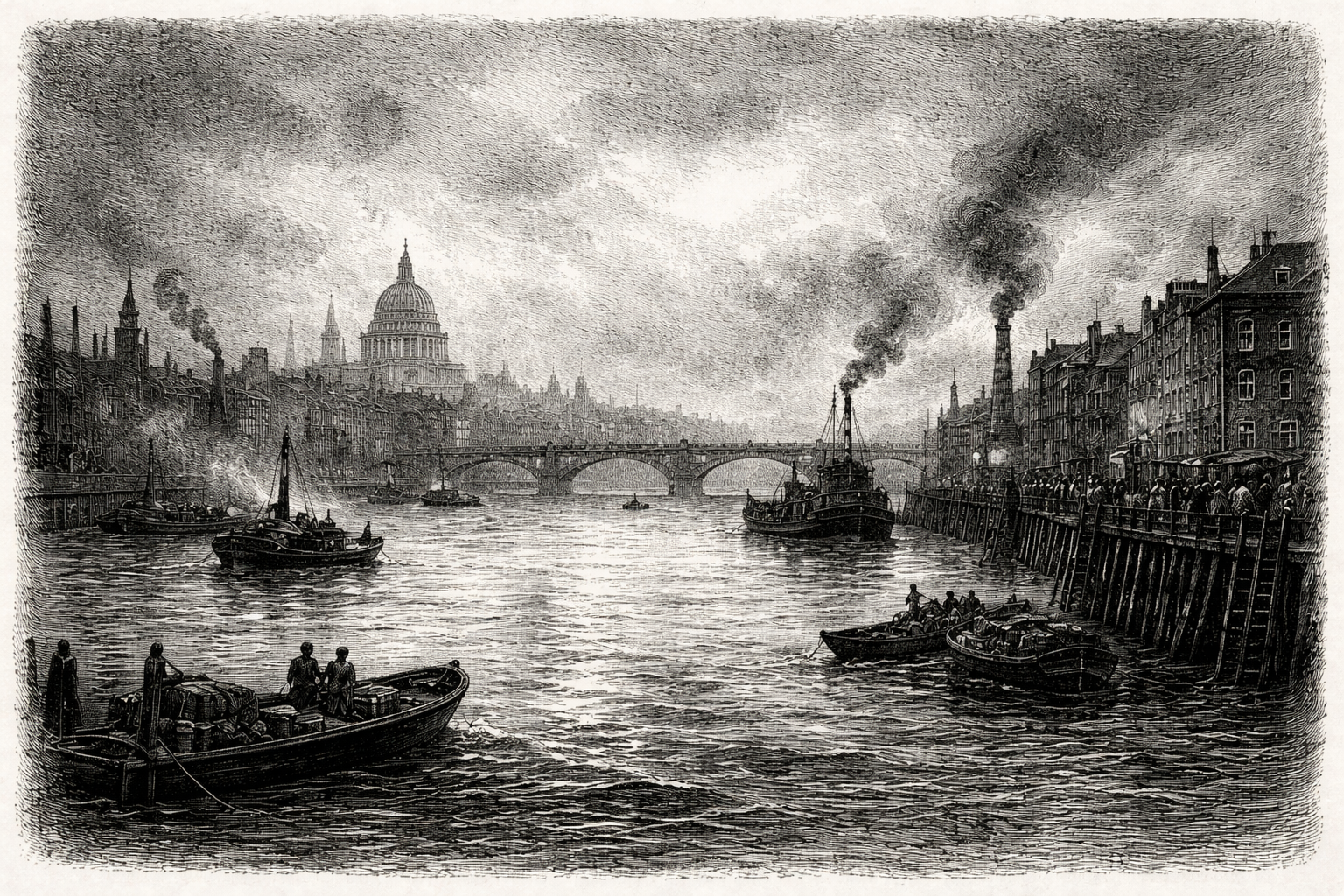
London in the summer of 1854 was not a place you would have chosen for a restorative weekend. The Thames had developed ambitions beyond being a river and was attempting, with some success, to become a broth. Parliament conducted affairs of state within polite strolling distance of what was essentially a moving archive of human waste. The prevailing scent suggested that civilization was still very much a draft.
When cholera swept into Soho that August, it did so with unnerving briskness. People who were perfectly healthy at breakfast were frequently beyond improvement by dinner. Entire families vanished. The explanation, happily, was already in place. The air was bad. Everyone agreed on this. London’s air had been bad for years. It was almost reassuring to discover that the smell was not merely unpleasant but medically consequential.
The dominant theory of disease was miasma, a word that sounds precisely like something you wouldn’t want near your lungs. Poisonous vapors, rising from filth, entered the body and did what poisonous vapors are known to do. It was tidy. It was intuitive. It was unfortunately wrong.
Officials responded with admirable seriousness. They discussed ventilation and sanitation and odor control. They held meetings. They considered improvements. What they did not consider, at least not seriously, was the possibility that the air was innocent.
Into this smelly crisis stepped John Snow. This John Snow had no dragons, no brooding monologues, and no urgent need to defend the North. He bought a map.
When someone died, Snow wrote down the address and marked it. One dot became five. Five became twenty. Soon Soho began to resemble a constellation whose theme was mortality. The dots were not evenly sprinkled across London’s famously democratic foulness. They clustered, with quiet insistence, around a public water pump on Broad Street.
A brewery nearby experienced remarkably few deaths, largely because its employees drank beer rather than pump water. A workhouse with its own well also fared better. The air, rather inconveniently for the miasma enthusiasts, was the same everywhere. The water was not.
Snow did not have the advantage of germ theory. He could not produce a microscopic villain and point to it with a flourish. What he possessed instead was something both less glamorous and more dangerous: a pattern. If the deaths cluster around the pump, perhaps the pump is the problem. It seems obvious now, in the way that most important inferences eventually do. At the time, it bordered on impolite.
Snow persuaded local authorities to remove the pump handle. People stopped drawing water from Broad Street. The outbreak subsided. The Thames continued being itself. The air retained its character. What changed was the conclusion.
The bodies had been visible. The streets had been visible. The pump had been visible. What had not been visible was the line connecting them.
History, when tidied up for textbooks, looks like a succession of discoveries. In practice, it is more often a succession of inferences. The facts sit around patiently, like some guests waiting to be introduced. Someone eventually notices that two of them belong together. For most of human history, making that introduction was expensive. You needed time to gather information, tools to organize it, and sufficient standing to persuade others that your line between the dots was not a decoration. Inference required infrastructure. Intelligence appeared rare partly because drawing conclusions required effort and, occasionally, courage.
Then something rather astonishing happened. We made inference cheap.
Inference
noun
	1.	A conclusion reached on the basis of evidence and reasoning.
	2.	The act of deriving a logical judgment from known facts.

In machine learning, inference has a more technical meaning. It refers to the process by which a trained model applies what it has learned to new data. You feed the system an input. It produces an output. It estimates what is most likely true.

This is, in effect, what happens each time you prompt a large language model and wait for it to reply.

The word sounds modest. Procedural. Almost bureaucratic. It is anything but.
Today, you can sit at a kitchen table and do something that would have caused John Snow to blink repeatedly. You can ask a machine to scan thousands of pages of text and extract patterns in seconds. You can compare arguments, surface contradictions, generate counterpoints, and summarize complexity before your tea cools. It feels, at first encounter, faintly sorcerous. It is statistical pattern recognition operating at an industrial scale. It is automated inference.
We have, in short, reduced the friction around the first connection. When something becomes cheap, it ceases to be the bottleneck. Electricity was once a spectacle; now it is background. Computation was once a laboratory curiosity; now it runs your refrigerator. Inference, which once required weeks of reading and considerable stamina, now arrives on demand.
This is more destabilizing than it sounds.
Most people treat language models as answer machines. They ask a question, receive a response, and lean back as though a minor oracle has spoken. The machine produces structure; the human consumes it. The exchange feels complete.
John Snow did not stop at the map. He noticed clustering. Then he inferred causation. Then he inferred transmission. Then he inferred intervention. Each inference leaned on the one before it. The map was not the breakthrough. The sequence was.
This is what might be called inference stacking, though Snow would likely have preferred a quieter phrase. The first inference reveals a pattern. The second explains it. The third predicts what happens next. The fourth suggests what to do about it.
Language models now hand you the first inference at negligible cost. They will summarize. They will compare. They will identify trends with admirable diligence. And then they will stop. What follows is up to you.
If this pattern is real, what else must be true? If this explanation holds, where does it fail? If this assumption is correct, what collapses under it? The difference between someone who feels submerged in information and someone who moves through it with clarity is often one additional inference. And then another.
For centuries, institutions dominated not because they possessed superior brains but because they controlled the machinery of inference. Now that machinery hums quietly inside your browser. The first step toward clarity no longer requires permission.
The revolution, contrary to some breathless commentary, is not that machines have become intelligent. The revolution is that inference is no longer scarce.
Retrieving information is no longer impressive. Generating a plausible explanation is no longer rare. What becomes valuable is the willingness to extend the chain, to press further, to remove the metaphorical pump handle when the dots suggest you should.
John Snow did not rebuild London’s sewers. He removed a handle. The act was modest. The inference behind it altered history.
We have spent centuries making information abundant. Now inference is abundant as well. The machine will show you the dots. It will sketch the first line. It will not decide what follows.
Intelligence is one inference away.
The question is whether you will make the next one.
He saved the file before he could think better of it.
set my world on fire.txt
It sat on his Windows desktop among things that pretended to matter: resume, induction notes, a folder called Java that he hadn’t yet opened properly. The clock in the corner of the screen glowed a patient blue, 5:48 p.m., Friday, Feb. 4, 2000, already leaning toward evening. The first weekend of February, the new millennium barely underway. He stared at the title for a moment, then opened it again. Notepad filled the screen with its blank white rectangle, black letters aligned obediently to the left. No fonts to choose. No margins to hide behind. Lowercase, as always. He preferred it that way. It felt humbler. Less sure of itself. Words that didn’t raise their voices or ask to be noticed.
He read it once on the screen. Considered changing a line. Decided against it. Read it again anyway.
set my world on fire

i didn’t mean
to be careful

that came later
with bruises
and apologies
and learning how to stand
still

this was before that

this was when everything
felt possible
because nothing
had failed yet
not once
not even a little

i woke up
already running
too much blood
for one body
too many thoughts
tripping over each other
all day
all afternoon
all night

your name
was a spark
i picked up
with bare hands

every street
looked like it was waiting
every corner
like it had been rehearsing
for us
every red light
felt personal
every green light
felt like permission

songs came on
and finally told the truth
the loud one
the kind you shout
out of windows
like somebody had written them
years ago
just for this
and hid them
until now

i wanted to tell strangers
i wanted to stop traffic
grab people by the arm
say
do you feel this
do you see this
do you see
how alive
everything is

i wasn’t thinking
about consequences
or endings
or what people would say
or who would be disappointed
or who would be right

i was thinking
we could change things
just by standing too close
that the air would move
that the world would have to
make room

that maybe this
this feeling
was the beginning
of something
the world had been missing
and didn’t even know
to ask for

i didn’t know
fire could hurt
i didn’t know
it could leave marks
or take things back

i only knew
it was warm
and bright
and loud
and mine

and i would have burned
every rule
every warning
every voice in my head
every future version of myself
that tried to slow me down

just to keep it burning
just one more minute
He didn’t linger. He wasn’t sure what one did with a poem like that. He didn’t decide. He closed Notepad and shut the computer down, the screen collapsing into darkness. Outside his room, the building had already begun to empty itself. The elevator arrived. He stepped in, pressed the button, watched the numbers descend.
Madras had begun its daily act of shedding skin. Offices exhaled clerks. Pavements filled with people who walked as if they had appointments with destiny but were really only going home. Anna Salai, that old tongue of the metropolis, spoke in horns and exhaust and the jingling coins of conductors. He came out of Shakti Towers with the slightly stunned posture of a man who has only recently been granted entry into adulthood’s waiting room. First job. First ID card. First time a security guard nodded at him as if he belonged to a category. He swung a leg over his Hero Puch, his two-gear austerity machine, his saintly petrol-sipper, the little pony that could carry a young man across Madras. Eighty-five kilometres to the litre, he told himself, as if thrift were a virtue that might protect him from everything else.
He rode into the city’s face. Spencer Plaza drifted by like a tired promise of modernity, smelling faintly of damp carpets and aftershave. The median grills flashed yellow, declaring Chennai Managaratchi with new paint and old authority, as if a coat of colour could discipline a city that had never been disciplined by anything except heat. Tamil movie posters shouted from walls and hoardings, heroes larger than traffic, heroines painted in perpetual astonishment, villains with oversized moustaches. Love stories everywhere, entering, exiting, colliding, surviving intermissions, while he, in his tucked-in shirt and earnest trousers, rode toward a meeting that insisted on calling itself a date.
Near Gemini, the bronze man clung to his rearing horse, frozen mid-command. He circled that statue the way people circle their own thoughts when they do not want to look straight at them. Then, almost without deciding, he turned into Woodlands Drive-In, that bright, cold republic of coffee and cigarettes and parked cars.
Woodlands Drive-In was doing what it always did at that hour: pretending to be temporary while quietly becoming permanent. Cars lined up like a patient ration queue. Maruti 800s with cracked dashboards and yesterday’s newspapers. An Omni with its sliding door half-open, breathing out cigarette smoke and half-heard film gossip. A Contessa parked slightly apart, arrogant by design, convinced that size alone matters. He threaded his Hero Puch into the margins, his small, faithful animal nosing its way between giants, and killed the engine. The silence that followed was brief and immediately filled by spoons clinking, coffee hissing, voices leaning into one another.
Inside, the air was heavy. Coffee boiled too long. Oil that had fried a thousand evenings. Ketchup sweetness lingering on steel tables wiped so often they had developed a shine that wasn’t quite cleanliness. The waiter saw him, nodded once, already reaching for a cup. “Coffee,” he said, not asking. It was the kind of recognition that mattered more than conversation. He took the cup, felt the heat travel through ceramic into his palms, and stood there a second longer than necessary, as if warmth could be stored for later use.
The washroom mirror gave him back a version of himself that seemed faintly provisional. Fluorescent light flattened ambition. He ran water over his face, watched droplets cling to his eyelashes, thought briefly of nothing, which was a relief. When he came back out, the cars were still there, the arguments still ongoing, the city still rehearsing itself for night. He swung back onto the Hero Puch and rejoined Anna Salai, that endless sentence that never quite found its full stop.
The Taj Coromandel passed on his left, wearing its wealth lightly, pretending that comfort was a moral achievement. Beyond it, the city shifted again. As Nungambakkam appeared, NIIT centre flashed by, its signboard blinking with the anxious optimism of a place that promised futures in computer science modules and instalments. Nine to twelve, it reminded him, already. Java would wait. Logic would wait. Tonight, even inevitability would have to wait its turn.
He took the right into Valluvarkottam High Road, the turn precise, the road immediately narrowing its voice. This was a different Madras now. Less noise, more assertion. Sterling Road was just ahead with its confident houses and guarded silences, balconies that had seen generations of afternoons and now preferred not to comment. College Road opened itself toward the women’s college, releasing a spill of young women into the evening, bags slung low, laughter unlicensed, futures still plural. He slowed without deciding to. Youth does that to you when you’ve only just begun to notice its edges.
And there, exactly where the roads negotiated their uneasy truce at Sterling, Valluvarkottam, and College Road, Pizza Hut waited.
It did not shout. It did not need to. Glass front, lights steady, air-conditioned confidence on display. It had been there only a few months, new enough that the city was still learning how to sit inside it, still getting used to the idea of pizza as a meal rather than a curiosity. Pizza Corner had made it familiar, but this felt different. As if a small, glossy piece of America had arrived in Nungambakkam and decided to stay. He pulled in, dismounted, helmet under his arm, and stood for a moment, watching his own reflection mingle with passing traffic.
She was there.
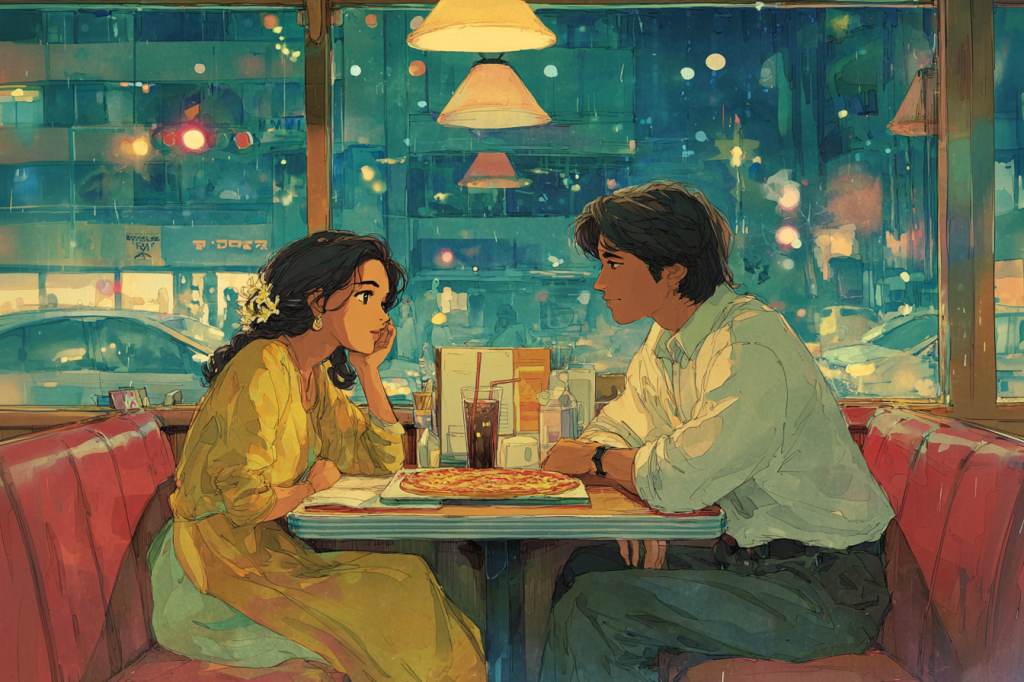
Yellow first. Always yellow first. The colour arriving ahead of form, announcing itself before permission was granted. Then her, assembled effortlessly, as if the city had been expecting her. Scooty angled with casual defiance. Jasmine pinned into her hair with care, already softening, releasing that particular sweetness that meant it had been chosen. The long bag hanging low across her shoulder, swinging slightly as she shifted her weight, patient, unhurried, entirely at ease with being waited for.
He felt the city recede a fraction. Traffic softened. Noise lost its edge. The air seemed to hesitate, not because it had to, but because it wanted to. She looked up and smiled.
It was not a large smile. It did not ask to be noticed. It arrived the way light does when a door is opened suddenly, filling corners you did not know were dark. Something inside him loosened. Something else tightened. The afternoon, which had been moving forward obediently until then, slipped sideways, as if time itself had briefly forgotten what it was meant to do.
She lifted her hand. He lifted his. They walked toward each other through a pocket of space that felt briefly sheltered, as though the city had leaned back to let them pass.
“Hi,” she said.
Inside Pizza Hut the cold arrived first, aggressive and immediate. The kind of cold that made people sit up straighter. Red booths. Plastic menus that stuck slightly to the fingers. A low roar of voices. Laughter bouncing off glass.
A waiter appeared.
“Table for two?”
She said, “Sixteen.”
The waiter paused.
He said, “Two.”
She smiled, quick. “We’re expecting ghosts.”
The waiter nodded like this was not the strangest thing he’d heard all day and led them to a booth near the window.
They sat opposite each other. He noticed this immediately and pretended he hadn’t. She put her bag down beside her, then nudged it closer with her arm, then nudged it back again, never quite satisfied.
“You look like you’re about to give a presentation,” she said.
“I am sitting,” he said.
“You’re sitting very formally.”
“I’ve been trained.”
“By whom?”
“Life.”
She laughed, leaned forward, elbows briefly on the table before remembering herself and pulling them back.
“So,” she said.
“So,” he said.
She grinned. “We’re good at this.”
He picked up the menu, held it with both hands. She watched him, amused.
“You don’t have to read it like that,” she said.
“Like what?”
“Like it’s going to ask you questions.”
“It might.”
She tilted her head. “You’re nervous.”
“I’m thinking.”
“That’s the same thing.”
He scanned the page, frowned.
“What’s capsicum?”
She froze. “You’re kidding.”
“I’m not.”
“You are.”
“It sounds medicinal.”
She stared at him for a second, then laughed. Not polite laughter. Real laughter. Loud enough that the boy at the next table looked over.
“It’s kudamilagai,” she said.
“Oh, I thought it was gulab jamun.”
“Why would you think it’s gulab jamun?”
“In English,” he said, weakly.
She shook her head, still smiling. “You’re impossible.”
“You knew this.”
“Subbu, I knew you were nerdy. I didn’t know you were this nerdy.”
The waiter came back.
“One Veggie Supreme,” she said without looking at the menu.
“Medium,” he said quickly.
“Large,” she said at the same time.
They both stopped.
He glanced at her. “We don’t need a large.”
She shrugged. “It’s the new millennium. Go big.”
He smiled despite himself. “That’s not how budgets work.”
She leaned back, crossed her arms. “This is not about budgets. This is about optimism.”
The waiter waited.
He sighed. “Large.”
She smiled, satisfied.
“And one Coke,” she said. “Two straws.”
“One straw,” he said.
She raised an eyebrow. “Why?”
“I don’t like straws.”
“You drink Coke like you’re mad at it.”
“I am disciplined.”
She laughed. “You’re ridiculous.”
“Two straws,” she told the waiter.
He considered this. “Fine. Two straws. But I get first sip.”
She smiled. “Negotiation. You’re learning.”
When the waiter left, there was a brief silence. Not awkward. Just new.
She picked at the edge of her napkin, tore a tiny piece off, rolled it between her fingers without noticing she was doing it.
“This is our first time,” she said, lightly. “Actually sitting like this.”
He nodded. “I keep thinking that.”
“Does it look weird?”
“No.”
“Because it feels a little weird.”
“Good weird,” he said.
She looked up at him then, something softer passing across her face before she caught it and smiled again.
“Yeah,” she said. “Good weird.”
“Are you nervous?” she asked.
“I’m thinking.”
“That’s a synonym.”
“I’m thinking about how the word girlfriend still feels like stolen property.”
“You didn’t steal it.”
“I borrowed it irresponsibly.”
“Intent matters,” she said. “Even in theft.”
The Coke arrived. Condensation already racing down the glass. She pushed the straw toward him. He resisted. She pushed again. He surrendered.
She grinned. “Small victories.”
“You’re dangerous.”
“I’m efficient.”
He traced a finger through the moisture on the glass, watched the line disappear almost immediately.
“You know,” she said, “everything feels possible right now.”
“Everything?” he asked, still looking at the glass.
She nodded. “It’s 2000. New century. New rules.”
He looked up. “Some rules don’t change.”
She didn’t answer immediately. Took a sip of Coke instead. When she spoke again, her voice was the same, but a little quieter.
“Yeah,” she said. “I know.”
Then she smiled, brighter, like she’d just fixed something.
From somewhere behind them came the sound of metal against metal, a tray being negotiated through a narrow space. Then she appeared. Not a waiter, not yet. A girl, younger than both of them, hair tied back too tightly, wearing an apron that still believed in neatness. She carried the pizza like something that mattered.
She set it down between them on a thick cork mat, the kind that looked vaguely scientific, as if heat were a problem that needed engineering.
“Hot, sir,” she said, already pulling her hand back. “Careful.”
Steam rose. Cheese shifted. The smell expanded its borders.
She placed the slicer beside the plate, the handle facing outward, professional, practiced.
“Anything else?” she asked.
“No,” she said, smiling. “This is good.”
The girl nodded and disappeared back into the kitchen, carrying their attention with her for a second longer than necessary. They leaned in instinctively, both of them, drawn toward the center.
She pointed immediately. “That,” she said, tapping one of the green pieces with her finger, “is capsicum.”
He leaned closer. “So that’s what it looks like.”
She laughed. “You were expecting something round?”
“I don’t know,” he said. “Brown. Sweet. Respectable.”
She shook her head. “You thought capsicum was gulab jamun.”
“In English,” he said again, stubborn.
“And this,” she said, moving her finger to a small black ring, “is olive.”
“Olive?” he repeated.
“Yes.”
“Like olive oil?”
“Yes.”
He frowned. “Why is it solid?”
She stared at him. “You don’t know olives.”
“I know coconut oil,” he said. “Groundnut oil. Gingelly. Oil that behaves.”
She laughed, delighted now. “You’re impossible.”
“I’m local.”
She picked up the slicer, then paused, held it up like a prop. “Watch carefully. This is my kind of technology.”
She pressed down. The slicer resisted for a second, then yielded.
He watched, intent. “You’re very confident.”
She cut the pizza with surgical calm. Eight pieces. No drama.
“Symmetry,” she said. “Like a family where everyone pretends.”
“Dark,” he said.
“Accurate.”
“There,” she said. “No fights later.”
He took the first slice, held it awkwardly, the tip sagging under its own weight.
“Fold it,” she said.
“Why?”
“So it doesn’t collapse on you.”
“I don’t like folding food.”
“You like eating it, don’t you?”
He folded it. Cheese threatened again.
She laughed. “Commit to it.”
He took a bite, too quickly, and hissed.
“Hot,” she said, satisfied.
She paused. The restaurant noise dimmed briefly, as if listening.
“Don’t philosophize until after the second slice,” she said.
They ate. At first, quietly.
“So,” she said. “Tell me again why you won’t eat chicken pizza.”
He smiled. “You already know.”
She wiped her fingers carefully on the napkin, folding it once, then unfolding it again, as if checking its obedience.
“You know what still surprises me?” she said.
“What?” he asked, mouth full.
She looked him over deliberately, head tilted, eyes narrowing in mock inspection. “This.”
“This what?”
“You.” She gestured vaguely. “This version.”
He glanced down at himself. The tucked-in shirt. The belt. The shoes that were trying very hard to look serious.
“I’ve always known you as…” She paused, smiling. “You know. kurta. jolna bag. rubber sandal. Walking everywhere with a book like you’re about to invent something.”
He laughed. “That was a phase.”
“That was your personality.”
“I work now,” he said. “I have responsibilities.”
She raised an eyebrow. “You?”
“Yes,” he said, offended. “I write SQL now.”
She blinked. “You just said that like it’s impressive.”
“Relational databases are impressive,” he said. “Tables. Relationships. Constraints.”
She shook her head, laughing. “You’re still the same.”
“No, I’m not,” he said. “I tuck my shirt in now.”
“That’s tragic.”
“I have an ID card,” he added.
“Stop.”
“I have a chair.”
She laughed harder at that, leaning forward, hand briefly touching the edge of the table to steady herself. “A chair.”
“With wheels.”
“Oh my god.”
“I spin sometimes when no one’s looking.”
She wiped at the corner of her eye. “I cannot believe you.”
“Beans, you loved me in kurta,” he said. “This is growth.”
She looked at him then, softer. “I didn’t know you like that then.”
“I know.”
“But I noticed you,” she said quickly, as if correcting something. “Just… differently.”
He nodded. He understood the difference.
She picked at a piece of crust, then pushed it aside.
“I always thought you were very chill but serious,” she said.
“I am both.”
“No,” she said. “You’re intense. You look like you’re always thinking three thoughts ahead.”
“I am.”
“That’s exhausting.”
“It’s efficient.”
She laughed. “You make life sound like a program.”
“It has inputs,” he said. “And outputs.”
“And errors,” she said.
He smiled. “Especially errors.”
They ate again. The pizza was almost gone now. The plate marked with grease and fingerprints. The cork mat darkened in places where oil had escaped.
“You know,” she said, lowering her voice a little, “for a long time, you were just… around in the college.”
“Around?”
“Yes. In the background. Always there.”
“I was waiting.”
She nodded. “I didn’t know that then.”
“I know.”
“I thought you were quiet.”
“I am quiet.”
“No,” she said. “You observe. Quiet people disappear. You didn’t.”
He shrugged. “You were easy to observe.”
She smiled at that, pleased despite herself. “I didn’t really know you until recently.”
“Recently,” he repeated.
“Last year, maybe,” she said. “You started talking more.”
“I ran out of patience.”
She laughed. “That explains it.”
She took a long sip of Coke, eyes drifting to the window for a moment, watching a bus struggle past traffic. When she spoke again, her voice was the same, but there was a half-second delay that hadn’t been there before.
“It’s strange,” she said. “We’ve known each other for years. And then suddenly…”
“Suddenly,” he said.
“Suddenly everything happened very fast.”
“It didn’t feel fast to me,” he said.
She nodded. “Of course it didn’t.”
Her foot tapped once under the table. Stopped. She folded her hands together, then separated them again.
“I still can’t believe you said it,” she said lightly.
“Said what?”
She looked at him. “You know.”
He traced the edge of the Coke glass with his finger, watching moisture gather and slip away.
“I’ve been saying it for a long time,” he said. “Just not aloud.”
She smiled, but her eyes stayed on the table. “You always do things thoroughly.”
“I don’t like half measures.”
She looked up at him then. “That’s what scares me.”
The sentence landed softly. No emphasis. No accusation.
He didn’t answer immediately. Took a bite of the last remaining slice instead, chewed slowly.
“You make it sound dangerous,” he said.
She shrugged. “Everything good is.”
She reached up, touched the jasmine briefly, as if checking it was still there.
“I like this,” she said, gesturing between them. “This sitting. This talking.”
“So do I.”
“It feels… grown-up,” she said.
He smiled. “We are grown-up.”
She laughed. “Don’t push it.”
They shared the last bite without discussing it. He held the slice steady while she tore off a piece. Their fingers brushed again. Neither apologized. For a moment, neither spoke. The music changed overhead. A song they both recognized but did not name.
Outside, evening settled further into itself. Inside, something delicate held.
They sat back as the plate was cleared, the cork mat lifted and taken away, leaving behind a faint ring where the pizza had been. The table looked suddenly larger, emptier, like a room after furniture has been moved. The Coke glass remained between them, half-full now, ice thinning, bubbles losing conviction.
She stirred the straw without drinking.
“My mother asked today,” she said, casually, as if mentioning weather.
He looked up. “About?”
“Nothing,” she said quickly. “Just… asking.”
“Asking what?”
She smiled. “Everything.”
He nodded. He understood the category.
“What did you tell her?” he asked.
“The truth,” she said. Then corrected herself. “A version of it.”
He traced the rim of the glass with his finger. “You’re good at versions.”
“You have to be,” she said. “In my house.”
“In mine too.”
She glanced at him. “Did you tell yours?”
He hesitated. “I told them I was going out this evening.”
“That’s not telling.”
“That’s surviving.”
She laughed softly, then stopped. Folded her hands together.
“You know they’ll ask eventually,” she said.
“I know.”
“And they won’t ask gently.”
“I know.”
She leaned back, crossed her arms, then uncrossed them again, as if trying positions on for comfort. “They’ll want details.”
“What kind of details?”
She ticked them off with her fingers, half joking. “Who. From where. Why. Food. Church. Language. Relatives.”
“Horoscope” he added.
“Not in my family.”
He nodded. “Horoscope always comes last.”
“Because it confirms what they already want to hear.”
They sat quietly for a moment. The music overhead shifted to something slower, more deliberate.
“Do you ever think,” she said, “that maybe we just started too late?”
He frowned. “It’s been twenty days.”
“Exactly,” she said. “Twenty days and already we sound like people from a black-and-white movie.”
“Maybe that’s romantic.”
“Maybe that’s doomed.”
He stared at the Coke bubbles. “Families.”
“Religions.”
“Food.”
“Language.”
He sighed. “You think it’ll get easier?”
“I think we already know the answer,” she said.
He smiled. “You’d make a terrible politician.”
“And you’d vote for me anyway.”
“In a heartbeat.”
“You ever think about how many people are involved in a marriage?” she said.
“Too many,” he said.
“My aunt alone could run a small country.”
“My athimber thinks he already does.”
She smiled, then sighed. “It’s strange, isn’t it?”
“What?”
“That we’re sitting here talking about this like we’re planning a trip.”
He looked at her. “We plan everything.”
“That’s a problem,” she said again, softer this time.
He didn’t respond immediately. Looked out the window instead, watched a man argue with an auto driver, both of them certain of their righteousness.
“You know,” he said finally, “I never thought this far.”
She raised an eyebrow. “You?”
He smiled. “I thought about you. That was it.”
She looked down at her hands. Picked at her nail with her thumb.
“I think about further,” she said. “That’s my problem.”
“That’s not a problem.”
“It is when the further looks… complicated.”
He nodded slowly. “You think it would get easier?”
She didn’t answer right away. Took a sip of Coke. Grimaced slightly at how flat it had become.
“I think,” she said carefully, “we would get tired.”
“Tired?”
“Of explaining,” she said. “Of defending. Of translating ourselves.”
He considered that. “I don’t mind.”
“I know you don’t,” she said. “You’d fight.”
“Yes.”
She looked up. “And I don’t want you to.”
He frowned. “Why?”
“Because you’d lose something,” she said. “Even if you won.”
He opened his mouth, then closed it again.
“My brother may get married in the next two years,” she said, suddenly.
“Oh.”
“And my sister,” he said. “Same two years.”
She nodded. “Everything starts lining up.”
“Against us?”
She shook her head. “Not against. Just… around.”
He smiled sadly. “The world has good timing.”
“Too good,” she said.
She reached for the Coke glass again, then stopped, pushing it away slightly, as if distance might clarify something.
“You know what I hate?” she said.
“What?”
“That this makes sense.”
He nodded. “That’s the worst part.”
They sat there, both of them quiet now, not touching anything. Outside, a horn blared, impatient. Inside, someone laughed too loudly at another table.
“I don’t want to stop liking you,” she said, very simply.
He looked at her. “Neither do I.”
She swallowed. “But liking and living aren’t always on the same side.”
He held her gaze. “We don’t have to decide now.”
She smiled, grateful and sad at the same time. “We already are.”
Neither of them moved.
The Coke melted itself into water.
He watched her for a long second before speaking, as if rearranging his thoughts into something that could pass for lightness.
“You know,” he said, attempting a smile, “we could also choose to be wildly irresponsible.”
She laughed, but it didn’t travel very far. “You already are.”
“I mean it,” he said. “Ignore everything. Religion. Language. Food. Aunties. Uncles. All of it. Just… decide.”
She leaned back, crossed her arms, then let them fall again. The jasmine in her hair had loosened slightly, one petal clinging stubbornly near her ear.
“That sounds very heroic,” she said. “And very exhausting.”
“I don’t mind exhausting.”
“I know you don’t,” she said. “That’s the problem.”
He frowned gently. “Why is that a problem?”
“Because you’d keep going,” she said. “Even when it starts hurting. Even when it stops making sense.”
He opened his mouth, closed it, tried again. “Things don’t have to make sense all the time.”
“They do if they involve other people,” she said. “Families. Siblings. Futures. We won’t just hurt ourselves. We’ll hurt everyone. And then we’ll still end up here.”
“Here where?”
She gestured around them. The empty plate. The thinning Coke. The table that now felt too wide.
“At the end,” she said.
He looked down, then up again. “You’re saying our first date is also our last.”
She nodded. “That’s exactly what I’m saying.”
He absorbed that. Let it move through him slowly.
“I don’t even know what a date is,” he said finally. “It sounds like something invented by restaurants.”
She smiled, then her smile broke just a little. “For me, if this is ending badly, I want it to be forgettable.”
He shook his head. “That won’t work.”
“Why not?”
“Because this,” he said, gesturing between them, “isn’t forgettable.”
She sighed. “You always do this.”
“Do what?”
“Turn everything into meaning.”
“I’ll probably write it into a book someday,” he said, half joking.
She rolled her eyes affectionately. “You and your books.”
He smiled. “You like that about me.”
“I do,” she said. Then, quieter, “Which is why I don’t want to watch it break.”
There it was. The sentence that closed the door without slamming it.
He shut his eyes for a moment. Just long enough for the city to pass behind his eyelids. When he opened them again, the optimism was still there, but it had learned its limits.
“I don’t agree. At least we should have given it a shot,” he said quietly. “But I hear you.”
“Okay,” he said.
She looked at him. “Okay?”
He nodded. “Okay.”
They stood. The chairs scraped. The sound was ordinary, and somehow unbearable.
He reached into his pocket, felt for the folded notes he had been carrying all evening without counting. He left them on the table, more than necessary, pressed flat with care. As they walked out, he paused, called the girl back, and added a little more, the kind of gesture that wasn’t about generosity so much as order.
She nodded, surprised. “Thank you, sir.”
He nodded back.
Outside, the night had fully claimed the street. Headlights cut through warm air. The city moved on, generously indifferent.
They stepped out together.
“Happy birthday,” he said.
She smiled, thin but real. “Say it again.”
“Happy birthday.”
This time the words fell gently, like something being put down rather than offered.
He hesitated. The idea of a hug rose in him, fully formed, already aching. Too public. Too new. Too late.
So he held out his hand.
She took it.
And in that single, ordinary touch, time lost its discipline.
In the instant their palms met, a future burst open.
They were married in a small government office with peeling paint and a bored clerk who stamped their names without looking up. They argued over curtains. They had children who ran barefoot through a Madras afternoon. He walked with a slight stoop now, a cane tapping rhythm into the pavement. She wore yellow still, always yellow, laughing at him for forgetting where he left his glasses. They grew old the way people always think they will. Gently. Together.
Then it vanished. The street returned. The noise. The rules.
She let go.
“Take care,” she said.
“You too,” he said.
She put on her visor. Mounted her Scooty, looked back once, lifted a hand, not smiling this time.
He sat on his Hero Puch, helmet resting on the handle, watching as she drove away. Watched her take the right at College Road. Watched until yellow became distance. Until distance became nothing.
Only then did he straighten, place the helmet on his head, and ease the engine awake. The little pony answered. And carrying with it everything that had not happened and everything that somehow still had, it took him back into the long sentence of the city.
 kirukkal.com