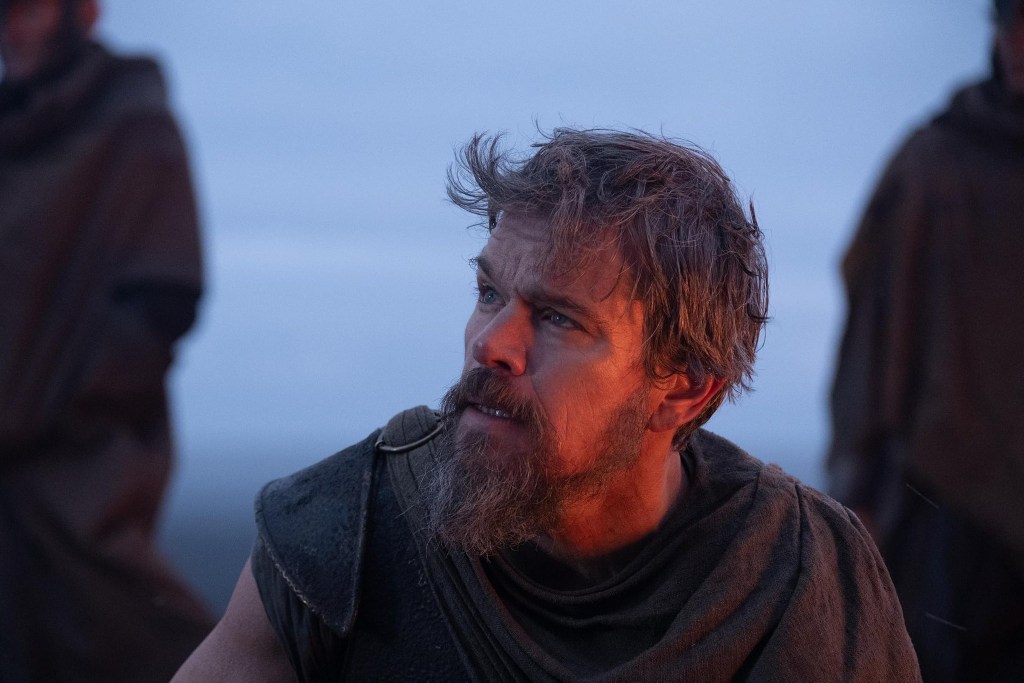
The first thing to report about Christopher Nolan’s Odyssey is that it commits the one sin Homer never managed: it feels short. Nearly three hours pass like a fair wind, and I never once wondered how many were left. Time, Nolan’s oldest obsession, is here his only remaining magic trick, and he needs it, because the second thing to report is the scandal. He has sacked the gods except for Athena. Olympus has been made redundant. The horse is not a miracle but carpentry, timber and rope and terrible patience, and what I felt watching it was not wonder but dread, because you know what that kind of patience is for. The ships all leak. The men stink of salt and of the thing they did at Troy and cannot leave behind. The purists will write letters to the editor, and let them; Homer was a remixer himself, every age gets the Odyssey it deserves, and ours, it turns out, deserves the plain version.
And plain is a choice. In another director’s hands the horse would have been grand, and a younger Nolan would have made it grand himself. Think of The Dark Knight Rises, the camera looking up to the sky while the music swells and Batman stands on top of a building. That film is epic in every frame, and it knows it. Here, Nolan has the chance for a shot like that in every other scene, and he keeps turning it down. He shoots the grand things small and human. That restraint is new, and it looks like maturity to me.
If you have read the original poem, or Emily Wilson’s swift English version of it (“Tell me about a complicated man,” she begins, and Nolan has clearly taken the adjective personally), the film keeps handing you small rewards. If you haven’t, it’s fine; the movie carries you regardless, being the oldest tale there is, a soldier trying to get home to a wife who has become a fortress.
Yes, the Greeks talk like Americans. For ten minutes I found this jarring; then I didn’t; then it became the point. Part of that is the fact that I saw it in IMAX, and at that size you start standing inside it, and once you are inside, the accents are simply how the men around you talk. But the bigger part is that the film is not ancient at all. It is insufferably modern, a story about war and the men who come back from wars altered, wearing antiquity the way its hero wears his beggar’s rags, as a disguise, and nothing in it is only what it appears to be. Nolan simply declines to make the casual viewer notice. You may keep your spectacle; the film keeps its secrets in plain sight.
The craft is confident across the board, and the proof is that I mostly stopped noticing it. The score works on you before you catch it working, and the camera does the same. I believed every face on the screen, including Charlize Theron. The editing, Nolan’s signature skill, is the one part that announces itself. You feel the cuts pulling the story together long before you understand how. For two hours the film wanders, as it must, telling you what happened. In the last hour it arrives, and I sat up in my seat and stayed that way; the movie, like the man, only becomes fully itself when it gets home. (After Tenet and Oppenheimer, both of which I liked less than this one, this feels like a homecoming for the director too.)
He has taken the most classical story in Western literature and told it in the most modern way possible, which is a great achievement. It has been waiting three thousand years for exactly this sort of nobody.


Leave a Reply