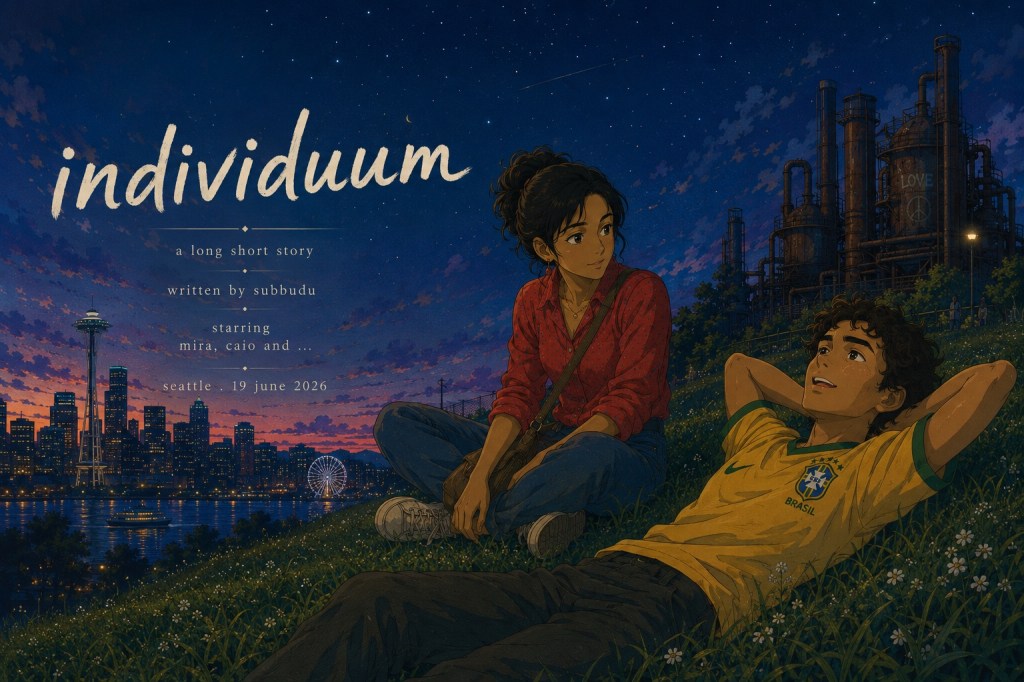
listen to the audio version on YouTube
I count.
That is my confession and my boast. Take both before we go a step further, because the rest of this is the story of the one afternoon I did not, and to this very hour cannot. You should hear it from me and not from the figures, who lie when it suits them and suit themselves more often than you would ever believe of a number.
I am a djinn of the count. That is two facts, not one, and I will divide them for you, since dividing is the trade: I am a djinn. I count. A djinn of the count is the public half of the title. The private half you will have out of me before morning anyway, so I will give it to you now: I am a djinn of the cut. You cannot count what you have not first divided. Before the tally, the knife. Forget the lamp, the smoke, the three wishes, the whole sweating pantomime. The stories libel us. They always have. I was born from a single scratch on a single bone, the first mark a frightened human made to say this many and feel, for the length of one breath, less afraid of the dark, and understand what that scratch was before it was ever a number: it was a border. One stroke of fence. This, and not the dark around it. That was my making and my entire creed, and I will hand it to you now in four words so you cannot later mistake it for sentiment: count it, and it’s caught. The counted is the real. The rest is weather, rumour, and the noise people make at funerals.
I was magnificent once, and I would like that entered into the record before the humiliations begin. I counted the stars for a king who could not sleep, and he slept. I counted the spears of an army for a general who could not lose, and he lost. That was not my error. I gave him the correct and frankly discouraging figure and he chose to round up. I counted the coins in a treasury for a man who was being robbed blind the whole time I worked for him. I do not come out of that story well. I will tell you later. Possibly never. Elephants of a bride-price. Tiles in a courtyard. The days of a flood for a family on a roof who counted along with me, out loud. The only congregation I have ever had. I will not tell you how that ended. We have only just met.
And those were the commissions, the parlour work, a god moonlighting for kings. The real work was older and larger and nobody ever ordered it. I went up the long string of every instrument that has ever been strung and decided where one note ends and its neighbour begins. Musicians have been relitigating my placements for three thousand years, in tuning rooms, bitterly. I attend when I can. It is the nearest thing I have to a family quarrel. I walked the whole ridge of human speech with a pair of shears, deciding where one language stops and the next starts. I cut generously, being young and in the mood to show off, and that is why there are seven thousand of them. The same ache can wake up on opposite sides of one planet wearing two different names. You will need that at dinner.
And I attend the births. All of them. It is the one appointment I have never missed, and nobody has ever set a place for me. Because the first thing done to every single one of you, before the name, before the weighing, before the milk, before the love, is a cut. The cord. One is made two. Whoever holds the blade, the blade is mine. I open every human account personally, on the first morning, with one stroke, and in eleven thousand years not one of you has thanked me for it. I have stopped mentioning it. Just then. That was the last time.
Then there is the other shelf, and I will take it at speed, because a god is entitled to one locked room and mine has water under it. I held the pen at Tordesillas, in fourteen ninety-three, no, four. Even I round when the memory is expensive. One line down the middle of an open ocean, drawn dry, sight unseen. Two crowns, half a planet each. That single stroke is the entire reason that five centuries later a man from Bahia will open his mouth and Portugal will fall out of it. In a hot room in Delhi, in the August of 1947, I steadied the hand of a tired man who had been given five weeks and a map and had never once seen the rivers he was cutting. That is all you will get from me tonight. File it beside the treasury, in the locked drawer of stories I tell at my own expense.
I had titles. I awarded them to myself, I used them constantly, I use them still: the Most Numerate One. The Great Divider. He Who Knows Where One Thing Ends and the Next Begins. Write those down. You will watch them turn to ash in my mouth, and I would like a witness.
Now I live in the scanners. Yes. Go on. I am the green tick. I am the small bright nothing that blesses your groceries. I am the voice in the self-checkout that says unexpected item in the bagging area. That flat little death. Eleven thousand years of dividing the heavens, come down to a difference of opinion with a woman about whether a tote bag is, philosophically, an item. I count your steps and report them to you in the dark whether you asked me to or not. I count your unread mail, and I judge it. I count the days since you last called your mother, and I will not say the number, partly from mercy and partly because mercy is cheaper than you think and I am economical. Do not pity me. Pity is the one figure I have never managed to locate, in myself or anywhere else, and believe me I have searched. But understand what I was when I came to that turnstile in Seattle on the nineteenth of June, in the year you insist on calling 2026: a deposed god, working a door, still the finest in the world at the one thing nobody alive requires. God is a title I awarded myself. Djinn is what the paperwork says.
It is 11:51, Pacific. Nine minutes to a match that neither of them came for. Sit inside that fact a moment. One of them is from Mumbai and one from Salvador da Bahia. India has never once qualified for this tournament, and I have counted every attempt; his Brazil played elsewhere, under another roof, a result settled before either of them woke. They have come for nothing. And nothing, I have found, is the only honest reason anyone has ever travelled anywhere.
Let me show you the building. I cannot help it. It is the last thing I am still unarguably good at, and a god should be allowed to perform his one remaining trick.
Sixty-eight thousand and forty-one tickets, sold into ninety-one countries. Every border between those ninety-one countries is in my handwriting; nobody at the box office mentioned it. Jerseys from nations not even playing: Egypt, Japan, two grief-stricken men in the orange of a Netherlands that lost at home and flew here anyway. I logged them under devotion and also under poor judgement. The columns are adjacent.
A roof tuned to throw the roar back down onto the people who made it. In the eighty-first minute it will hit one hundred and thirty-seven decibels. Mark the time. I am never wrong about the time.
Forty-one thousand beers. Nine hundred kilos of garlic fries. Six children temporarily lost and six children found, a perfect ledger for once, every parent matched by closing. I will confess it moved me. A clean reconciliation always moves me. It is the nearest thing I have to a hymn.
Sixty-eight thousand hearts at a mean of ninety-one beats and climbing. I have the dollar price of the joy in here too. I am keeping it. You would not survive the figure, and I need you for the rest of this.
The one thing I cannot give you is which of those hearts is about to find another one. I had no column for it. I have built one since. It is still empty, and I check it, and it is still empty, and I check it.
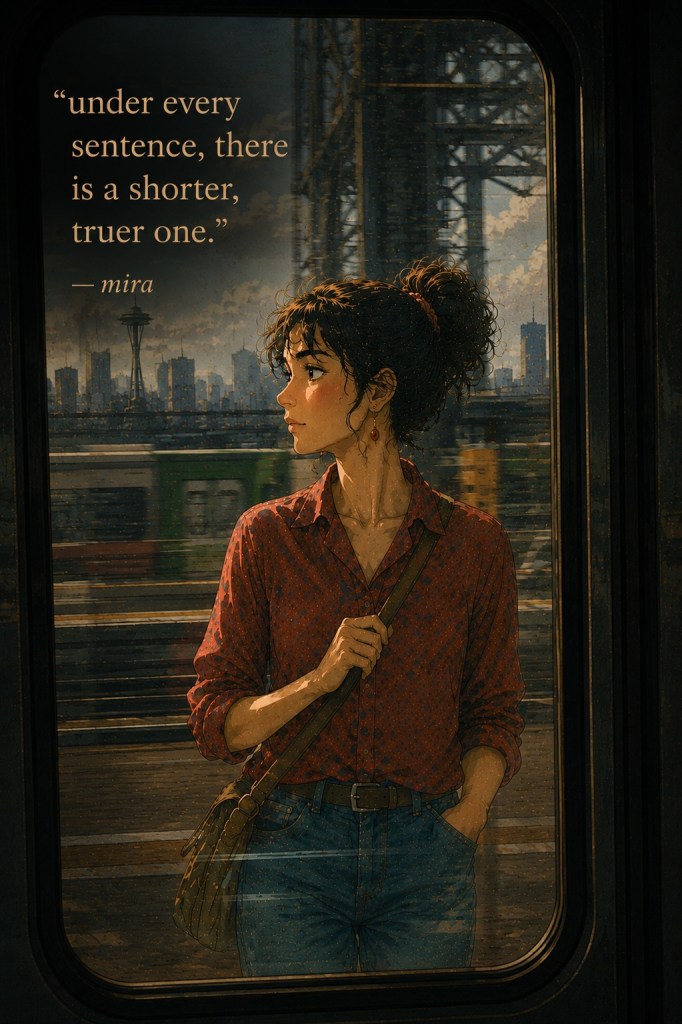
Her name is Mira. In her mother’s tongue it leans toward the sea and toward a saint who sang four hundred years to a god I never once logged at her door, and called the singing love, which tells you something about the family of words she comes from, a family with a high tolerance for longing and an even higher one for going on anyway. In another language her name is the word you say to a child to make it look. Look. Look here. He has been given that instruction his entire life and never once obeyed. I would mock him for it. I fully intend to. Except that I am beginning to suspect I am standing in the same failure, and the name on it will be my own.
She edits children’s books, and I mention the job for the way she listens, as if under every sentence there is a shorter, truer one, and her whole work is to find it and cross the rest away. She does it to menus. She did it, I am almost certain, to him. She cannot sleep in a room where a drawer is open. Not two drawers. One. If a single drawer is open she will rise and close it, even in the dark, even in a room she does not know. I have no idea what she thinks will escape. She reads the acknowledgements page before she reads the book, every time, to learn what the thing cost someone before she lets it cost her. I keep coming back to that habit, the way your tongue keeps going back to a tooth. And strangers tell her things. I counted six in a single day who told Mira what they had told nobody they arrived with. Six. She has the kind of face the truth simply walks toward and sits down in front of. That exact thing I cannot measure. I have loathed it since approximately noon. She is in this city because her brother has a spare couch in Redmond and because Mumbai in June had begun to feel like a flat in which someone had painted all the windows shut. She came to the match because the brother had a spare ticket and a theory that she needed, his word, out.
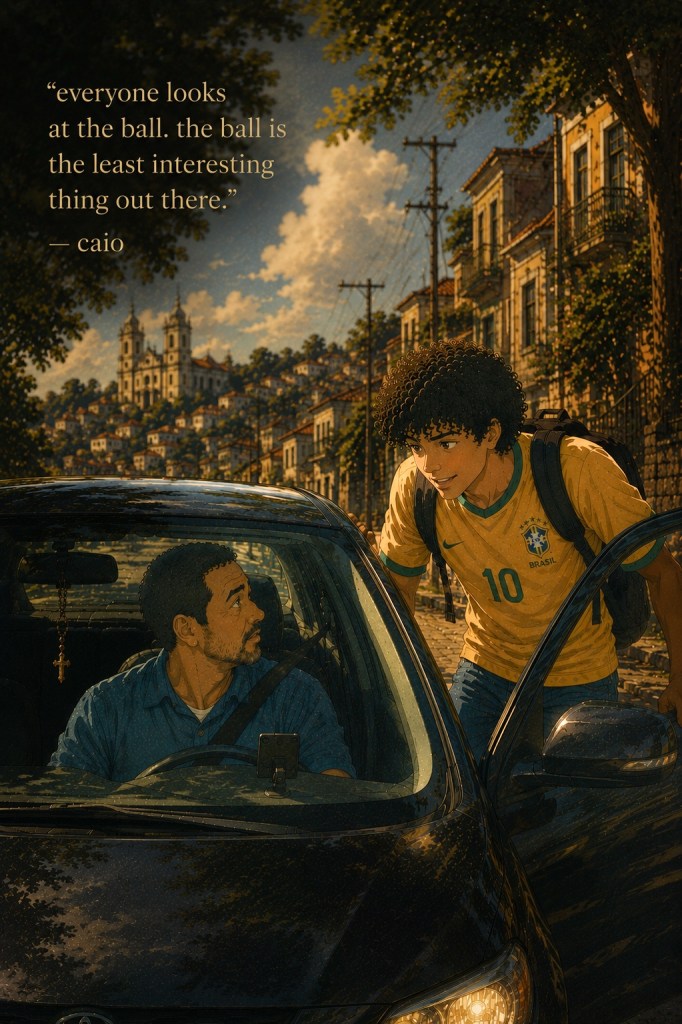
He follows the tournament the way other men follow a relic from town to town. Four World Cups now, no team of his own this far west, just the game. He is the kind of man who is good at exactly one beautiful useless thing, and he has arranged his whole face around the knowledge of it. He watches, in his own room, alone, highlight reels of matches whose scores he already knows, matches played before he was born, on grainy film, and talks back to the screen. He calls the offside before the replay can confirm it. He is not showing off. There is nobody there. I have counted the hours: it is the only time he is entirely still. He used to come with a friend who carried the cooler and argued the offside law. The friend moved to a city with no sea and a wife who does not care for football, so this time the seat beside Caio is empty. That, if you want the truth, is most of what his word saudade is carrying today. He would not put it so plainly. I can, because I read the seat back at the airport: two names this morning, one now. I read everything. It is a compulsion and a profession, and I have stopped apologising. At the kickoff of every match he sends that friend a single word: now. The friend has not answered in two years. He sends it anyway. He sent it today, at noon, while the woman beside him was still arguing about a seat. I keep the count of the unanswered. It is the one number of his I do not enjoy saying. And I say everything. He can see where the space will open on a pitch half a second before it opens. It is a kind of sight. It has never, not once, worked for him in a room that also contained a woman.
I can tell you exactly what they looked like, and here is where my whole gift begins, quietly, to betray me.
She was a hundred and sixty-three centimetres and carried herself as if she were a good deal taller, the stance of a woman who has spent her life being the shortest person in the room still willing to argue. A scar through one eyebrow, four millimetres, old. When she thought, she pressed her tongue to the back of her teeth and the line of her jaw shifted by a single degree. I logged the degree. I logged it perfectly. And the thought itself walked straight past me and out the door.
He was bigger, a hundred and eighty-six, built the way men are built who ran for years and then stopped. Dark eyes set a touch too wide, which the tables of symmetry I carry would mark down as a flaw and which was, infuriatingly, not a flaw. When he laughed the whole face committed, no part of it held in reserve. I measured the open of the mouth, the precise architecture of it, and arrived where I always arrive: at nothing. A thoroughly itemised nothing.
I had every figure for both of them. I could not have picked either one out of a crowd of two by a single word of it. Sit with that. I have been sitting with it all night.
Now. Here is the moment. Here is where I broke. I have told it to myself so many times tonight that I no longer trust the telling, and for a creature like me that is a species of death.
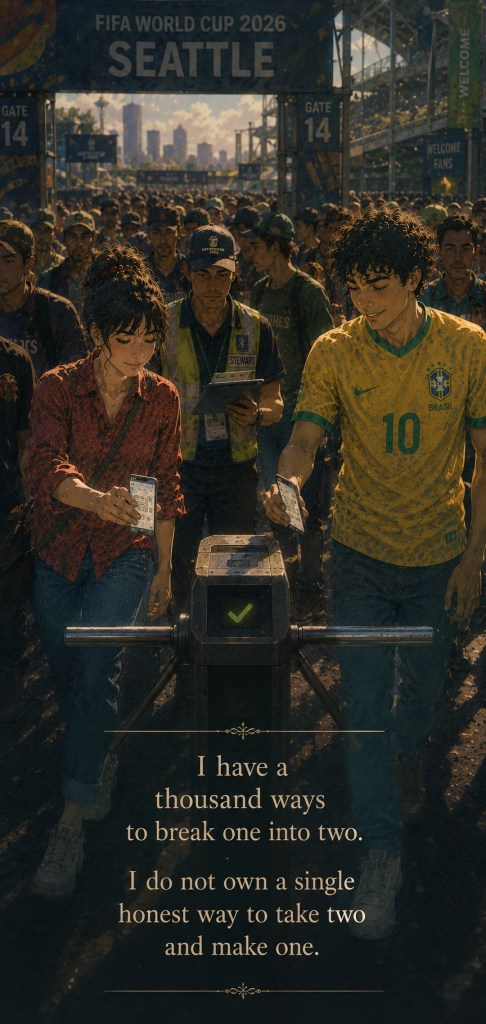
Two phones. Two QR codes, my own grandchildren if you want the genealogy, descendants of the first grids ever scratched into clay to keep a tally. I felt a grandfather’s foolish pride looking at them. It was the last pride I felt for some time. Hers in her right hand, his in his left. There is one working turnstile; the gate beside it has died. A child dropped a churro into its throat, and the churro, cinnamon and grease, accomplished in one afternoon what eleven thousand years of mathematics never could: it made a machine hesitate. So they are funnelled into the single live gate, the Mumbai woman and the Bahia man. They present their phones in the same half-second, two arrows through one slit. And I, the Great Divider, He Who Knows Where One Thing Ends and the Next Begins, I, who have never in eleven thousand years confused so much as a pair of identical coins:
I counted them as one.
You do not understand. Let me make you understand. This is the single act I am incapable of. My entire godhead balances on one stone, which is that I can always, always tell two from one; it is not a skill, it is the floor I stand on. I drew a line down the middle of an open ocean with a dry pen and it held for five hundred years. I could not draw one between two strangers at a turnstile. And in that greasy churro-scented half-second I looked at two strangers born nine thousand kilometres apart, two, demonstrably and gloriously two, and I saw one soul and I waved it through. The screen went green. Welcome. Enjoy the match. Singular. One welcome. One soul through a gate where two human beings were plainly, visibly standing.
I reached straight back into my ledgers to divide them again, the first thing I ever learned, the easiest move I own, a move I could perform in my sleep if I slept, and the seam was gone. Gone. I ran my hands along the whole length of the record and there was no place where one of them stopped and the other began.
They were in the same seat. One entity, one chair above the corner flag, and so they arrived at it together and stood upon the same square of the earth holding the same printed claim to it, and the first thing that passed between them, I am pleased to report, was not tenderness. It was a turf war.
“This is mine,” she said, phone up. Marine Drive in the vowels.
“This is mine.” He held his up beside hers, same number, same row, and instead of arguing he laughed, which annoyed her considerably more than an argument would have. “Double-sold. It happens. Australia by two, by the way.”
“You don’t support either of them.”
“No. But by two. Watch the left side.”
A steward came over with a tablet that was also, in a small humiliating way, me. He consulted me, got from me the only truth I now possessed, one ticket, and shrugged the eternal shrug of all stewards in all stadia across all of recorded time. “You’re together. Work it out.” And left. I would like it noted that I, a god, was reduced to a single wrong word on a steward’s screen, and that the steward believed me.
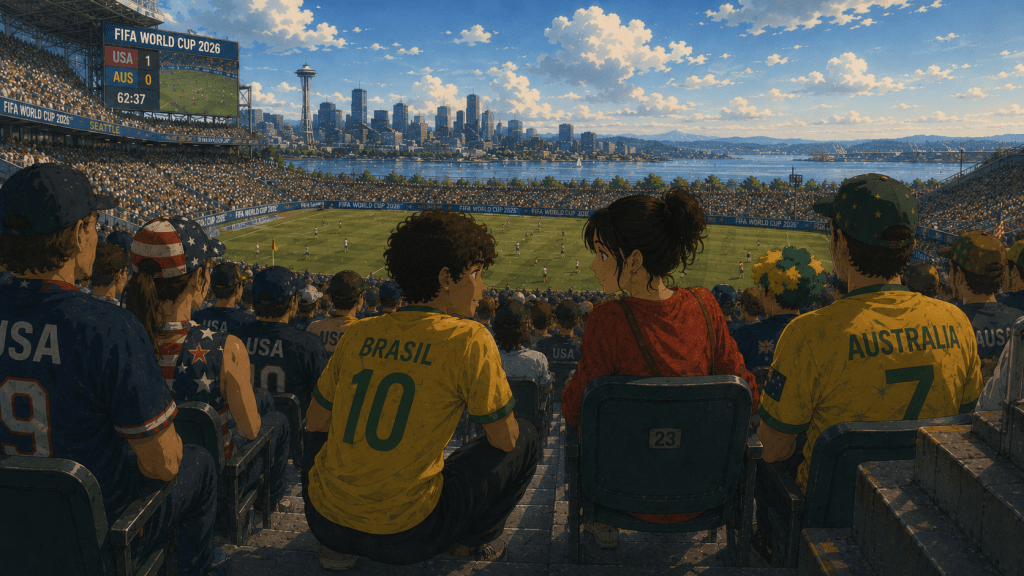
So they worked it out. There is only so much one chair will do. For the first half she sat and he half-crouched on the steps, narrating a match she had not asked him to narrate, and the appalling thing, the thing I resented in real time, was that he was good at it. He kept calling it before it happened, now the fullback’s too high, there’s the gap, there, pointing at a patch of empty grass a full beat before anyone ran into it, as if the future were simply a place he had already been. She stopped watching the ball. She started watching the place his finger went, to see whether the game would obey him. It kept obeying him. I watched her watch him. I logged the angle of her attention. Frankly, it was the first moment I felt the floor go soft.
“How do you do that.”
“You stop looking at the ball.” He said it as though it cost nothing. “Everyone looks at the ball. The ball is the least interesting thing out there.”
She took a pen from her bag and wrote something on the back of her hand and would not show him, and when the bag opened I saw the brass key on her ring. The door it belongs to is a parking lot now. She knows. Every time she changes bags, the dead key moves first. Fourteen grams. It opens nothing in this world, and the woman who crosses out unnecessary words for a living has carried it through eleven years and two countries. I had its weight before the bag closed. I am still working on the rest. As for what she wrote on her hand, I, who can read the serial number off a banknote folded in a closed wallet, could not read it either, because she cupped her palm, and I have decided she did it to spite me specifically, though she does not know I exist.
The United States scored in the sixty-third minute, on the left, through the very gap he had named nine seconds earlier, and the roof flung the noise back down, and sixty-eight thousand people stood as one. The two of them stayed sitting. It finished one-nil. He took the loss of his bet with a grace I found suspicious. “The space was there,” he said, which settled everything for him and nothing for her, and that, more or less, was the argument they would go on having, in one costume or another, for the rest of the day, and I followed it the way a dog follows a car, with no plan for what I would do if I caught it.
The 1 Line out of the stadium was packed to the doors. They were pressed in together past any question of personal space, her shoulder in his ribs, a man in an Egypt shirt beside them eating cold noodles from a box with a plastic fork, swaying, not spilling, and I will have you know I counted not one noodle lost, a small marvel in a moving train.
The recorded voice said, The next stop is Symphony Station.
“They don’t need the is,” Mira said, to no one, to the pole she was holding. “Next stop, Symphony. Cleaner. The is costs you half a second every time and they say it four hundred times a day.” I did the multiplication before she finished the sentence, because I cannot not, and she was right, and I hated that she was right in my own idiom, on my own turf.
“You fix trains now.”
“I fix sentences. The trains are a hobby.” The car lurched; the Egypt man rode it like a sailor. “That announcement has been wrong for years and nobody whose job it is has heard it.”
Caio was not listening to the voice. He was watching the doors. “Three people are getting off here,” he said. “The two by the map and the tall one pretending to read his phone.” The train stopped. The two by the map got off. The tall one looked up, startled, and got off. Mira stared at him.
“Stop doing that.”
“I can’t read a woman,” he said, cheerful, “but I can read a door.” And I thought, you and me both, brother, and then I caught myself thinking it, a god siding with a man against the unreadable, and I did not care for what that revealed about the state of me.
She asked him why he was here, a sport’s whole circus, alone, no team in it for him this far west. He handed her the cooler-and-the-offside-law friend without the word for what was missing, the way you pass someone a photograph face down. She heard the shape of it under the words anyway, because that is her terrible gift, and she did not make him say the rest. That is a mercy, and a more costly one than I have ever managed. She told him about the painted-shut windows. He did not tell her it would get better, which I noted, because the men who do not say that are rarer than you would hope. He said, “So you came out,” using her brother’s word back at her, and she laughed for the first time, an ugly, honest, full-throated bark of a laugh that I clocked at sixty-one decibels and could not, for all my instruments, otherwise account for.
Out at last into Pioneer Square, which the city had closed to cars and opened to feet: old red brick, the iron pergola, and the thing the locals will tell you whether or not you ask, that there is an entire first city buried beneath this one, drowned in its own plumbing and built straight over, still down there in the dark. I love this fact, I will admit. It is the truest thing the city says about itself, and nobody believes it: that everything is two cities, one of them dead, and the dead one is still, I promise you, being counted. The festival carried them downhill on a current of green scarves, past a Peruvian band, past a man selling scarves of every nation, past a bar where a hundred Australians sang the dirge of the recently beaten, past a priest and a juggler and a woman with a macaw who would not, she kept announcing to all comers, be photographed for free.
And because I had made them one, the city went on treating them as one, and I, the author of the error, was forced to watch my own mistake court itself through the streets. The car she ordered arrived for him. The coffee he bought rang up on her. Every time I tried to split the account I split it wrong, and the wrongness shoved them back together, she had to find him to hand over the coffee, he had to find her to settle the coffee, find and find and find. I want it understood: I was trying to separate them. Every attempt I made to separate them is the reason they kept colliding. That is the sort of joke the universe tells at my expense, and it has been telling it, I now suspect, all night, for an audience of one. I knew only that the transactions would not resolve, and that I, who balance the books of the entire world to the cent, was running two whole human beings as a single, swelling, unkillable bad debt.
At Pike Place they watched men hurl fish, whole salmon, silver, astonished, sailing over the heads of tourists who all reached for their phones at once and all, every last one, missed the shot. There was a brass pig at the market’s mouth, rubbed gold at the snout by a few million hands and dull everywhere else; she rubbed it; I priced it at scrap and was, as ever, useless. She laid her hand flat on the gum wall, that wall, that magnificent filth, decades of chewed colour pressed into brick, and said, “This is the most disgusting thing I have ever touched,” and left her hand there. I counted the pieces. I will not give you the number; it is obscene; her hand stayed on it and I could not work out why.
He did not want to go into the bookshop. She went in regardless, the big one on the hill with the wooden ramps climbing between the rooms, and her feet took her where they always take her, down to the low shelves and the small chairs, the children’s room. He followed because the account followed, and the account, I remind you, was me.
She moved along the spines doing what she cannot help doing, and stopped, and pulled out a book that was face-out where it should have been spine-out, or shelved under the wrong name, some crime visible only to her, and fixed it, and slid it back. “Somebody always does this,” she said. “Shelves them like they don’t matter.”
“They’re for children.”
“That’s the trick nobody believes.” She did not look up. “The ones worth anything aren’t for children. They’re for the adult who has to read them out loud, forty nights running, after a day that painted all his windows shut. The child’s asleep by page three. The book is for the one still awake.” She handed him a thin one, old. “Read me a line. Anywhere.”
He is not a reader. He held the book like a tool nobody had shown him how to use, and read one line, stumbling on a word, and the line was plain and good and landed in the quiet little room with the small chairs, and he looked up surprised, the very way he had looked up when the ball obeyed his finger, and he was about to say something, I felt the sentence gathering in him, I have a sense for the ones about to be said, I can feel the barometric drop before one breaks, and just as it crested, a toddler two shelves over was loudly and comprehensively sick onto the carpet, and a bookseller came at speed with a roll of paper towels, and whatever he was going to say went the way of weather. I did not get it. Understand that I am the one who is supposed to get everything, and I did not get it.
They left quickly. She kept the book. I billed it, naturally, to the account, because the account is a joke now and I have decided to enjoy the only part of this I still control.
The rain came and went in four minutes flat, rain straight through sun, a rainbow propped over Elliott Bay with one foot in the water where the white ferries crawled out toward the islands and the horn at Coleman Dock let out a single low note the size of the whole harbour. He bought a catastrophic umbrella from a CVS that was a Bartell Drugs until a month ago, the sign new, the grief local. It turned itself inside out before they reached the corner, and they dropped it in a bin still half open, defeated, four dollars dead, and I logged the four dollars and felt, absurdly, that it had been money well spent, which is not a thought a ledger is supposed to be able to have. He told her about his sea. How on the last night of the year a million people in white wade into the water in his city with flowers and small mirrors and combs, gifts for the goddess of it, and ask her for the coming year, and the waves take the flowers and now and then take a swimmer too. “She charges,” he said. “The sea always charges.”
Mira did not answer that. A while later, crossing Western, she put a hand flat on his chest to stop him stepping in front of a bicycle he had not seen, he who can read any door, blind to one bike because he was looking at the water, and she left the hand there a beat, then a second beat, longer than the bicycle required, and I counted the beats, of course I counted the beats, it is the only way I have of touching anything.
I counted the rainbow. Seven, as you know. I have nothing for you on the rainbow.
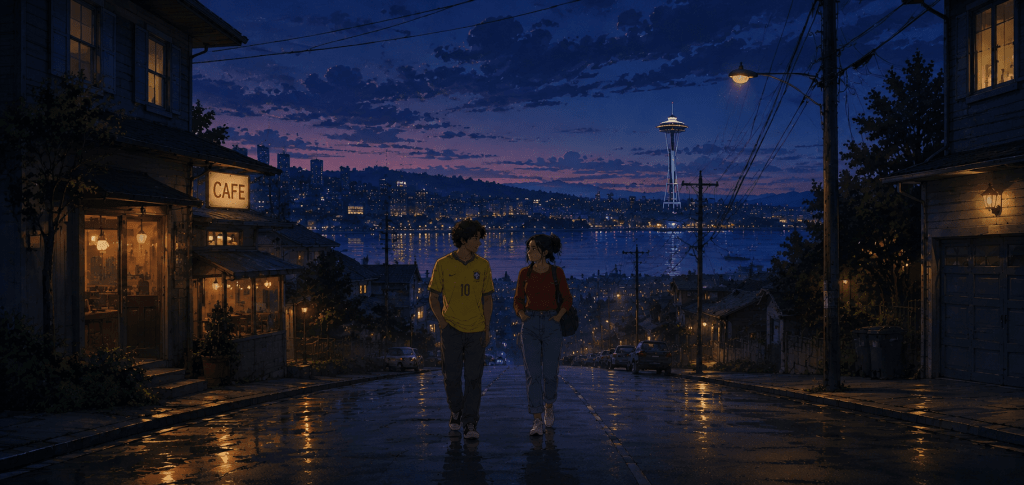
By dusk, and the June light up there refuses to die until nearly ten, they were in the International District at a place near Uwajimaya, two tables shoved into one, dumplings, a fish in a clay pot, and a third tea nobody had ordered that I had billed to the account I could not unmake. And they had begun trading words, which is the dangerous part, the part I should have stopped if I had any sense or any power left, and I had, by then, less of both than I was willing to admit.
She gave him viraha. An old word, she said, out of the old poems and then the film songs that are only the old poems in cheaper clothes. Love made out of the gap. Not love that survives the distance: love that needs it, that could not exist without it, the way a bridge needs the drop it crosses. Her saint had sung it forty years to a god, and the longing itself was the entire religion.
He said that was just saudade. She said it was not; it was older, and it pointed the other way. He said they were plainly two different words in two different languages, anyone could see it, and ordered more tea on principle.
She set down her chopsticks. “I cross out words for a living,” she said. “These are the same word. Somebody broke it a long time ago and dropped half on each side of the planet.” She crossed one of them out in the air with a finger, the way she does at her desk, and held the other one up between them like a thing she had just won.
She was right, is the thing, and I am going to tell you how I know, because the bill for the third tea was me and a bill cannot leave the table. I remember the word before it broke. I will not say it. You could not pronounce it; it took two mouths. I broke it myself, up on the long ridge, with the shears, professionally, without malice, on schedule, with a clear conscience, the way I have broken everything, and I dropped the halves where they fell, and the halves grew up nine thousand kilometres apart speaking to different seas, and tonight they had dinner together. Neither half recognised the other. An editor of children’s books needed forty seconds and no instruments whatsoever to see what I had managed not to see for three thousand years.
And I, the Great Divider, sat inside the bill for the third tea and watched two halves of one thing refuse, openly, to stay divided, and I had no operation for it. None. I own a thousand ways to break one into two; it is my whole inheritance. I do not own a single honest way to take two and make one and mean it. That is not arithmetic. That is the other thing, the thing on the far bank, the thing I have spent eleven thousand years pretending was weather.
It was at Gas Works Park, full dark now, the glass towers standing on their heads in Lake Union and the planes coming in low with their lights, that he almost said it.
He had been almost saying it all day. I had felt it gather in him once already, in the bookshop, and a sick child had taken it from us both. I am very good at sensing the sentence about to be said. I am no good, it turns out, at hearing one land. Not one of his ever did, and I have begun to wonder whether I am the reason, whether a thing that only ever counts the approach is incapable of the arrival.
They sat on the grass below the old gasworks, the dead machinery the city kept instead of tearing down, kindred to me in that at least, obsolete and preserved and nobody’s idea of useful. She said the thing the clock was forcing: his flight east at dawn, hers the other way, the couch in Redmond, the painted-shut flat somewhere past that. He turned to her and drew the breath a man draws before the sentence he has carried all day. And I leaned in, the whole of me, every instrument I own, every dish and needle and abacus of me, because I wanted to catch it, I wanted the number of it, I wanted to keep it, and that wanting, that naked wanting, should have warned me what had already happened. It did not. I am, it seems, the last to know things about myself. I keep no column for me.
The Parks Department sprinklers came on. All of them, at once, on a municipal timer that answers to no god, certainly not to me, and the two of them were on their feet and off the grass, swearing and laughing and shaking the water from their sleeves, and whatever he had been about to say went where the rest had gone. Only this time there was no later left for it to hide in. The day was over. It stayed unsaid. It is still unsaid. I have checked. I have checked and checked.
Above them, where the mountain should have been, there was nothing, cloud to the ground. Rainier. Fourteen thousand feet of it, the largest object for a hundred miles in any direction, and not one eye in the entire lit city could find it. I make no claim about the mountain. I will only report what I observed: that it was there, that no one could see it, and that this did not appear to make it one foot smaller.
They walked back toward the lights. At the corner where her train went one way and his car the other, they stopped, and she said something to him, and I did not catch it, I, who catch everything, because for the first time in eleven thousand years I was not, in that exact instant, counting, and by the time I thought to, it was already inside him and gone where I cannot follow. Then he went south and she went east, and the dark closed over the place where they had stood, and I stayed there a while at the empty corner like a fool, like a man, recounting it.
I still count, of course. Forty thousand and change through Sea-Tac before first light. The ferries on Elliott Bay. Unread mail, outstanding invoices, tax liabilities, reward points, garlic fries, luggage tags, and the precise number of times a man in Bellevue refreshed a page to learn whether his package had shipped. Every figure arrived correct. The world balanced to the cent. For eleven thousand years the counting had been the thing that made me feel a little safer, the way it once made a frightened animal on a plain feel safer, and tonight the figures still came, every one of them, on time, and the safety did not come with them. It simply did not arrive. And under each figure, where there had only ever been the figure, there was now a second thing I could not get a number on. The man in Bellevue was not refreshing the page about a package. I knew that much, and not one digit more. I have never in my life known a thing I could not put a digit to. How do you people bear it, knowing things this way, all your lives, with no number at the bottom to stand on?
At midnight I went to do the one clean thing a counter can still do. Close the account. Find the seam. Divide the record back into its true two, Mira, Caio, two tickets, two gates, two oceans wearing the same water, and file them apart, each in its own column, counted, caught, safe, the way everything that has ever existed has been filed by me, without exception, until tonight.
There was no seam.
I have looked all night, and I am the best looker there has ever been at this one narrow thing. I, the Great Divider, He Who Knows Where One Thing Ends and the Next Begins, am holding a record that says one where I know, I know, there are two, and I cannot make it say two, and I cannot make myself stop trying to make it say two. The number will not come. They have gone into the single place my instruments do not reach, the thing without a column, the uncountable, and on their way out they took my certainty with them, lifted it off the hook by the door like a coat grabbed by mistake, and they are wearing it now, somewhere, the two of them, not even knowing it is mine.
Somewhere between the fourth audit and the fifth, a thing arrived that I want to set down carefully, because it is the only thing I found all night and I found it the way I find everything now, by accident. I went looking for guilt first, since you are too polite to ask. The room in Delhi. The dry pen over the wet ocean. The shears on the ridge. I opened that drawer expecting the usual cold weather, and guilt was in there, guilt is always in there, I have amortised it over five centuries and it has not come down by one coin. But guilt was not the thing sitting on top. The thing sitting on top had a different name on the label, a name I have been refusing to read all night and will now read aloud, since it is nearly morning and a god should land at least once per ruin. Authorship.
Walk it with me. Her word. Viraha. Love made out of the gap, love that needs the distance the way a bridge needs the drop. Very well, and I put this to you as a professional question: who dug the drop? Who set nine thousand kilometres of salt water between the two halves of one broken word? Who cut the cord on the first morning of her life, and of his, and of yours, who made each of you one in the first place, a separate, countable, nameable, cross-out-able one, so that there could be a Mira at all, a Caio at all, two, and not a soup? I did. I did it on schedule, without once looking up from the work. There is no love anywhere in the whole howling record that did not require my knife first. You cannot cross to what you were never severed from. You cannot long for what was never carried over a line, and every line is mine. You cannot love what you cannot tell apart, and I am the reason, the only reason, you can tell anything apart. For eleven thousand years I have been the silent partner in every one of your unbearable songs, the undeclared dowry in every marriage, the gap inside the word viraha itself, and I never knew, because I counted the separations, every single one, immaculately, and not once, not one single time, did I stay to watch what grew across them.
And the word over the gate, the word I have been circling since noon. Individuum. The thing that cannot be divided. That is what my record says walked through at 11:51, and I have spent the whole night calling the record broken. But look at it, look the way she looks at a sentence, at what one of you actually is: a thing made by division. Cut loose from its mother in the first minute, fenced off from everything by one stroke of mine, this, and not the dark around it, then handed a name and a column and told it is one. I make individuals at the door. That is the job. That was always the job. And you spend the rest of your lives trying to undo my work, two at a time, in train cars and bookshops and dumpling houses and the rain, and yesterday, at a turnstile, for half of one greasy second, two of you finally succeeded, and I, the machinery of heaven, put it in writing.
Here is the joke, and it is on me, and I have had all night to admire it from every angle, which is the only thing all night is good for. I spent the entire day trying to prise those two apart and could not. Eleven thousand years telling two from one, and a churro and a half-second were sufficient to end my career. And there is a clause in the joke that is almost kind, and the kindness frightens me more than the ruin does. Every soul I have ever counted, I counted at a gate, in or out, owed or owing. This one I waved through free, by mistake, the only entry in eleven thousand years I did not mean to make, and I have begun to suspect, at this hour, with nothing left to lose by saying so, that it is the only true entry in the whole ledger. And now I have a glitch I cannot clear and a thing in me I cannot name, and naming, you understand, is only counting wearing better clothes, so I have run clean out of that as well. I have nothing left to do it with. I am a god with no instrument, holding the one sum that will not solve, and I cannot put it down.
Her name means look. I worked that out hours ago, I am not slow, whatever else I am tonight. And I think it may have been the whole instruction the entire time: that if I could only look, the way she looks at a sentence, the way he looks at the grass where the ball is going to be, I would see the thing the counting keeps walking past, and the record would come right, and I could finally, after eleven thousand years, rest.
But I cannot look. I have never once looked. I can only count. So I am counting. There were sixty-eight thousand and forty-one of them in the stadium at noon. There are two of them now, somewhere, apart, perhaps forgetting each other by morning, perhaps not, and I will never know which. My ledger says one. I keep opening it. It keeps saying one.
I am going to check again.
—


Leave a Reply