Last winter I spent fifty-one minutes on the phone with an insurance company, and I would like those minutes back, although I understand the request will be routed to a department that does not exist.
Forty-three of the fifty-one were hold. The other eight were spent talking to a man named, he said, Brandon, who was very sorry, who was so sorry, who was sorrier than anyone has ever been about anything, and who was, structurally, unable to help me, because Brandon was the human equivalent of the “door close” button in an elevator, which has been disconnected since the nineteen-nineties and is left there purely so you have something to press. The other forty-three minutes belonged to a recorded woman. She had a lovely, untroubled voice. At intervals she informed me that my call was important to them, and she did this with the warmth of someone who has never once been on hold, who will never be on hold, who exists on a higher plane entirely, untouched by the menu system she serves.
The music, while this went on, was The Girl from Ipanema. It is always The Girl from Ipanema. I have come to believe there is one recording of it somewhere, sealed in a vault under a mountain, and that every telephone hold line on earth pipes from this single source, because no human being has ever consciously decided to play it and yet there it always is, tall and tan and young and lovely, going by, while you slowly age. And yet someone did decide. Somewhere there is or was a person whose whole job was to select, for an entire company, the sound a frightened customer would be made to listen to while deciding whether to give up. A piece composed, as far as I can tell, to be survived rather than heard, the audio equivalent of a beige wall. It struck me at minute forty as a kind of authorship, unasked-for and unthanked.
There is a betrayal built into the menu, and I want to honor it. You press one. Pressing one sends you to a submenu. The submenu, after some thought, returns you to the main menu, the way a cat brings a dead bird to a door. At one point a cheerful voice offered to let me “press seven to hear these options again,” and I want to meet the person who, at minute thirty-nine of a hold, thinks what would help here is hearing the options again.
At minute fifty-one the call dropped.
I mention this not because the insurance company wronged me, though it did, comprehensively, but because of something Mani Ratnam once said that I have never managed to shake. He was talking about where scenes in stories come from, and he made the claim, calmly, as though it were not faintly monstrous, that there is no situation so sorrowful or so absurd that a writer cannot salvage something from it. The writer, he said, comes in two halves. One half is inside the moment, suffering it like a normal person. The other half is a few feet back, unmoved, professional, already going through the wreckage for anything it can carry home. And that is exactly what happened on hold. One half of me was with Brandon, aging audibly, genuinely losing. The other half was asking, over the Girl from Ipanema, whether a man this thoroughly beaten might be worth an essay. He was not, as it turned out. But the half that asks does not know that yet, and never does, which may be the only reason any of us keeps writing things down.
Here is the thing nobody tells you. Having a topic and having an essay are as different as owning flour and owning bread, a distinction I grasp instantly in a kitchen and forget every single time at a desk. I had all the flour. I had bags of it. The words would not emulsify. Some subjects have a person trapped inside, hammering to get out, and some subjects are just the wall, and you cannot tell which is which from the doorway. They look identical on the list where you write down topics. They stay identical right up until the afternoon, months later, when one of them has quietly eaten a season of your life and the other one became a different essay, a good one, that I will not name here because it would be tacky.
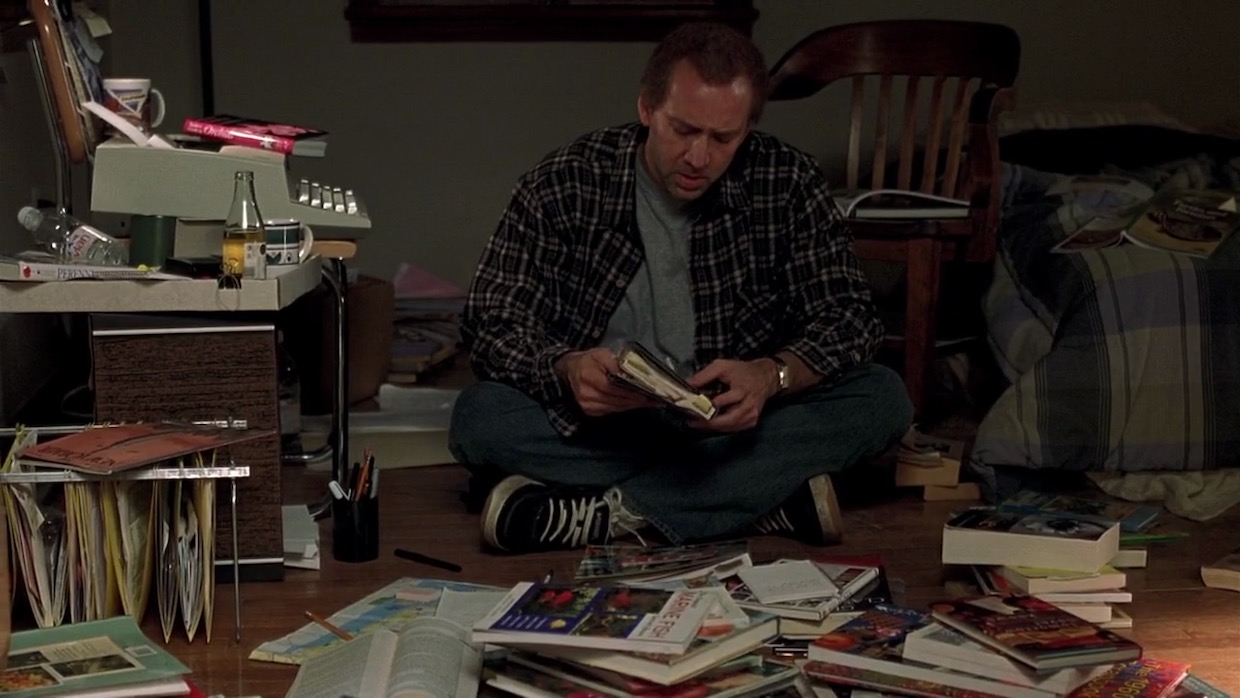
Anyway. There is exactly one movie about this, and it should never have been allowed near a studio.
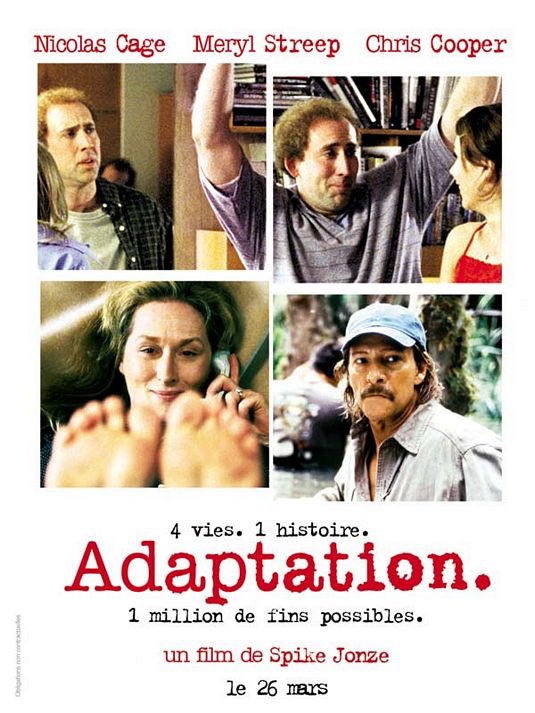
In the late nineties a screenwriter named Charlie Kaufman, who had just become famous for writing a film in which people climb through a tunnel into the head of the actor John Malkovich, was hired to adapt a book called The Orchid Thief. The book is real and lovely. It was written by Susan Orlean, and it is about a man in Florida who steals rare orchids, and about orchids, and about wanting things, and it has, as a piece of plotting, the forward momentum of a parked car. Nobody is trying to get anywhere. There is no villain, no clock, no chase. It is a wonderful book to read and an impossible book to turn into the kind of thing Nicolas Cage runs away from explosions in.
So Kaufman, unable to find the movie inside the book, wrote a movie about Charlie Kaufman being unable to find the movie inside the book. The film is two hours of a sweating, balding, romantically hopeless screenwriter failing to write the exact film you are watching. It opens inside his head while he hates himself, a setting I recognized so fast it was less like watching a film than catching my reflection in a shop window I had not realized was there. And then it gets strange.
Kaufman gives Charlie a twin brother. Donald. Donald is everything Charlie is not, which is to say Donald is happy. Donald wanders into screenwriting the way other people wander into a good parking spot, attends a weekend seminar, learns the rules, and dashes off a serial-killer thriller so dumb and so commercial that it sells for a sum of money that makes Charlie want to lie down on the floor. Donald’s big twist is that the killer, the victim, and the detective are all the same person, and when Charlie gently points out that one person cannot be in two places at once, Donald is completely unbothered, because Donald has discovered the one freedom Charlie will never have, which is not caring.
Both brothers are played by Nicolas Cage, who in another film had surgically swapped faces with John Travolta, so playing his own twin was for him practically an easy weekend. Meryl Streep is in it. A marvelous actor named Chris Cooper plays the orchid man and won an Oscar for it, a sentence I include just so you know the film is better than I am making it sound.
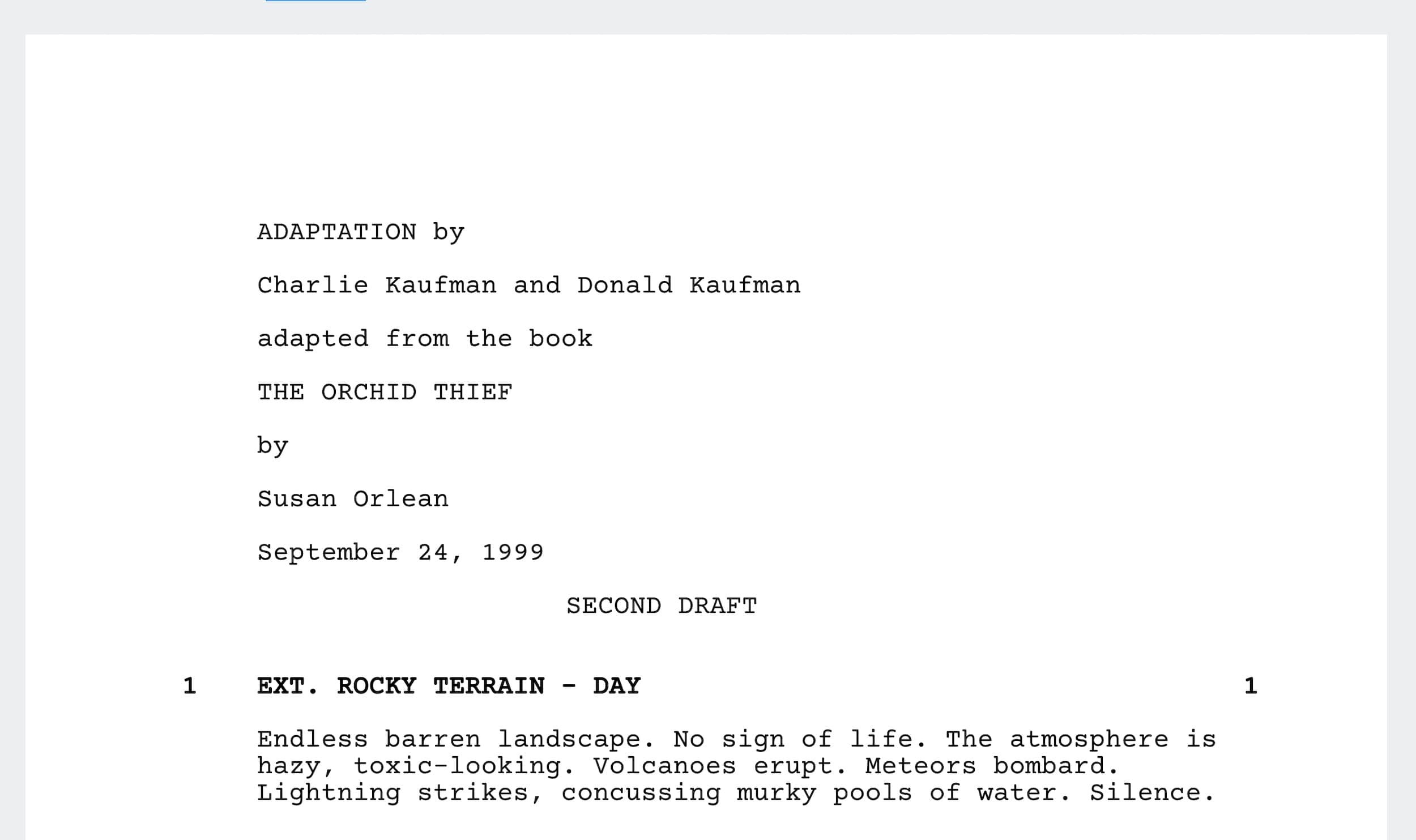
Here is the quirky part. Donald Kaufman does not exist. There is no Donald. Charlie Kaufman is an only child who invented a brother, gave him a personality, gave him worse taste, and then put his name on the screenplay, so that the credited writers of the finished movie are “Charlie Kaufman and Donald Kaufman.” And when the film was nominated for an Academy Award, the nomination went to both of them, which means a person who has never been born was nominated for an Oscar for co-writing a film about not existing.
I first saw the film around 2004, on a DVD taken from a video store called TicTac in RA Puram, Chennai. I thought it fell apart at the end. It does fall apart at the end. It took me an embarrassing number of years to understand that the falling-apart is the point, that I had watched a man burn down his own house on purpose and gone outside to complain about the smoke.
Because near the end a real person walks into the movie. Robert McKee, the most famous screenwriting teacher alive, who travels the world running a seminar on the holy architecture of structure, played by a wonderful growling actor whose name I had to look up and am not going to pretend otherwise. The drowning Charlie goes to the seminar for rescue, and McKee, on screen, roars that the one unforgivable sin, the mark of the hack, is voiceover narration. A writer who leans on voiceover, he thunders, has given up. The entire film is narrated, top to bottom, in voiceover.
Kaufman imported the high priest of structure specifically so the priest could denounce, by name, the device Kaufman was using to tell the story, while he used it. And then he does the braver thing. He takes the advice anyway. He asks McKee how to end the picture, McKee says send them out dizzy and they will forgive you everything, and the movie obediently hands itself an ending stolen straight from Donald’s garbage thriller. Drugs, a gun, a midnight chase through a swamp, an actual alligator, a death, a small moral about love beamed nearly into the lens. Every cliché Charlie spent two hours being too refined for arrives at once, like relatives, and Donald, who would have loved every second, dies in the swamp.
And it works. That is what I could not forgive at twenty-six and have come to love since. The dumb ending lands. After two hours of gorgeous paralysis the gun and the gator hit you exactly where Donald swore they would, and you leave the theater moved, and faintly humiliated by how moved you are.
The tidy reading is that the formula is the enemy, that Charlie was the artist and Donald the sellout and art beats commerce. The film will not say this. It refuses with something that looks like real grief. Donald is not the villain. Donald is the part of every person who makes anything that knows where the buttons are and feels no shame about pressing them, and the film loves him without respecting him and never resolves the contradiction, because resolving it would be a lie, and this film would rather end on an alligator than tell you a lie. The credits carry a dedication. In loving memory of Donald Kaufman. They are grieving the half of one man that knew how to finish things.
What Kaufman worked out, drowning in those orchids, is the thing I keep failing to remember about a man on hold. He could not find the story in the book because the story was never in the book. The story was him, failing to find it. The thing he was hunting for was the hunt. The orchids had no plot and were never going to grow one, and the second he stopped pretending the writer was a clean sheet of glass between the reader and the flowers, the wall turned out to have been a door the entire time.
I went back and looked at my notes on the hold music, which I had been treating as evidence, as though if I gathered enough of it the essay would assemble itself out of the pile. The phrase that means its opposite. The recorded woman on her higher plane. The menu folding back into itself like a Möbius strip designed by someone who hated you. Brandon. And I saw, finally, that there was nothing inside any of it. The hold system is genuinely empty. That is the entire design. It is built to contain no story, no person, no exit, so that you will eventually do the math and hang up, and the company keeps its money and its afternoon. I had spent a winter trying to extract a human being from a structure engineered, at considerable expense, to make sure no human being was ever there.
The man I kept imagining, the lonely one who chose the music, was the tell. I had invented him for the same reason Kaufman invented a brother. Because the alternative was unbearable, and a fiction was carrying the weight of it, and the only way to write honestly about a thing with no one inside it was to put the person back in from the outside, and the person available was me. The fifty-one minutes were never the subject. The man who lost them was. I had been on hold, in every sense the phrase can carry, and the door I kept failing to find had my own hand on the other side of it the whole time, which is a sentence I would cut from anyone else’s draft for being too pleased with itself, and am keeping in mine.
I should confess, since it has been crouching under this whole thing, that I do not fully buy my own flattering version of events. The duller possibility is that hold music had a perfectly good essay in it and I simply was not good enough to find the latch, and that draping my small ordinary failure over Charlie Kaufman’s enormous glamorous one is a way of getting my inadequacy a better seat at the table. I see it. I definitely see it, guilty as charged.
The folder is still open. The phrase is still sitting in it, meaning the opposite of what it says, the way it always has. The Girl from Ipanema is going by somewhere under a mountain, tall and tan, outliving us all. Outside the sky has gone the flat Seattle gray that isn’t really a color so much as a mood the whole city agrees to, and I have not gone for my walk. I am about to not go on it again.
Donald would have finished this two hours ago. Worse, and shorter, and you would have called it his best work.


Leave a Reply