I went for a walk last Sunday afternoon and witnessed a man in a driveway trying to summon his Hyundai Ioniq out of his garage with an app. His wife and son were on the lawn, hugging each other and laughing at him with the specific giddy energy reserved for moments when a piece of expensive technology is making a husband look foolish in front of his family. The car was backing out about half as fast as a normal car would back out, and about a quarter as fast as it would have if the man had been inside it driving it like a normal person, which is to say it was backing out at the speed of a vehicle that had agreed in principle but was reserving the right to renegotiate. The man checked his phone, then the car, then his wife, then the phone. The wife kept laughing. The kid kept watching. I have no idea whether that boy will remember any of this when he is forty. I will tell you which version of his father he will remember, though. He will remember this one. The Sunday one. The one in the driveway, looking faintly ridiculous, being laughed at by his wife. The weekday version doesn’t make it to forty. Most things don’t.
I know this because I read the New York Times Sunday Routine column compulsively and have for years, and I only recently figured out why. Let me explain the column, if you don’t know it. Every Sunday, the Times profiles some notable person, an actress, a novelist, a chef, occasionally a hedge fund manager whose Sunday begins at four in the morning and is therefore not a Sunday but a Monday other people haven’t gotten to yet, and the column tells you exactly what they do with their day off. What time they get up. What they eat. Whether they go to the farmer’s market. They go to the farmer’s market. Whether they read three newspapers. They read three newspapers. Whether they cook on their day off if their job is cooking, which several of them do, and which I think is its own essay for another day.
I don’t really want to know about these people. I have never been to a farmer’s market with the kind of intentionality the Times column describes. I do not know what it would feel like to have a routine, in the sense the column means it, which is the sense of doing something on Sundays you actually want to do as opposed to doing something on Sundays because the laundry has reached a state of constitutional crisis. And yet I read it. I read it the way some people watch British baking shows, the way some people scroll Zillow listings of houses in towns they will never move to. There was something I was looking for and I could not name it, and then a few months ago at a Trader Joe’s I caught myself doing the same thing in the dairy aisle, and the thing had a shape. It was the hand-holding.
Couples in grocery stores on Sundays do this thing. One of them reaches for the milk. The other one is holding their hand. Not in a romantic way, in a I’m-here way, in the way you hold a hand you have been holding for fifteen years and have stopped thinking about. They are moving slowly. They are obstructing the aisle. The same two people on a Wednesday would have moved through that aisle like they were being timed by a fitness app. On Sunday the milk can wait. The aisle can wait. They have, briefly, no business being efficient. Once I noticed this I started seeing it everywhere. A father in Volunteer Park pushing his daughter on a swing as though the swing were a religious observance. The same man on Monday at the espresso bar in his office building would not be making eye contact with his own barista. A guy I saw on a bench in Paris once, in the Marais, reading a newspaper at noon with the particular Parisian conviction that what he was doing was not idleness but a small civic duty. A Tokyo father in Yoyogi Park with a stroller and a tiny dog, looking like he had never seen a meeting, like meetings had been invented for someone else, and I happen to know, because I had been in Tokyo earlier that week, that this man’s commuter-train face on Tuesday morning had been carved out of granite. The Yoyogi face was something else. Softer, maybe. Less defended. I had never seen it on the man and still felt like I knew it already.
Sundays don’t slow people down. That’s what I thought at first, and I was wrong, in the way you are wrong about something when you have the right data and the wrong theory. Cities are quieter on Sundays. Traffic does thin. None of that explains the swing. Here is what is actually happening. The man on the swing is not a slower version of the man at the espresso bar. He is a different man. He lives in the same body and gets out on a different schedule. The body is one body, but the man at the espresso bar and the man at the swing are not exactly the same person, and the kid in the swing is one of approximately four people on earth who has met both of them.
The Japanese have a clinical phrase for this. Shumatsu papa. My father told me about it, sometime in the late eighties, from behind The Hindu Newspaper on a Sunday afternoon. He had read a piece about Japanese salarymen, the hours they worked, the trains they slept on, the children who saw them only on Sundays, and he relayed it to me with the slightly amused detachment of a man describing an exotic foreign practice. They have a name for it, he said. Shumatsu papa. He thought the Japanese had it worse. He was, on the evidence, mostly right; Japanese hours were longer, the trains were sadder, the absence was more fundamental. He was also, on the evidence, one of millions of Indian fathers doing essentially the same job in a different climate, and he had located himself on the comfortable end of the comparison the way most of us locate ourselves on the comfortable end of any comparison that involves the word worse. There were also, to be fair to him, no obvious alternatives. He went back to his newspaper. He never mentioned it again. We had this in Madras. We just did not have a phrase for it. We had Sunday.
Our flat was five hundred square feet. Possibly four-eighty, depending on whether you counted the small verandah where the laundry lived a more interesting life than most of us. Four of us in there. Me, my sister, my mother, and a father who worked six full days a week at a job that exhausted him in ways that, at the time, I did not have the vocabulary to understand and now have too much of it. The Sunday nap was, in our house, a constitutional requirement. After lunch. Sunday lunch was longer than weekday lunch, by maybe twenty minutes, which doesn’t sound like a lot but in a five-hundred-square-foot flat with a single ceiling fan in 1989 was the difference between a meal and a small event. My father would roll out the pai on the floor of the front room and we would all lie down. All four of us. On a single woven mat. With the doors closed and the fan mostly just moving hot air around.
My father always woke up first. I don’t know why. I have a theory now, which is that he had figured out, somewhere in his thirties, that the nap was not actually rest. The nap was the door to Sunday afternoon. Sunday afternoon was the thing he had been working six days to reach. The longer he stayed asleep, the less of it he got. So he woke up at three, or sometimes two-forty-five, and he would shake me, very gently, without waking my mother or my sister, because what he had in mind required exactly one foot soldier and not three. The errand was tea powder. There was a shop a hundred feet from our front door. Less, maybe. I could throw a cricket ball and hit it, badly. This shop, like every shop in Purasawalkam in 1989, sold tea powder by the sachet, hung on a string from the ceiling like a small garland of laundry. You did not buy a tin. Buying a tin would have been an admission that you had planned to drink tea, and tea was not planned. Coffee was the lifeline. Tea was Sunday afternoon and my father had woken up wanting it. So you bought one sachet. One sachet was enough for the family. I would run, with two rupees in my hand, possibly less, and come back with the sachet warm from being clutched. My father would already have the milk on the stove. He had not lit it yet, because he was waiting for the sachet, but the milk was on it, the way a sprinter is on the blocks.
The chai he made was Bombay chai. He had spent three years in his twenties working for a firm in Bombay that, my mother once told me, had treated him not so well, although she did not specify how. From this period of his life, he retained two things: a low-grade suspicion of all landlords, which was unjust but which I have not had the heart to relitigate, and a recipe for chai that involved a quantity of cardamom that would have alarmed a normal household. He used a lot of cardamom. He used so much cardamom that I genuinely believed, until I was twenty, that all Bombay tea contained that much cardamom, and the first time I drank Bombay tea elsewhere I assumed it was broken. He added the sugar last. He never explained this. There was also a clove in there sometimes, allegedly, but I have no memory of the clove, because the cardamom had eaten it. The dominant edition eats the minor ones. Memory is unfair to small spices.
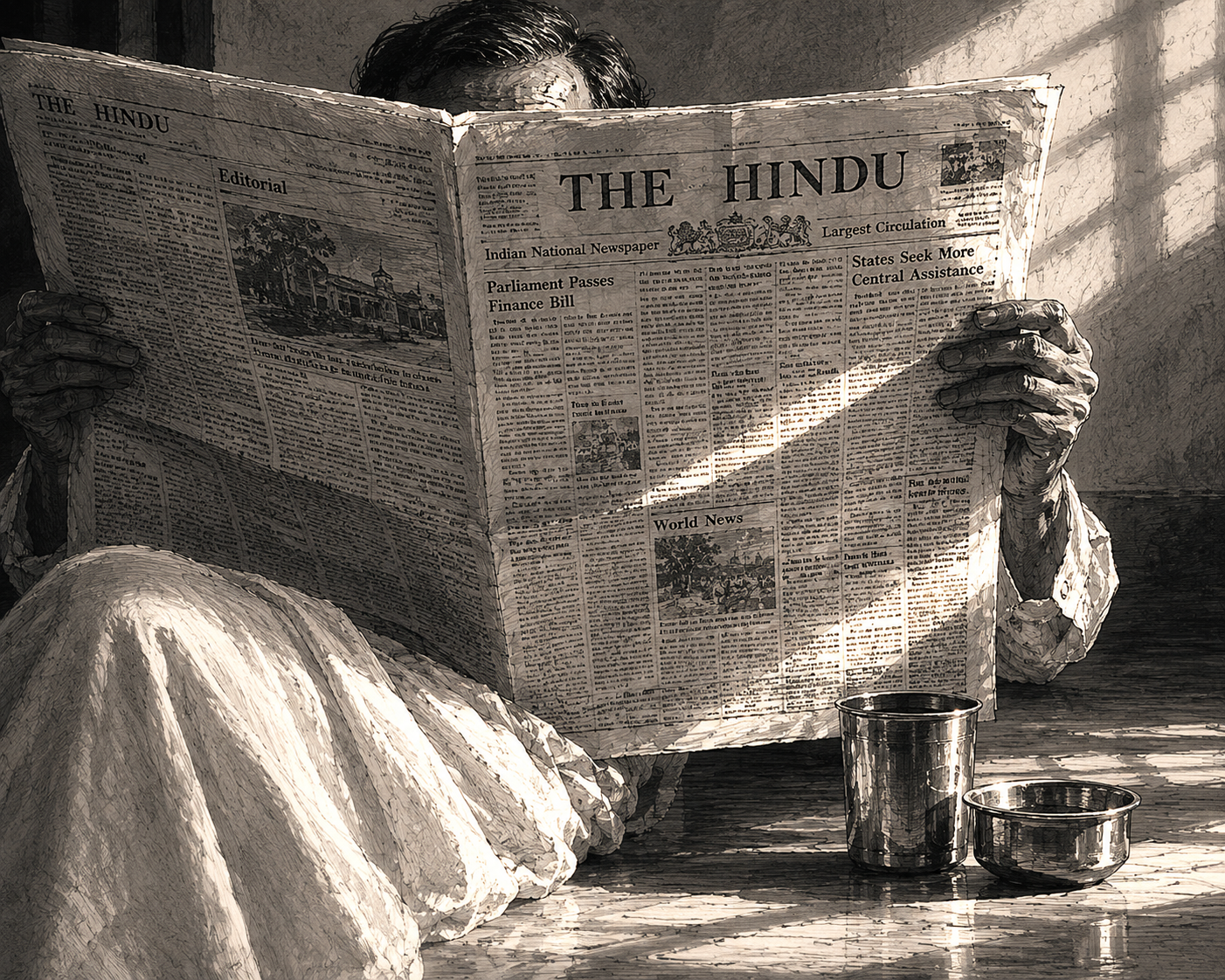
Then he would wake my mother and my sister with the chai, and he would go and read The Hindu. He read The Hindu the way men of his generation read newspapers, which is to say he opened it fully, with a wingspan of nearly five feet, and disappeared behind it for forty-five minutes. You could leave the room. You could come back. The newspaper would still be there, with two hands sticking out of the sides, and one foot, occasionally, doing a slow tap to a song he had just put on. The editorial section used to slide out onto the floor because he never folded the paper properly again after opening it the first time. My mother complained about this constantly. I think she was right. The paper occupied most of the room when fully expanded. Around four the music started. He had a Philips tape deck, and eventually a CD player that he never trusted, in the way certain people of his generation never quite trusted CDs to do what they had promised. On Sundays the same names came out, every Sunday for thirty years. S D Burman. Kishore. SPB. Asha. Some Lata although I am no longer entirely sure how much Lata; I may have added her in retrospect, because she belongs there. Some Tamil playback if he was in a particular mood. I made a playlist after he died. It is almost exactly the playlist of those Sunday afternoons in 1989. I have not added a song to it. I do not think I ever will.
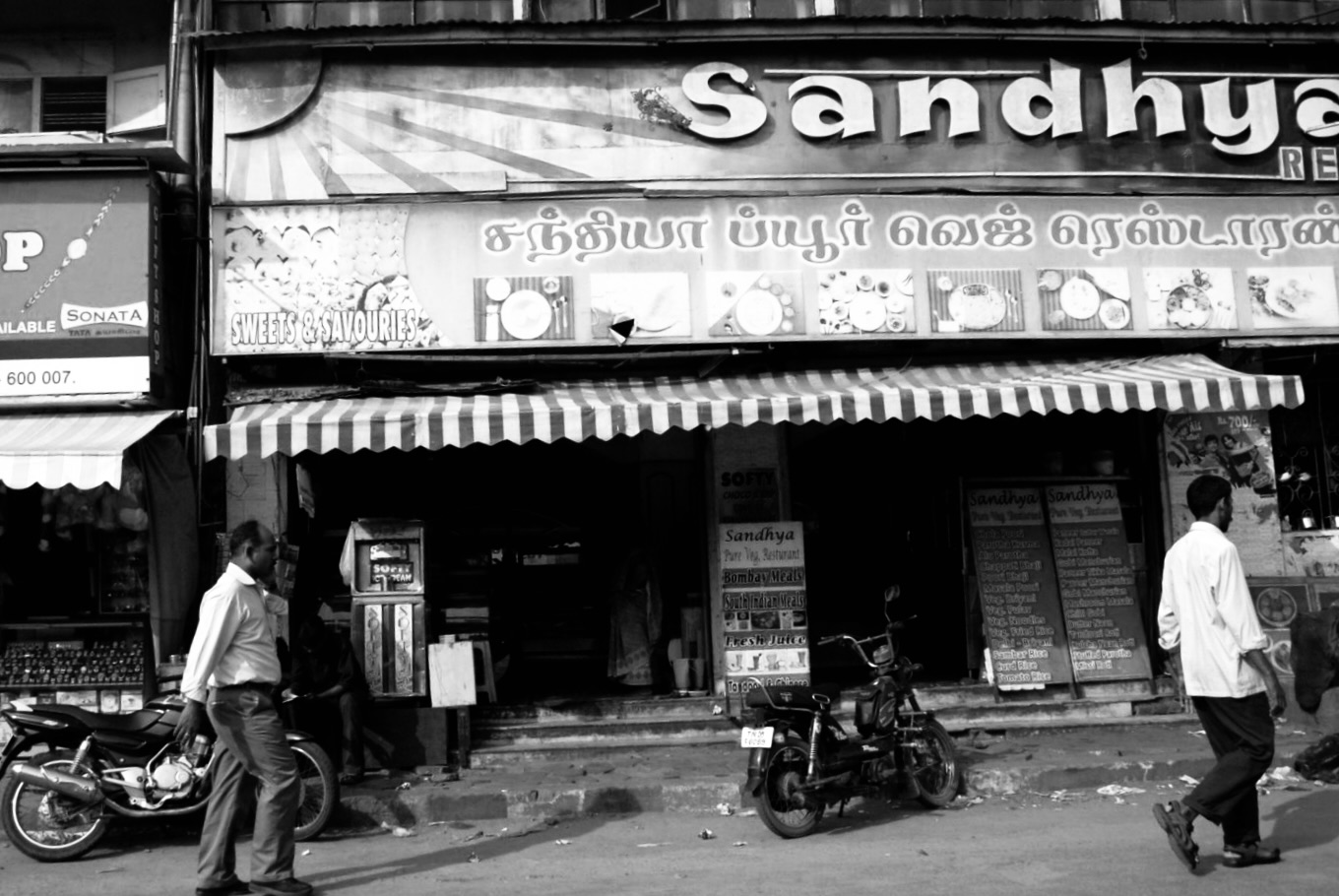
At four-thirty, give or take, he would announce that anyone who wanted to go to Sandhya Restaurant could come. My mother almost always declined, with the small pleasure of a woman who has been managing a government job and household for six days and was not going to spend her Sunday afternoon evaluating someone else’s chaat. My sister and I went every time. He would walk us, the quarter mile down Purasawalkam High Road, past the temple, past the bus stand, past a tailor’s shop with a mannequin in the window that had been wearing the same shirt since 1985, possibly 1987, the years have started to compress, and we would arrive at Sandhya Restaurant, which served North Indian food at a level of authenticity that absolutely nobody in Purasawalkam was qualified to evaluate but which we patronized with the loyalty of regulars who had decided not to know. The Sandhya tea was made in a brass vessel the size of a small bathtub. It boiled all afternoon, the way the chai at certain Indian establishments does, which is to say it had been boiling since approximately 1973 and was, by physics if not chemistry, a different substance than the tea anyone had made that morning. It was thicker than my father’s. Sweeter. Slightly oilier. My father would have a cup. Sometimes two. He would let me have one, which my mother had explicitly forbidden and which both of us understood would not be discussed when we got home. My sister usually had Chola Batura and Limca. The pav bhaji at Sandhya came on a steel plate with a small mound of chopped raw onion and a wedge of lime, and there was a slick of butter on top of the bhaji that you were supposed to stir in but never did. You scooped around it. You preserved it. You ate it last. I still do this, in my forties, in restaurants that have never heard of Purasawalkam.
He worked six days a week. Full days. I am going to say this once and then not put any sentences around it. He left before I got up. He came home after I had stopped expecting him. From Monday to Saturday, my father was a tired man who was kind, but the kindness was rationed in the way the kindness of tired adults is rationed, by people who do not have the surplus to spend. The man who made cardamom chai on Sunday afternoon was not a tired man. He hummed. He did not hum on Mondays. I knew this without having been told. Kids know.
I should admit, before going any further, that I might be making all of this up. Not the cardamom. The cardamom I will defend in any court. Not Sandhya, not the playlist, not the garland of tea sachets, not the mannequin in the shirt since 1985 or 87. Those are facts. What I am less sure about is the man. It is entirely possible that the difference I keep wanting to describe between weekday-father and Sunday-father is a difference I have constructed in retrospect, out of the fact that I only really had access to him on Sundays, and the rest of the week he was a function and not a person, and I have spent thirty years assembling a man out of those Sunday afternoons because the alternative was admitting how little I knew the weekday version. Anyway.
I don’t actually think kids experience adults as continuous people. Adults insist they are, mostly because paperwork would become impossible otherwise. What a kid gets is the recurring edition. The Sunday father. The festival father. The man who arrives at school events looking slightly uncomfortable in trousers he does not wear at home. The funeral edition, which is the one you don’t meet until you are older and which arrives, when it arrives, as an entirely new species. Kids assemble a parent out of these editions the way a paleontologist assembles a dinosaur out of bones. You get the foot. You get a vertebra. You make a guess about the rest. You don’t know, until decades later, how much of your father you were inventing. The children of shumatsu papas everywhere have always known both versions, in every country that has ever had a six-day work week and a household to come home to, which is most of them.
This, I think, is what the Sunday Routine column is doing, and why I read it. Most profile journalism captures people in their public capacity. The novelist at her desk. The CEO at her conference table. The actress in her green room. The journalist sits with the subject for two hours during work hours and reports back on the version the world is paying to see. The Sunday Routine column is the only column in the newspaper that goes to the kitchen. It goes at seven-thirty in the morning. It catches them in sweatpants, walking the dog, making pancakes for a kid who is not actually hungry. It is, exactly, what a child does. The column is doing, with strangers, what I started doing at eleven in a five-hundred-square-foot flat on Purasawalkam High Road, which is trying to figure out who someone is when they are not being asked to be useful. The rest of the newspaper has given up on telling us. The column has not. I read it on Sundays. I have noticed this only now.
Civilization built the window through which any of this is possible, and it built it everywhere. The Christian Sunday. The Jewish Sabbath. The Friday in Cairo when the father is walking his daughter home from prayer along a street where the shops have closed for the same reason they close in Purasawalkam. The market day, the festival pause. The day moves. The window doesn’t. A Cairo father on a Friday afternoon and a Madras father on a Sunday afternoon are the same man in different weather, and a Cairo kid watching her father walk back from prayer is doing the same assembly job a Madras kid was doing on Purasawalkam High Road in 1989. Nobody designed this. It accumulated. It is one of the oldest pieces of soft infrastructure humans ever built, and we have mostly forgotten it was ever specifically anything, and you can move to a country that has never looked anything like yours and find Sunday already installed, holding the window open, doing its quiet weekly work, asking nothing of you except that you show up.
I went back to Sandhya in 2019. Purasawalkam has changed. The tailor’s shop is gone. The bus stand has moved. The temple is the same temple. The brass vessel is the same vessel, or its grandchild, you cannot tell. The pav bhaji still arrives with the slick of butter on top. It was humid enough that my glasses fogged when I walked in. I stirred the butter in this time. I am older. I cannot defend the choice.
Somewhere in the world, right now, a shumatsu papa is waking his kid from a Sunday nap. He has six other days of being someone else. There is cardamom on the counter. There is milk on the stove. In ninety minutes he will be humming a song he does not hum on Mondays, and the kid will be assembling a parent out of the afternoon without knowing it. The fathers, of course, only know one. They are inside it.


Leave a comment