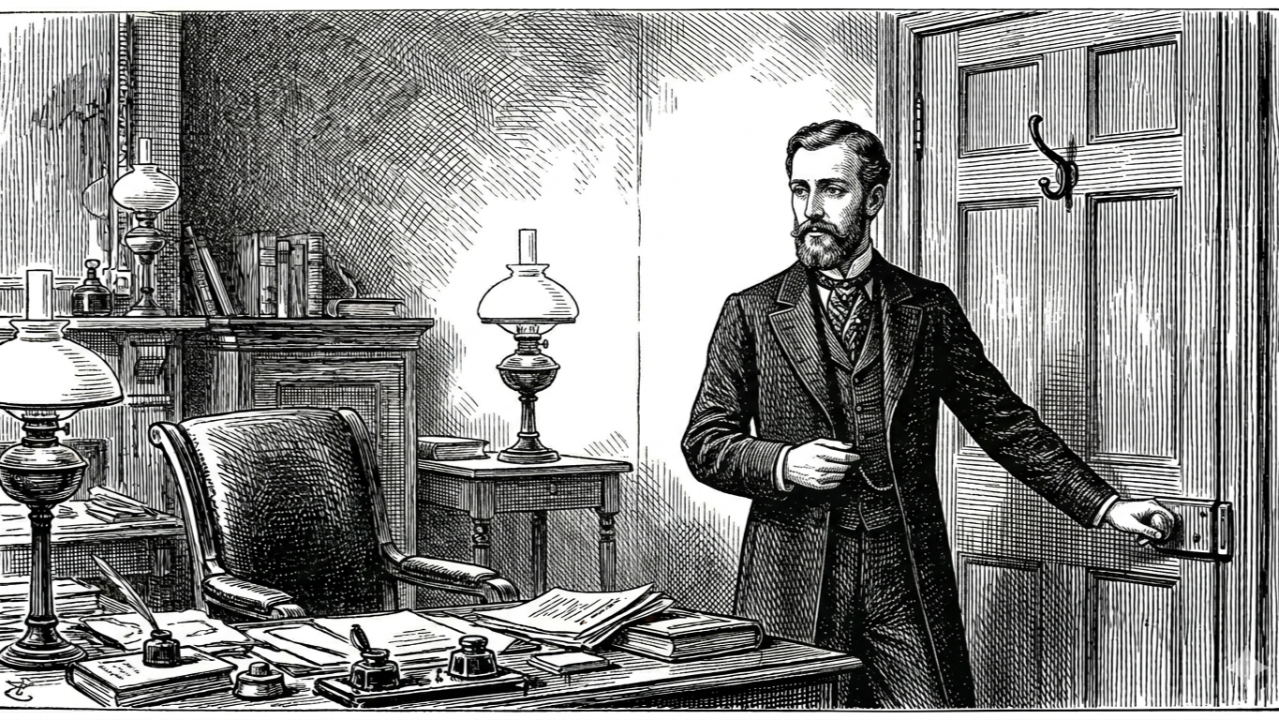
The hook was at the exact height of the average adult human skull, which is the kind of thing you only notice once.
Many years ago, I worked in an office in a downtown I will not name, in a building whose interior architectural decisions had been made by people who I can only assume were no longer available for comment. The door of my office, when closed, presented a coat hook. The coat hook was positioned, through some collaboration between the original carpenter and the laws of probability, at exactly that height. The hook itself was not the problem. The hook was, by any reasonable measure, doing exactly what hooks do, which is essentially nothing. It hung there. Coats found it. Civilization proceeded. If you were grading hooks on professional conduct, this hook would have been in the upper percentile, possibly receiving a small annual bonus.
The problem was a friend of mine. He was, and remains, one of the most animated talkers I have ever known. A man who could not deliver a piece of news, however small, without committing his entire upper body to the project. He came into my office one afternoon to tell me something I no longer remember, closed the door behind him out of habit, and leaned back against it in the way he leaned back against everything, with the full and undefended weight of a man who had never in his life considered the question of what was directly behind his head.
I saw it happen before it happened. I saw the small sequence. The lean. The contact. The pause of confusion that precedes the realization. Then a level of vocalization that suggests we have departed conversation entirely and entered a different category of human experience, one that involves forms. So I cupped the back of his head with my palm, and moved him forward by a few inches, like a piece of furniture I had suddenly developed strong opinions about. He stopped mid-sentence. He looked at me. I looked at him. We agreed, without speaking, never to discuss what had just happened, and he went on telling me whatever he had been telling me, and I went on listening, or rather pretending to listen, because the part of my brain that listens had been temporarily reassigned.
The thing I want to tell you is not that I did this. The thing I want to tell you is that I did not decide to do this. It was already happening. By the time I noticed it was happening, it had happened. Some part of me had run the entire calculation. The lean, the impact, the email I would have to send afterward. And it had dispatched my hand on a small mission of pre-emptive intervention before the rest of me had finished forming an opinion about it. He continued his story. I continued my pantomime. Nothing in the conversation acknowledged that one of us had just briefly seceded from the meeting in order to avert an injury that the other one was in no danger of sustaining.
I started noticing it everywhere. A glass tips. Your hand is already there. A child stumbles. You are crouching before you remember the verb for crouching. There is a particular genre of short video that I have come to find quietly mesmerizing. A parent walking with a toddler, and at some point the toddler does something the toddler did not warn anyone about, and the parent’s hand simply arrives, palm out, between the child and a piece of furniture that was about to teach the child a lesson nobody wanted them to learn yet. The parent keeps walking, keeps talking, keeps doing whatever the parent was doing. The hand was already there. The video is six seconds long, and you can find a thousand of them.
It is, on the whole, an extraordinarily useful arrangement. If every action required formal approval from the conscious mind, most of us would spend a great deal of time watching things fall. But it does create a peculiar hierarchy. Because once a behavior has been moved into this layer, it stops negotiating with you. The hook did not care that the person standing in front of me was telling me something that was, by any reasonable measure, more important than the structural integrity of his skull. The system had already decided. It would run. And I, the official executive of my own life, had been informed only as a courtesy.
You can see versions of this elsewhere, if you start looking. A small bird, finding a predator near its nest, will perform a strangely theatrical injury, dragging one wing as though it has just remembered a previous engagement with gravity, to lure the predator away from something smaller. An animal will position itself between danger and its young with a decisiveness that suggests this is not the first time the situation has arisen, even when, in the literal sense, it is. There is a quality to these actions that is hard to miss once you have seen it. They do not look considered. They look pre-written.
⸻
In the autumn of 1942, in Warsaw, there was a woman who was about to develop a problem that did not admit of hesitation. Her name was Irena Sendler, and she was, on paper, a social worker. The paper, as it turned out, was the useful part. Her credentials gave her permission to enter the Warsaw Ghetto on the grounds of inspecting for typhus, a disease the German occupiers were terrified of and consequently reluctant to investigate too closely themselves. The ghetto at that point contained roughly four hundred thousand people pressed into an area meant for a small fraction of that number, and among those four hundred thousand were children whose situation, in the autumn of 1942, was beginning to clarify itself in a way no one wanted to look at directly.
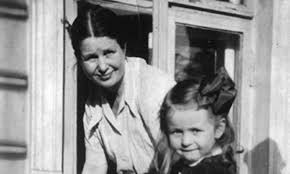
Sendler began removing them. The methods were, by the standards of any reasonable description, improvised. Children were carried out in toolboxes, which had to be the right size and which had to contain a child who had been taught, somehow, in advance, not to make a sound. Children were carried out in sacks, in suitcases, in the false bottoms of carts. Older children were walked through sewers. Infants were sedated and placed under stretchers in ambulances, beneath the legs of adults who had been instructed to look bored. A mechanic named Antoni Dabrowski drove one of the ambulances, and his dog, who had been trained for this, would bark whenever they passed an occupier’s checkpoint, loudly enough to cover any sound a sedated infant might unexpectedly produce. The dog was, I want to note, a participant in this. The dog had a job and it did the job.
Each removal would have required a decision, if the system had been built to require decisions. The cost of being caught was not ambiguous. Sendler knew this because in October 1943 she was caught, and what happened was that the Gestapo broke both her feet and both her legs and sentenced her to be shot. She was not shot, in the end. Zegota, the underground organization she worked with, bribed a guard, who added her name to the list of executed prisoners and let her escape into a country where she would have to remain in hiding for the rest of the war.
If Sendler had been operating on a model where each child required fresh deliberation, the system would have collapsed under the accuracy of its own arithmetic. The risks were too large. The cost of being caught was too clear. Any honest internal accounting, performed in real time, in the moment, with full information, would have produced a number of children significantly closer to zero than to two and a half thousand. Two and a half thousand is the number of children Sendler and her network removed from the Warsaw Ghetto.
She wrote their names down. She wrote their real names, and the names they had been given for their new identities, and the addresses of the families and convents and orphanages where they had been placed, on small pieces of cigarette paper. She rolled the papers up. She placed them in glass jars. She buried the jars in the garden of a friend’s house at 9 Lekarska Street, beneath an apple tree, because she believed, correctly, as it turned out, that if she did not survive the war, someone would need to know who these children had been, in order to give them back to whatever was left of their families when whatever was left of their families came looking. She kept going. She kept going through 1942, through 1943, through her own arrest, through everything that should have been a stopping point and was not.
And here is the thing that I want to say carefully, because I think it is the thing that is usually missed about her, and about the very small number of people in any given catastrophe who behave the way she did.
They were not her children.
⸻
There is a temptation, when encountering a story like this, to reach for words like courage, or sacrifice, or goodness. Those words are accurate as far as they go. They are also, in a particular way, a little lazy, because they describe the behavior as if it were something chosen each time, weighed each time, decided each time, by a person standing at a moral fork in the road with the leisure to think about it. What you are actually looking at is something else. You are looking at a system that does not wait to be chosen.
The bravery is not absent. It has been moved. It happened once, somewhere earlier, in a decision that the woman walking back through the gate with an empty toolbox no longer has to make. Some commitments, made deeply enough and early enough, get moved out of the part of the mind that deliberates and into the part of the mind that simply runs. They stop being decisions. They become behaviors. And behaviors, unlike decisions, do not require the person performing them to be brave at the moment of performance. They require the person performing them to have been brave once, long ago, at the moment of installation.
This is, structurally, the same thing that was happening with the coat hook. Just so I’m clear, I am aware of the size of this comparison and I am not trying to flatten it. The hook is small. Sendler is not. But the mechanism, the thing where the body moves before the deliberating mind has been consulted, the thing where some category of event has been placed on a list of events that are not allowed to occur, is the same mechanism. The hand that moves to catch the back of a head that was not actually going to be injured is operating on the same wiring as the hand that moves to lift a child into a toolbox. The only difference is what has been pre-committed, and how deeply, and at what cost.
Most of what we admire in other people, when we look closely, turns out not to be a series of admirable choices. It turns out to be a single choice, made once, that has been moved so far upstream of the moment of action that it no longer feels like a choice at all. It feels like temperament. It feels like instinct. It feels, to the person doing it, like nothing in particular. The instinct that lifts a child who is not yours into a toolbox is not, technically speaking, an instinct. It was installed. Somebody installed it. Somebody decided, at some point, possibly without knowing they were deciding, that certain categories of event were not going to be allowed to unfold in their presence if they could help it. And then they stopped having to decide.
This is the part of the story we usually skip, because it is harder to celebrate than courage. Courage is a moment. This is an architecture. Courage gets a medal. This gets a coat hook, and a hand that moves before the rest of you has been informed.
⸻
Most of the time, nothing happens. Which is, when you think about it, the entire point. The system exists so that nothing happens. The visible outcome of a working pre-commitment is the absence of an event. No one notices it, because there is nothing to notice. The injury that didn’t occur, the child who lived, the head that didn’t meet the hook, these all share the same characteristic, which is that they do not show up in any account of the day. They show up only in the negative space, in the things that should have happened and didn’t, because somewhere upstream a decision was made once so it would not have to be made again.
We don’t decide to move. We move.


Leave a comment