People are forever telling you to stop and smell the flowers, which is a lovely instruction and, I have come to believe, a slightly dishonest one. Because the trouble is not that you don’t stop. The trouble is that if you stop every day, at the same flowers, on the same walk, with the same expression of mild appreciation on your face, then within about three weeks you will be walking past those flowers without smelling anything at all. You will have invented, through the sheer force of repetition, an odorless flower. The flowers will be fine. You will have become the problem. This bothered me for a while before I understood what I was actually looking at.
Here is the version I think about more often. You drive home from work. You pull into the driveway, turn off the engine, and sit there for a second with the keys in your hand, and you realize, with the faint uneasiness of someone who has misplaced a small but important object, that you have no memory of the last twenty minutes. You took a highway. You changed lanes. You stopped at lights. You made decisions, presumably sensible ones, because you are here and not in a ditch. But the drive itself has vanished. It was happening. You were not. What unsettles me about this isn’t the safety question, which is its own separate anxiety. It’s the metaphysical shrug of it. You did everything correctly. You just didn’t experience it.
This is habituation. I don’t want to over-explain it, because the feeling of it is more interesting than the mechanism. But the rough shape is this: the brain is not a camera. It is not trying to record your life. It is trying to keep you alive and upright and reasonably efficient, and one of the ways it does that is by quietly declining to report anything it has already reported enough times. The first time your hallway clock ticks, you hear it. By the third week, you couldn’t tell me if the batteries were in.
A signal that doesn’t change stops being delivered. Because it’s been accounted for.
It is worth pausing here, before we get to the cost, to be fair to the filter, because the filter is doing extraordinary work and almost no one thanks it. Imagine the alternative, a nervous system that insisted on re-experiencing the waistband of your jeans every eight seconds, forever. You would not be a writer or a parent or a functional adult; you would be a person lying on a floor, overwhelmed by fabric.
Now consider the actual life most people are running. A demanding job, a small child, twenty open browser tabs that have been open since March, a parent who is getting older, a phone that will not stop. The filter is not a luxury in that life. The filter is the only reason you can hold a conversation while loading the dishwasher while remembering that the permission slip is due Thursday. Strip it out and you don’t become a more spiritual person. You become a person who cannot complete a sentence. The filter is what lets you carry the load. The cost is everything inside the load that wasn’t urgent.
The street you live on is, objectively, a remarkable thing, a long, strange arrangement of brick and light and other people’s lives, and you have almost certainly stopped seeing it. The coffee shop on the corner has a particular smell in the morning, slightly burnt, slightly sweet, and you registered it maybe forty times and then the registration quietly ended. The friend you’ve known for nine years has a specific way of pausing before she says something she actually means, and you used to notice. The route to your office passes a building with an absurd decorative molding that a person once stood on scaffolding to carve, and you go by it twice a day, and you could not, under oath, describe it. None of this is a moral failure. It is the filter doing exactly what the filter is for. But it’s worth naming what has happened. Familiarity is not knowing more. It is noticing less.
Which brings us to the most common misdiagnosis in modern adult life.
A great many people, somewhere in their thirties or forties, look around at a perfectly reasonable life, partner, work, home, friends, the whole arrangement they spent fifteen years assembling, and conclude that something is quietly wrong with it. The food is boring. The weekends repeat. The partner has become a kind of ambient presence, like the refrigerator. The conclusion they reach, almost always, is that the life is the problem. So they book a flight, or they take up a hobby with theatrical enthusiasm, or, in the more dramatic cases, they make a much larger change involving a lawyer. But the life isn’t necessarily the problem. The reporting is the problem.
Travel, in this light, is what people do when they have noticed they have stopped noticing. You get on a plane and thirteen hours later you are in a city where the traffic lights are the wrong color and the bread is differently shaped, and suddenly, gloriously, you are present again. Every sign is information. Every meal is an event. You take a photograph of a bus stop. You have not taken a photograph of a bus stop in your own city in twenty years, and there is no reason to think your own bus stops are less photogenic. You have simply stopped being able to see them.
I say this with no hostility toward travel. I love travel. But it’s worth being honest about what it’s doing. We go elsewhere to feel what we stopped feeling. The world didn’t become more interesting. It stopped being filtered. This is also, I think, the secret engine behind a great many small domestic rituals that people perform without quite knowing why.
Date night. The new restaurant on a Tuesday. The partner who puts on an outfit you haven’t seen before and walks into the kitchen and is, for a startled second, a stranger. The weekend away. The class you signed up for together that neither of you really needed. None of these things, technically, gives you more time with the person you live with. You already had the time. What they give you is a brief, deliberate disabling of the filter, a small disturbance large enough that the system, briefly, starts reporting again. The person re-emerges. The conversation is interesting in a way that last Tuesday’s conversation, which was probably about exactly the same things, was not.
This is also, incidentally, why the rituals stop working if you do them too often. A weekly date night, performed with sufficient discipline, will eventually become as invisible as the dishwasher. The reset becomes the routine. You can’t fix habituation by habituating to your fix. A varied life is not a more virtuous life. It is just a life the filter has a harder time settling on.
And this raises a question that I find genuinely interesting, because it pokes at something structural rather than personal. If novelty works by changing the world around you, what do you do if you can’t change the world around you? What about the people who didn’t get to travel, who didn’t have a career of motion, who lived, as most humans who have ever lived have lived, in more or less the same place, among more or less the same people, for more or less their entire lives? Were they just numb?
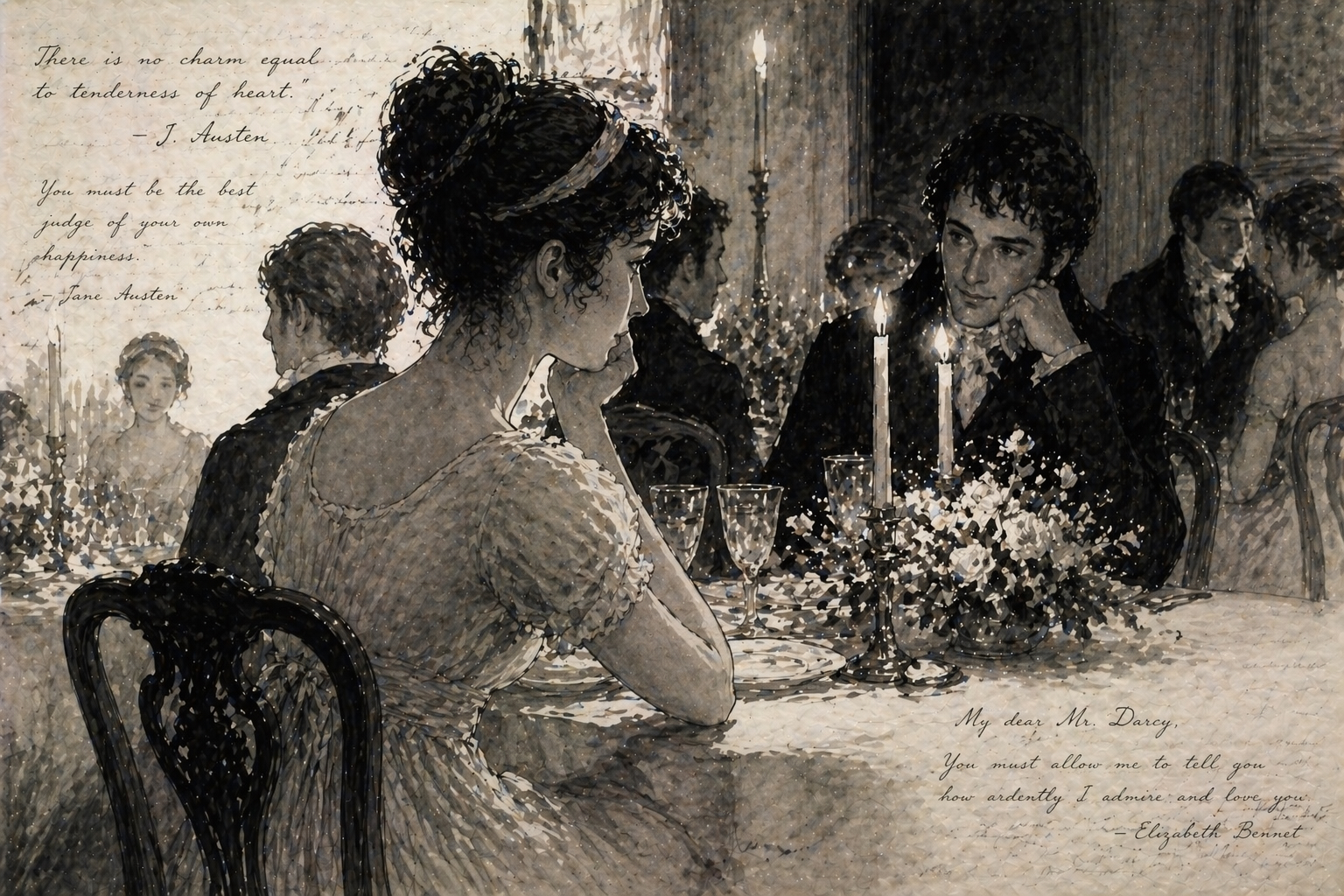
Consider Jane Austen. Austen spent most of her writing life within a small handful of English parishes, Steventon, where she was born, and Chawton, the cottage in Hampshire where she completed or revised nearly all of the novels we still read. The geography of her adult life would fit, comfortably, inside a single modern commute. Her social world was made of rectories and drawing rooms and the same several dozen families showing up at the same several dozen dinners. And out of this, out of a radius most of us would consider a kind of soft imprisonment, she produced Pride and Prejudice, Emma, Mansfield Park, Sense and Sensibility, Persuasion. A body of work that is still, two centuries later, funnier and sharper about human beings than almost anything else in the language.
She did not do this by traveling. She did it by refusing to let the filter win. She knew, with what reads now as something close to mischief, exactly what she was doing. In a letter to her nephew in 1816, the last birthday before her death, she described her own writing, half-modestly, half not, as “the little bit (two Inches wide) of Ivory on which I work with so fine a Brush, as produces little effect after much labour.” The line is usually read as humility. I think it is closer to a thesis. The two inches were not a limitation she was apologizing for. The two inches were the medium. The whole point was what you could do inside them.
Read her novels carefully and what you notice is not the size of her world but the resolution of it. She can separate two sisters who, to a casual observer, are the same sort of person, and show you precisely how they are not. She can distinguish between a man who is vain and a man who is merely shy in a way that looks like vanity. She can hear the difference between two kinds of silence at a dinner table. Emma is essentially one village, one season, and a misreading of three or four people, and it is inexhaustible. The books last because they were never about scope. They were about attention, applied with such patience that it begins to look like a moral position. She didn’t need new places. She needed finer distinctions. The same drawing room, visited with a sharper eye, contains more than most continents.
Contrast this, briefly, with Anthony Bourdain, who represents the other strategy and represents it beautifully. Bourdain’s method was motion. He kept moving, country to country, kitchen to kitchen, market to market, because motion was how he kept the world legible. When a place started to settle into familiarity, he left. His curiosity was real and his attention was ferocious, but the engine of it was change. Strip away the travel and it is not obvious the method would still work.
Two people, same problem, opposite solutions. One changed the world to keep seeing. One changed how she saw the world. Most of us, I suspect, aren’t going to become either of them. But it’s useful to notice that those are the two available moves.
Children, famously, do not have this problem yet, and this is often romanticized into something it isn’t. Children are not wiser than adults. They are not more spiritually awake. Their filters are simply not finished installing. A four-year-old can spend eleven minutes examining a beetle because, to a four-year-old, a beetle has not yet been sorted into the mental folder marked beetle, seen, filed. Give it a few years. The folder closes. The beetle becomes a category, and the category becomes a shrug. Curiosity, looked at this way, is not quite the noble trait we market it as. Curiosity is not a trait. It is delayed habituation. Which is not a reason to think less of it. It is a reason to think about it more carefully.
Zoom out far enough and the same machinery is running everywhere. The filter is why you can drive. The filter is why you can work. The filter is why your street doesn’t astonish you and why your partner can enter a room without your heart rate changing and why the taste of your usual coffee is no longer, strictly speaking, a taste so much as a confirmation. It is the price of competence. It is the price of calm. It is the price of being able to think about anything at all. The same system that lets you live is the system that makes you stop seeing.
You can’t turn it off. You probably shouldn’t want to. A person without habituation is not a mystic; a person without habituation is a person who cannot cross a street. But it’s worth knowing that it’s running. It’s worth knowing that most of what you call your life is being quietly edited before it reaches you.
Which brings us back, as these things tend to, to the drive home. Nothing about the drive is going to change. The road is the road. The lights are the lights. The route is the route you’ve taken a thousand times and will take a thousand more. The flowers on the walk are not going to learn a new smell. Your partner is not going to become a stranger. Your life is not, by any external measure, going to become more interesting than it already, secretly, is.
But the filter is a filter. It is not the world. Nothing disappeared. It just stopped being reported.


Leave a Reply