[For continuity, you may consult part 1, part 2 , and part 3. But like most sequels, they mainly prove that the hero is bad at learning lessons and even worse at reading books.]
“À Paris, monsieur, tout est chef-d’œuvre.”
(In Paris, monsieur, everything is a masterpiece.)
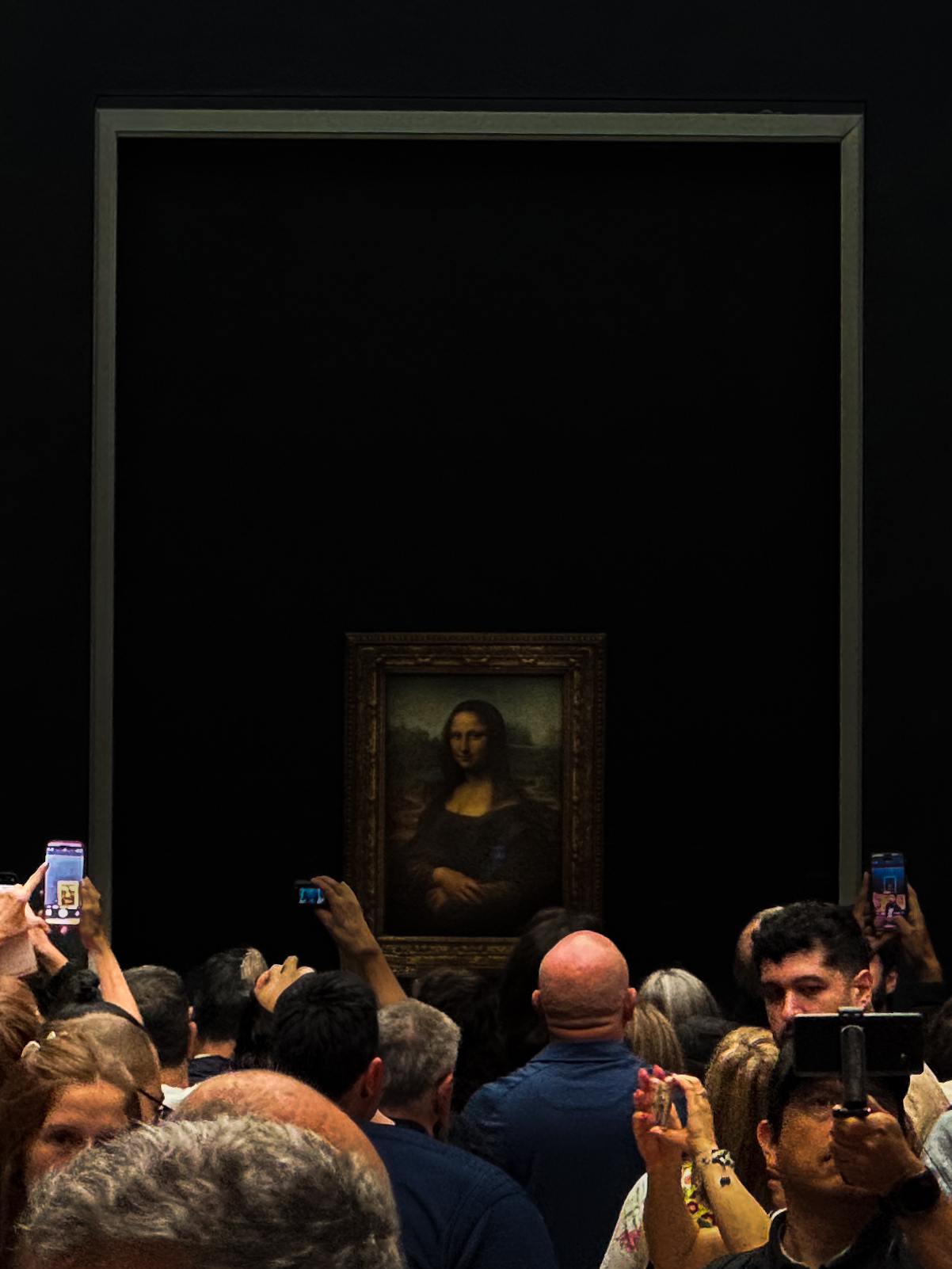
The tour guide’s voice rose above the static of elbows, backpacks, and camera shutters, rolled through the high-vaulted room delivered by a man who had repeated it nine times already that morning. The Good Reader turned, puzzled, and found a riot: at least three hundred people, and three hundred and five glowing screens, all raised aloft in a trembling forest of glass. Every angle of Mona Lisa was being harvested in real time pixelated, filtered, archived before breakfast.
Some faced her directly. Others turned their backs, holding phones in front of their grinning faces, reducing Leonardo’s enigma to a blurred wallpaper behind their own teeth. One woman rehearsed a TikTok dance, pivoting on sneakered heels while Mona Lisa’s half-smile photobombed her hips. A man wielded a selfie stick so long it nearly clipped the gallery lights; another filmed a vertical Reel with breathless commentary: “Here she is, guys, the most famous smile in the world!” The smile, meanwhile, held steady, inscrutable, timeless, unbothered. Our own inscrutable Good Reader, baffled, thought: But who here is looking? Was she smiling for Leonardo in 1503, or for the ten millionth iPhone in 2025? Was her mystery meant for kings and popes, or for TikTok’s algorithm, where she now looped endlessly between recipes and cat videos?
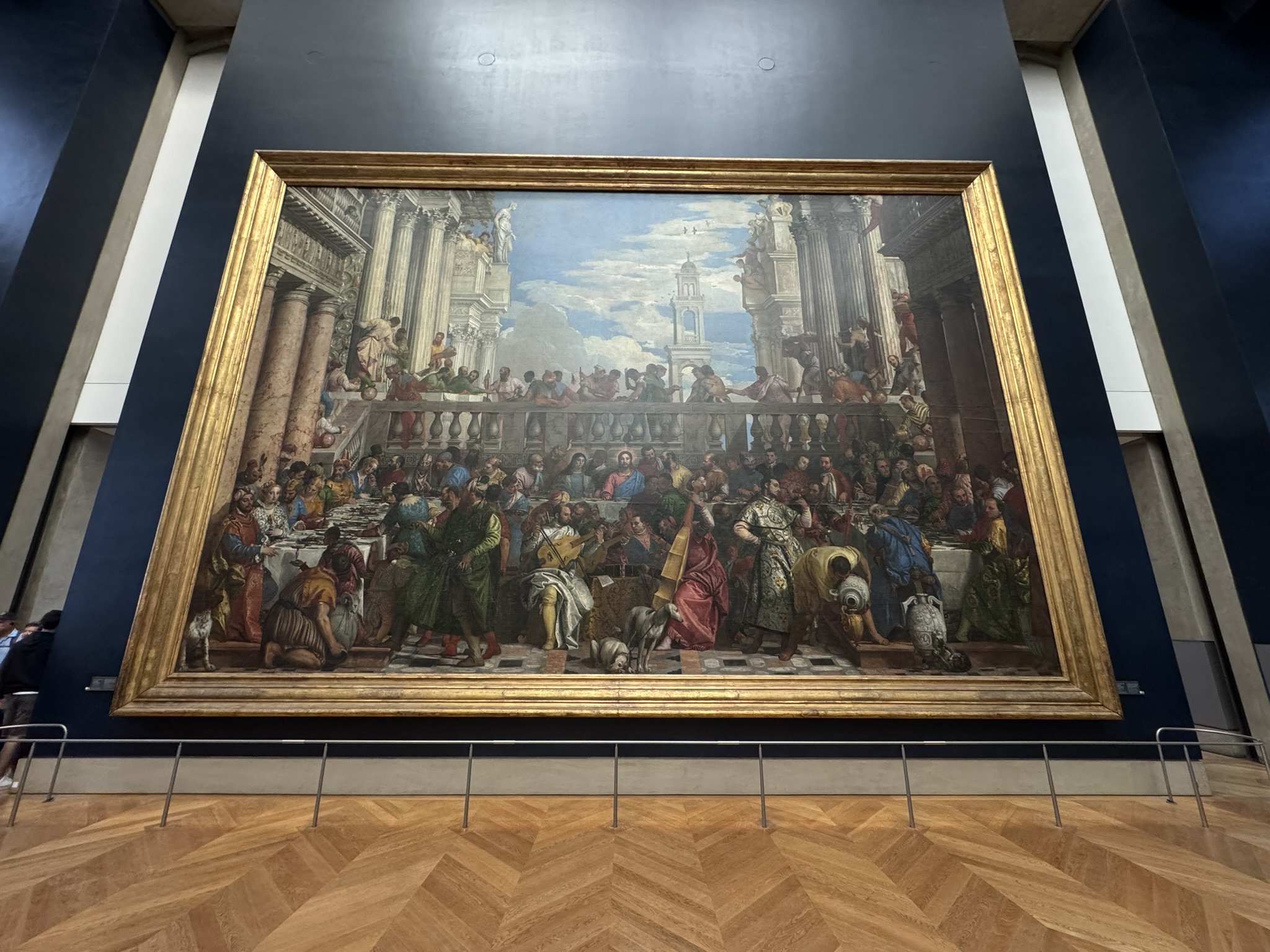
And directly opposite her, ignored, abandoned, was a miracle of another scale: Paolo Veronese’s painting named Wedding at Cana, a canvas so large it could double as a cinema screen in 70mm glory. It thundered across the wall with wine, music, robes and silver platters. It was a carnival of faces, a riot of color. Yet nobody looked. The Good Reader, still carrying the strange calm from the Eiffel Tower’s blaze the night before, felt it like a residue in his chest. While everyone pressed forward toward the ropes, he did the opposite: he lowered himself, cross-legged, onto the cold marble floor. Gasps. Side-eyes. Someone whispered “yoga?” But he was oblivious to the gasps around him. He was engrossed in the two-dimensional wedding. He tilted his gaze upward, scanning Veronese’s banquet inch by inch. Left to right. Top to bottom. From the musicians strumming on the balcony to the miracle unfolding in goblets below. He tried to absorb every face, every robe, every brushstroke.
Behind him, the tour guide launched into the Mona Lisa’s theft of 1911, her insurance value, her smile’s eternal enigma. But the voice thinned, muffled, drowned in the sheer flood of Veronese. The group surged forward without him. And the Good Reader, absurd, comic, reverent, remained behind, the only man in Paris who had come to the Louvre and sat cross-legged before the masterpiece nobody else had time to see.
That morning had begun in Saint-Germain, in a hotel whose name promised intellectual grandeur, La Villa des Artistes (Villas for the artists), but whose Wi-Fi coughed like an asthmatic. The Good Reader rose with the conviction of a man about to make history. Not the greatest of all time, not the GOAT, that was taken by goats and tennis players, but something rarer: the GREA-T, the Greatest Reader of All Time. A man destined to shoulder the unread world. He reached into his pile of twelve still-pristine companions and pulled forth the heaviest of them all: David Foster Wallace’s Infinite Jest, thick as a paving stone, its spine groaning under the weight of footnotes nobody had ever finished. And because Paris demanded costume, he briefly considered the full disguise: a beret, tilted rakishly, cigarette dangling at the angle of genius. For thirty long seconds he even pictured himself with ash trembling and smoke curling. But the fear of actually having to inhale defeated him. He chose the safer armor: a tote bag with printed Mona Lisa holding a baguette, earnest shoes, unread book.
The walk through Saint-Germain was expensive in every sense. Each cafe charged five euros for an espresso. Every boutique window displayed scarves that cost more than his flight. On the way was the shrine: Shakespeare and Company, the nostalgic book store of Paris. Its crooked green façade was already besieged by tourists, queuing for selfies. He wanted, desperately, the iconic shot, arms spread, hugging the very place where Sylvia Beach first gave James Joyce’s Ulysses to the world. But he hesitated. Who could he hand his phone to? Was there a trustworthy face among the selfie sticks? Would he, like last night, lose everything to theft, this time by an Instagrammer in yoga pants? So he compromised. He touched the glass window, palm flat, as though paying homage to a saint. He whispered something absurdly solemn, “Thank you, Sylvia,” then turned, and began his long march toward the Louvre.
Outside the Louvre pyramid, just as he was wondering whether to brave the queue or surrender entirely, a man with a red flag appeared like a Parisian prophet. His voice was theatrical, trained for echo: “Skip the line, monsieur! The fastest, the best, the only way to see the Louvre in under three hours!” He rattled off the itinerary: Mona Lisa, Venus de Milo, Winged Victory, The Raft of the Medusa. “All the great hits, monsieur, all the masterpieces!” The Good Reader, weak before conviction, nodded gravely. He tapped his digital wallet, paid the fee, and clutched the receipt with the dignity of a pilgrim buying indulgences. For this, he had purchased speed, access, and the official Louvre canon, the curated list of masterpieces for the impatient.
And yet, not twenty minutes later, he found himself cross-legged on the cold marble of the Mona Lisa room, staring not at Leonardo’s half-smile but at Veronese’s thunderous Wedding at Cana. Abandoned by his tour group, the Good Reader rose slowly from the marble, knees creaking. The crowd surged toward the greatest hits, and he, half-devout and half-deflated, followed a different scent: pastry. For even the Louvre had a cafe, and in that cafe he discovered the closest thing Paris had to fast food. He got himself a single almond croissant. He bit. And the heavens tilted. Buttery flakes clung to his lips, sugar scattered like divine dandruff onto his tote bag, the almond paste pressed against his tongue that he nearly wept. For ten seconds he forgot Da Vinci. If the guide’s proclamation was true “In Paris, everything is a masterpiece,” then surely this croissant deserved a wall of its own, a gilt frame, a velvet rope, and five million tourists lifting their phones to record its crumb. Wiping sugar from his face, he decided: Very well. If everything is a masterpiece, then I must read among the masterpieces. Among the greats. Among the saints of paint and pigment. He straightened his tote bag, clutched his relic of a book, and set off.
First stop: Venus de Milo. She was magnificent, pale and poised, her armless calm was graceful. But her gallery was more scrum than sanctuary. Elbows jostled, cameras flashed, teenagers practiced duck-lips beside her torso. Venus remained serene; the Good Reader did not. There was no space to sit and no silence. So he moved on, deeper into the Louvre’s arteries, seeking what all failed readers eventually seek, an empty chair and a little peace.
What followed was less pilgrimage and more slapstick. He drifted through the Louvre’s wings asking strangers in English, who replied in French, to which he nodded gravely, as though he had understood. Security guards gestured down corridors with authoritative sweeps of the arm, and every time he followed their directions, he arrived at yet another scrum: Venus again, Victory again, The Raft of the Medusa mobbed with backpacks, David’s Coronation of Napoleon. The masterpieces were everywhere, but peace was nowhere.
And as he shuffled in and out of these crowded chapels of art, the thought came to him, foolish and profound in equal measure: If everything in Paris is a masterpiece, why do people only look at some of them? Are there better masterpieces than the other masterpieces? But of course, they weren’t even looking. Not really. They were capturing. Every face turned not to Venus, not to Mona Lisa, but to their own phones. People didn’t want to see art; they wanted to see themselves near art. It puzzled him deeply, absurdly. If you stood in front of a canvas the size of a house and reduced it to a smudge on your phone, had you seen it? Or had you only managed to shrink the miracle into wallpaper for your lock screen? What was the point of flying across an ocean only to walk away with a thumbnail? Why not stand six inches closer and see the brushstroke itself and the tremor of a wrist from centuries ago. Would these painters and sculptors, if resurrected, thank the tourists for pixelating their life’s work into a 6.1-inch rectangle? Would Liberty Leading the People still look revolutionary if she was paused mid-swipe between a cat video and a Zara coupon? The Good Reader, who had failed to read anything all summer, now interrogated the world like a philosopher king. And yet his tone, even in his own head, was hopelessly foolish. He sighed, baffled by modernity, baffled by himself. And so, abandoning both the guards and the crowds, he decided at last to trust instinct, which in his case meant walking until he was lost.
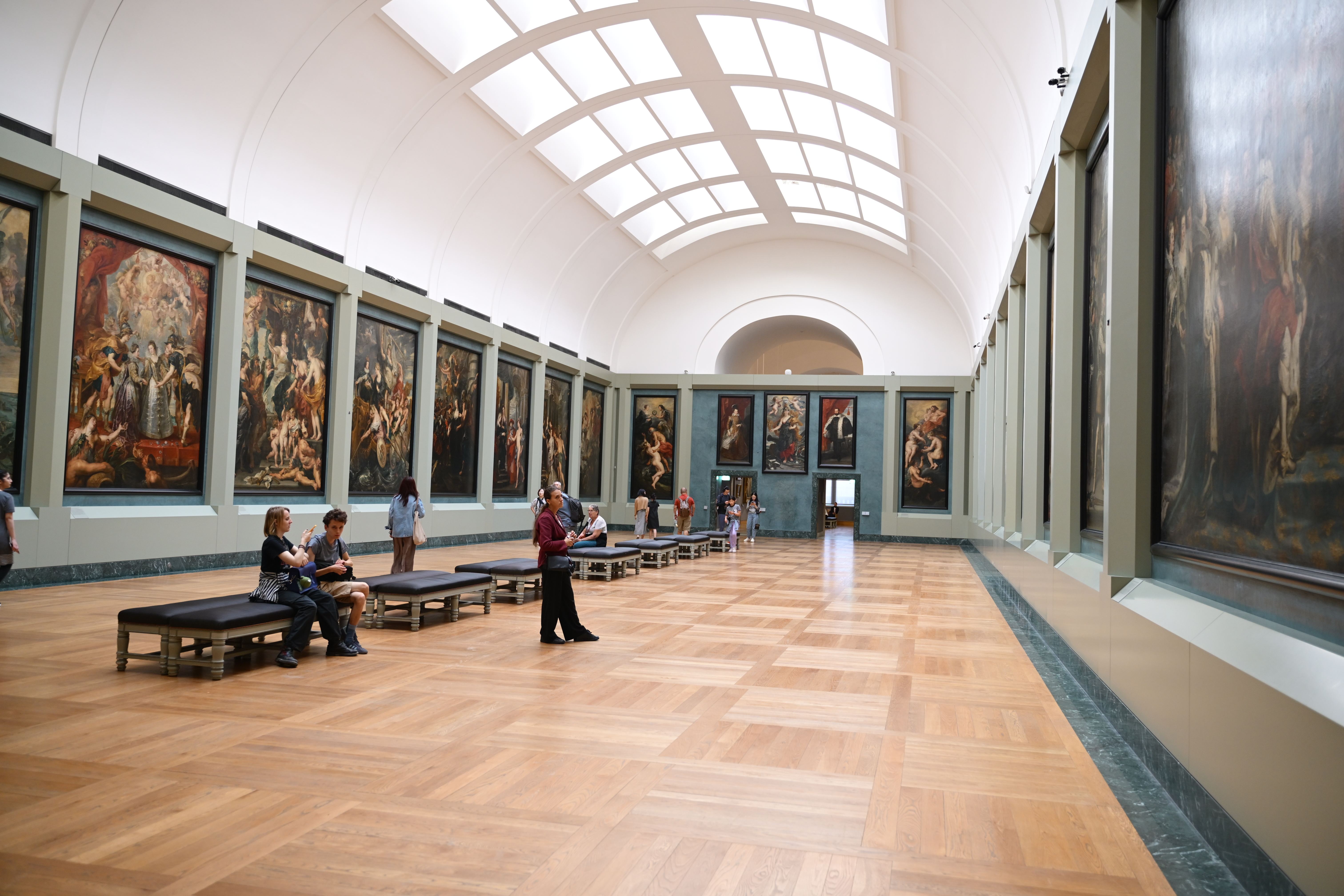
And then, like a miracle of misdirection, he stumbled into the Rubens gallery. On both sides towered were artist Rubens vast canvases, twenty-four in all, a Technicolor soap opera in oil narrating the life and scandals of Marie de’ Medici, the queen of France. Here she was, being married off to Henry IV as if Olympus itself had arranged the match. There she was, crowned, triumphant, every inch of her history swollen into allegory, packed with clouds, gods, cherubs (chubby, winged infants), battle smoke, and improbably muscular horses. It was less history than binge television, a seventeenth-century miniseries painted at wall size.
The gallery was nearly empty, only a few tourists drifting like bored extras at the far end. At the center stood some benches, stranded between canvases, facing everything and nothing at once. The Good Reader approached one of them as if it were a throne reserved for him. He sat. He wriggled. The bench was stiff, indifferent, a punishment slab. After one minute he conceded defeat, slid off, lowered himself cross-legged onto the parquet floor beside it.
He balanced the book, Infinite Jest on his lap as though it were both relic and weapon, the fattest volume in his possession, chosen that morning for its sheer gravitational pull. To attempt reading David Foster Wallace in the Rubens Room was like attempting to memorize the Mahabharata during a Superstar movie: theoretically noble, practically deranged. For Wallace was no ordinary novelist. He was the bandanaed prophet of excess, the man who believed sentences could stretch like suspension bridges and footnotes could metastasize into entire ecosystems. Infinite Jest was his cathedral, not merely a book but a continent, a twelve-hundred-page carnival of tennis academies and halfway houses, stitched together with digressions so long they became novels within novels.
He cracked Infinite Jest and read aloud, softly, almost reverently: “I am seated in an office, surrounded by heads and bodies. My posture is consciously congruent to the shape of my hard chair.” He blinked. He, too, was seated, not in a hard chair but cross-legged on parquet, and yes, he too was surrounded by heads and bodies. His eyes drifted from line five of Wallace to the painting in from him, The Apotheosis of Henry IV and the Proclamation of the Regency of Marie de’ Medici, a hurricane of clouds, horses, courtiers, and immortals.
The Good Reader froze, cross-legged, but then something absurd happened. As if Wallace himself had granted him footnote propulsion, his body began to creep forward, still folded in yogic posture, book clutched. Inch by inch he glided across the floor as a clay-mation pilgrim. To the casual onlooker the gallery appeared still; only if you squinted could you see it, the benches, the skylight, the whole room fixed in place, while the Good Reader inched closer and closer, as though the painting had switched on its own gravity.
The figures inside the canvas seemed to notice. A courtesan tilted her painted head. A cherub raised a finger. A horse rolled an eye as if to say, At last, someone is watching. Even Marie herself appeared to bend her painted gaze toward this man in sneakers creeping across the floor like an offering. He tried to look back down at Wallace, but the words blurred, footnotes dissolving into the painting’s flesh-colored clouds. It was no longer clear whether Infinite Jest was dragging him toward the painting, or the painting was pulling Infinite Jest toward itself. Either way, book, reader, and masterpiece edged steadily nearer, until he was close enough to see the grain of the canvas, the brushstroke itself, the pulse of the 1620s still beating in pigment.
He didn’t know if it was fifteen minutes or three hours that passed. And then, just as suddenly as it had taken him, the painting released him. The swirl of gods and courtiers retreated to their rightful places, the clouds flattened back into oil, and the Good Reader found himself again on the floor, cross-legged, the book cooling in his lap. He exhaled. Something had shifted. Rubens, centuries dead, had reached a hand through pigment and time and shaken him awake. Not with a revelation, but with a joke. The joke that Marie de’ Medici’s triumphs, his own distractions, and all the footnotes of history amounted to the same thing: spectacle, noise and jest.
And so what escaped him now was laughter. At first a low chuckle, then a bubbling grin, then the kind of laugh that made tourists glance sideways and quicken their pace. He laughed at Rubens’ gaudy excess, at the angels who looked suspiciously like overfed infants, at the horses who seemed perpetually constipated. He laughed at himself, a forty-two-year-old man sitting cross-legged on a museum floor with the world’s most unread masterpiece in his lap. He laughed until he was lightheaded, and when he finally closed the book, slipping Infinite Jest back into his tote, the laugh followed him out.
Through the long corridors he carried it, absurd and unstoppable, until he passed again through the Mona Lisa room. By then she was besieged by another five hundred tourists, five hundred phones, five hundred screens trembling in the air. No one looked at her; everyone captured her. And the Good Reader stopped and gazed at the scene. He laughed again, louder now, as if all the masterpieces in Paris had leaned out of their frames to whisper the same secret into his ear. It was not mockery, not despair, but the kind of laugh that belongs to fools and prophets alike, the recognition that Mona Lisa’s smile, Rubens’ brushstroke, Wallace’s footnotes, and even the almond croissant’s crumb were conspirators in the same grand jest. And in that moment, cross-legged pilgrim turned accidental sage, the Good Reader understood that he had finally read a masterpiece, and it wasn’t in his book.
 kirukkal.com
Leave a comment