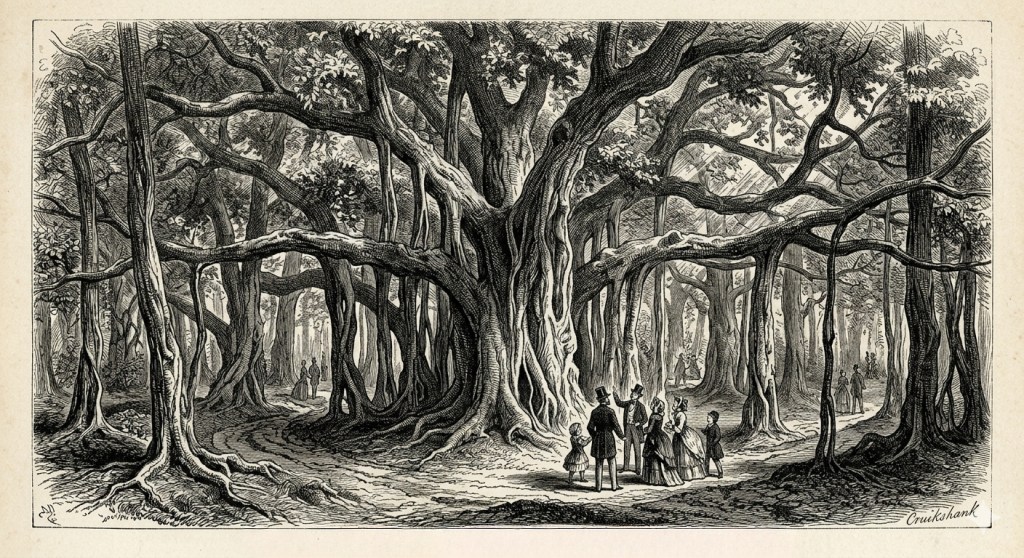
There is a particular kind of tree that refuses to behave like a tree. I want to be clear about this, because I think we all carry around a fairly reasonable mental image of what a tree is supposed to do. It is supposed to have a trunk. It is supposed to go up. It is supposed to have branches that extend outward at a respectful distance from the ground, like arms at a cocktail party, present but not imposing. There should be leaves. There should be shade. There should be a general agreement with gravity and with the basic social contract of vertical growth that most trees signed millions of years ago and have, for the most part, honored without complaint. The banyan tree on the grounds of the Theosophical Society in Adyar, Chennai, has other ideas.
It does not so much grow as spread. It moves sideways the way a rumor moves through a small office, slowly at first, then with a kind of ambient inevitability that makes you realize, too late, that it has already reached the far wall. It sends down roots from its branches, which is a thing that trees are technically allowed to do but which most trees have the decency not to attempt. These roots descend like slow-motion anchor lines, and when they reach the ground, they thicken, and settle, and begin, over years, over decades, to resemble trunks of their own. Until you are standing under what you believed to be one tree and you realize you are inside something closer to a small, self-governing forest that has been operating under a single canopy this entire time, without telling anyone.
In addition to being 500 years old, the whole thing covers something like two acres. Two acres. Of tree.
My childhood apartment in Chennai was five hundred and twenty square feet. For most of my life, I believed this was generous. The banyan tree in Adyar is roughly one hundred and sixty times the size of my childhood apartment, and it has never once had to explain this to a real estate broker or pretend that the bathroom was a “spa-inspired alcove.” So there is that.
You do not approach this tree the way you approach a tree. You approach it the way you approach a building that has been described to you by someone who was clearly not telling you the whole story. There is a moment, just before you walk under the canopy, where your brain is still insisting that you are about to look at a tree, and then there is the moment after, when your brain quietly abandons that project and begins searching for a better category. It does not find one.
Because the banyan does not greet you as an object. It greets you as an environment. You walk into it the way you walk into a shaded courtyard in a city you are visiting for the first time. There are paths, though no one seems to have planned them. There are pockets of light that fall through the canopy in a way that feels deliberate but probably isn’t, or probably is, or honestly, after a few minutes inside the tree, you lose your confidence about what is deliberate and what isn’t, and this turns out to be part of the point. There are branches that lower themselves just enough to make you feel as though the tree is, in a polite and understated way, paying attention to you. Acknowledging you. The way a very old host acknowledges a guest at a dinner party, warmly but without the slightest suggestion that your arrival has changed anything about the evening.
And then, after a few minutes, a thought arrives. This thing has been here for a while.
Not in the casual sense of “a while,” the way someone says, “Oh, I’ve been waiting a while,” when they mean eleven minutes. But in the more serious, geological, slightly vertigo-inducing sense. The kind of “a while” that includes the rise and fall of governments, the invention and abandonment of entire philosophies, festivals that were celebrated for centuries and are now footnotes, renovations that were considered essential at the time and have since been quietly demolished, and ideas, great, confident, well-funded ideas, that seemed permanent when they were introduced and have since been retired with the gentle discretion of a waiter removing an untouched plate.
The tree has been here for all of it. The tree does not appear to have opinions about any of it.
At some point in the late 1980s, during a cyclone, the central trunk collapsed. Now, let’s sit with this for a moment. Because for most trees, for virtually all trees, in fact, and for most buildings, most organizations, most things that have a center and depend on it, this would be the end of the story. The trunk is the tree. The trunk goes, and then the branches go, and then whatever was nesting in the branches goes, and then someone arrives with a chainsaw and a municipal work order, and that is that.
The banyan treated the collapse of its central trunk the way a large family treats the news that the kitchen is being renovated. There was a period of adjustment. Certain things were rearranged. But dinner was still served.
Because the banyan, and this is the part that begins to matter in ways that extend well beyond horticulture, had already been sending down those secondary roots for decades. Hundreds of them. They had already reached the ground. They had already thickened into pillars. They had already, quietly and without issuing a press release, taken on the structural work of holding the whole thing up. So when the central trunk fell, the system around it was already doing most of the work. The fallen sections were propped up by what remained. New growth extended from old branches. And what had once been the center of the tree became, over time, simply another part of the system, no more important, and no less, than anything else.
The central trunk collapsed. The tree did not.
I realize I may be making this sound like the tree had a plan. It did not have a plan. Trees do not have plans. Trees have structures. And the structure of this particular tree meant that the loss of its most visible, most central, most apparently essential component was not the catastrophe it would have been for almost anything else. Which is, if you think about it, a hell of a thing.
Because most of the things we build are not designed this way. And I am not just talking about buildings, though buildings are a fine example. I am talking about companies, and teams, and relationships, and systems of every kind. They depend on something. A central component. A key person. A founding assumption. A primary structure that quietly carries more weight than everything around it, and that everyone agrees is load-bearing, even if no one has recently checked whether this is still true. When that thing fails, when the key person leaves, when the central assumption turns out to be wrong, when the primary structure cracks in a storm that was not in the forecast, the rest of the system tends to follow it, politely but decisively, to the ground. We know this. We have all seen this.
And so, when something breaks, the instinct is immediate and nearly universal. Find the damage. Identify the crack. Fix it. Reinforce it. Do something. Do it quickly. Do it visibly. Show everyone that the damage has been acknowledged and that corrective action is underway. Issue the memo. Call the meeting. Announce the plan. Do not, under any circumstances, stand there looking calm, because someone will mistake your calm for indifference, and in a crisis, indifference is the one thing nobody will forgive. This is, in fairness, often the right instinct. Things break. Things need fixing. Speed matters. But sometimes, and this is the part that is difficult, and interesting, and slightly maddening, sometimes the speed is the problem.
During the Second World War, the United States military was losing bombers at a rate that was, to use the technical term, not good. Planes were going out on missions over Europe and not all of them were coming back, which is the kind of problem that generates a certain institutional urgency. The planes that did come back, however, were covered in bullet holes. And because the military was, among other things, an organization staffed by people who were very good at looking at problems and solving them, engineers began studying the patterns. They mapped the damage. They noted where the bullet holes clustered, across the wings, along the fuselage, near the tail gunner’s position. And they reached a conclusion that felt entirely, inarguably reasonable. Reinforce the areas that are taking the most damage. Add armor where the holes are. It was a clean answer. It was direct. It was responsive. It was the kind of answer that, in a meeting, earns a nod from everyone at the table, because it has the satisfying quality of seeming both obvious and actionable, which is the combination that most answers in most meetings are trying to achieve.
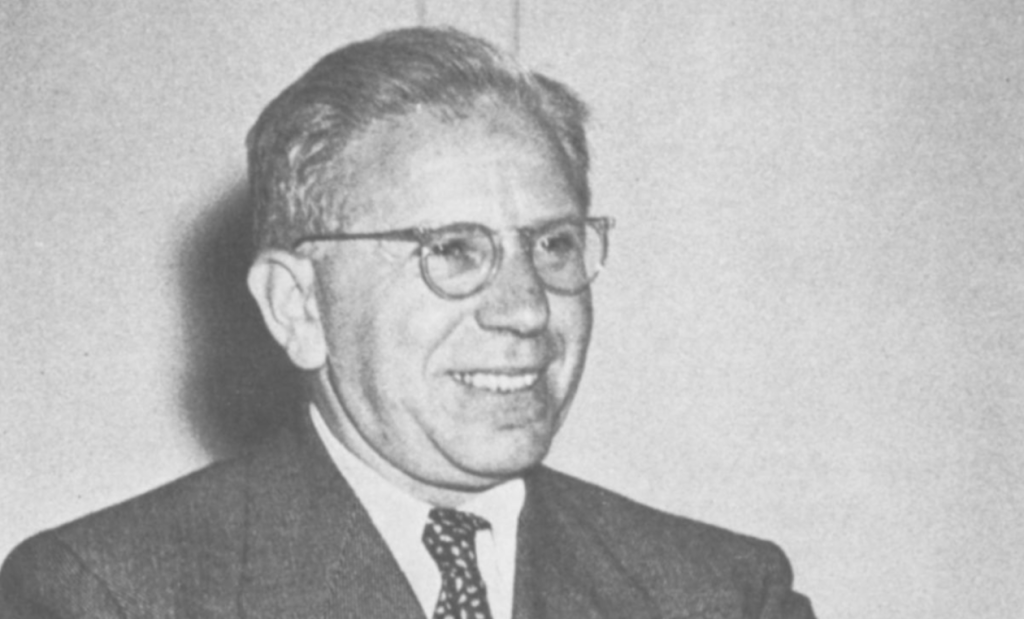
A statistician named Abraham Wald, a man who had fled Austria, who had lost most of his family to the war, and who had the particular, occasionally inconvenient gift of seeing what was not in front of him, suggested something slightly less intuitive. He proposed reinforcing the areas where there were no bullet holes.
There must have been a silence in the room. I like to think there was. The kind of silence that follows a statement so unexpected that the people hearing it need a moment to rearrange their assumptions before they can respond.
Because Wald had realized something that the engineers, in their speed and competence and entirely understandable desire to solve the problem, had missed. The planes they were studying were the planes that had survived. The bullet holes they were mapping were the bullet holes that had not brought the planes down. The areas riddled with damage were, by definition, the areas where a plane could take a hit and still make it home. The places where there were no bullet holes? Those were the places where planes were getting hit and not coming back at all. The damage the engineers were reacting to was the damage that had already been survived. The real vulnerability, the thing that was actually killing planes, was missing from the data entirely. It had removed itself from the sample by destroying the planes that carried the evidence.
I have thought about this more than I probably should. Not about planes. About the pattern. Because it is an unsettling kind of mistake. Not because the reasoning was careless, it wasn’t. The engineers were careful, and educated, and working under enormous pressure with the best information available to them. The mistake was not laziness. It was not stupidity. It was speed. The system reacted to what it could see. It looked at the evidence in front of it, and it moved quickly to address the most visible problem, and in doing so, it very nearly optimized for the wrong thing entirely. It almost spent its limited resources reinforcing the parts that were already strong, while leaving the parts that were actually failing completely unprotected.
Most of us would recognize this. Not from the Second World War. From Tuesday. From every meeting where the most vocal complaint got the most attention. From every organization that restructured itself around the most visible problem and missed the one that was quietly hollowing out the foundation. From every moment in my own life when I rushed to fix the thing I could see and ignored the thing I couldn’t, because the thing I could see was right there, demanding to be addressed, and the thing I couldn’t see had the decency to be invisible, and I mistook its invisibility for absence. This is what we do. We react to signals. We respond to what is in front of us. We move quickly, because the situation seems to demand it, and because moving quickly feels like competence, and because standing still feels like failure. And sometimes, not always, but more often than we would like, we reinforce the wings.
The banyan tree does not seem to make this mistake. When its trunk collapsed, it did not rush to rebuild what was lost. It did not concentrate its resources on restoring the visible center. It did not reorganize itself around the damage, or convene an emergency meeting of its branches, or issue a statement about its commitment to structural integrity going forward. It continued with the structure it already had. Distributed. Redundant. Quietly, almost maddeningly indifferent to the idea that any single part of itself, including the part that had, for centuries, looked like the most important part, needed to be preserved at all costs.
Which means it did not have to decide, in the moment of crisis, what the problem was. It did not have to interpret the shock correctly. It did not have to figure out, under pressure and with incomplete information, which part of itself to reinforce and which to leave alone. It did not have to react.
And I think this is the part that is actually worth sitting with. Because the banyan’s advantage is not intelligence. It is not awareness. The tree does not know anything, in the way that we understand knowing. It cannot analyze damage, or assess risk, or read Abraham Wald’s paper and draw the appropriate conclusions. Its advantage is that it is structured in a way that makes immediate reaction unnecessary. It does not have to respond quickly, because it has already, over centuries, built a system that absorbs shocks without needing to understand them. It does not have to diagnose the problem, because the architecture itself is the diagnosis, redundant, distributed, designed (or evolved, or arrived at, or whatever the right word is for something that a tree does without deciding to) so that no single failure can cascade into a total one.
It does not respond quickly. It responds over time. And by the time it has responded, the system has already absorbed most of what happened, the way a very large body of water absorbs a stone. There is a ripple. The ripple travels. And then the surface is calm again, and the water is still there, and the stone is at the bottom, and nobody is entirely sure when the ripple stopped.
The tree’s answer, of course, is not available on demand. You cannot decide on Sunday to become a banyan and expect to survive next week’s cyclone. The roots take time you do not have. The redundancy costs resources you are already spending on the visible damage. This is not advice. This is not even consolation. It is only a description of what a durable shape looks like from the outside, after the fact, when you are standing in the shade of something that had the luxury of becoming itself slowly.
You leave the tree eventually, because that is what visitors do. You step out from under the canopy, and the light changes, and the air changes, and you are back in a world that operates on a different schedule. Outside, things behave more urgently. Decisions expect to be made by end of day. Problems arrive with the implicit message that they are the most important problem you will face this week, until the next one arrives tomorrow and supplants them. Signals come at you from every direction, some meaningful, some not, most of them indistinguishable from each other in the moment, and they all seem to demand a response. It becomes natural to respond to them. Quickly. Directly. Visibly. In ways that demonstrate you have identified the damage and are already, heroically, reinforcing the wings.
The tree continues behind you. It is not especially concerned with what just happened. It is not particularly interested in reacting to it. It is extending itself, as it always has, one root at a time, in ways that will make whatever shock comes next slightly less important than it first appears.
I think about the engineers, mapping bullet holes on surviving planes, so certain they were solving the right problem. I think about Wald, quietly pointing at the empty spaces and saying, no, look here. I think about every time I have rushed to fix the visible thing and missed the invisible one, and every time the visible thing turned out to be the wound that was already healing, and the invisible one turned out to be the wound that mattered. And I think about the tree. Not because it has the answer. It’s a tree. It doesn’t have answers. It has roots. But it has a lot of them. And they are everywhere. And when the center fell, they held.
We tend to react to what we can see. The systems that last are often the ones that don’t have to.
 kirukkal.com
Leave a comment