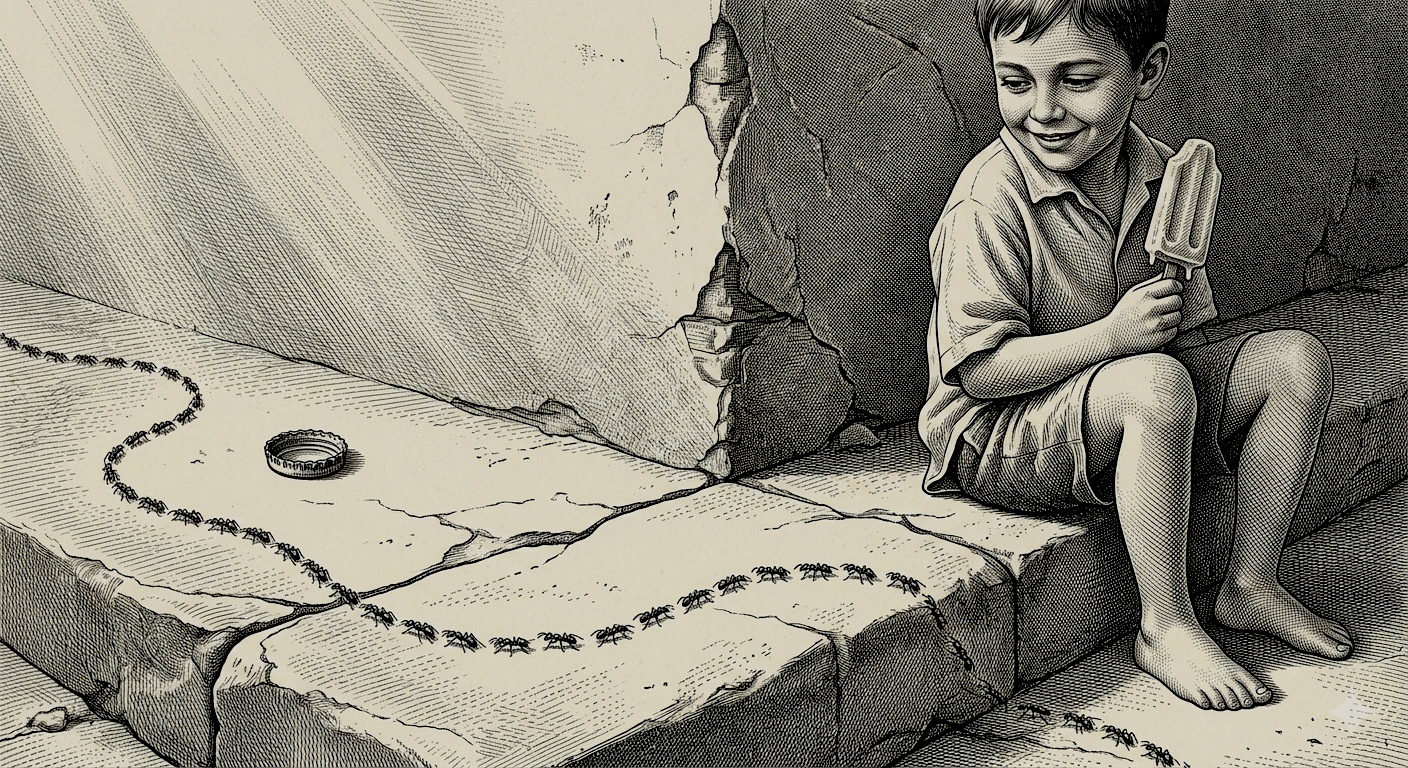
Have you ever noticed how ants move in a perfect line to a place no one told them about and back again, as if they had been given directions by someone extremely small and extremely bossy? It is usually midday when you notice them. The kind of heat that flattens everything except the things that refuse to be flattened, which, it turns out, includes ants. You are six, or eight, or ten. Childhood being less a timeline than a rough suggestion. You are supposed to be doing something else. You are always supposed to be doing something else. But instead you are crouched near a wall, watching a procession that appears to have an appointment it cannot miss.
They come out of a crack you have walked past a thousand times without once thinking about it. One after another, with a solemnity that seems, frankly, a bit much for creatures you could defeat with your thumb. Sometimes they are the small black ones. Though at the time you would have called them the ‘boring ones’ and gone back to your popsicle. Sometimes they are the red ones better known as fire ants, which you learn about not from a book but from standing in the wrong place at the wrong time in a pair of sandals, an experience that stays with you in the way that only very small, very painful mistakes can. And occasionally there is a larger black ant. The carpenter ant, built like it was sent from a different department entirely, with the kind of jaw that suggests it does not just bite but holds a grudge.
But regardless of species or temperament, they all do the same thing. They form a line.
A line. It stretches from nowhere in particular to something that has suddenly become the most important thing in the world. A crumb. A sticky spot on the concrete. A fragment of something you dropped and immediately forgot about but which has, apparently, made someone’s entire afternoon. And then, just as neatly, they turn around and go back the way they came, like very tiny commuters who all happen to work at the same office. It does not look accidental. It looks like someone is running things.
At some point you wonder how they know. Is there something they can see that you cannot? Is there a path already there, drawn in some ink visible only to ants? Is there, somewhere in the colony, a very small cartographer with a very small desk? There is not. They are following each other. Or more precisely, they are following what the others left behind.
The path is not there when the first ant sets out. It is made. Here is what actually happens, and it is both less and more impressive than you would think. An ant wanders. It does not know where the food is. It does not know there is food. It moves, stops, turns, doubles back, makes a series of small, unremarkable decisions that, taken individually, look exactly like being lost. Most of those decisions lead nowhere. This is not a failure. This is a workday, if you are an ant.
Then, by accident or persistence or the kind of dumb luck that occasionally changes everything, one of them finds something worth carrying home. On the way back, it leaves a trace. It’s just a faint chemical mark, a pheromone, laid down in passing, the way you might leave a fingerprint on a glass door without meaning to. The next ant that happens upon that path is slightly more likely to follow it. Not certain. Just nudged, in the gentlest possible way, toward a direction that might be worth trying. That is enough.
Here is where it gets elegant, and I use that word deliberately, because what follows is one of the tidiest bits of math in the natural world. If the path is short, ants traverse it quickly. Faster trips mean more ants walking the same route in less time. More ants mean more pheromone. More pheromone means the next ant is even more likely to follow. The path thickens, simply because it is being used. A loop forms. A beautiful, brainless, self-reinforcing loop. More use strengthens the path. A stronger path attracts more use.
Meanwhile, other ants are still out there wandering, the way other ants do, and some of them stumble onto alternative routes. If one of those routes happens to be shorter, it begins to accumulate pheromone faster, because shorter path, quicker trips, more ants, more trace. The system does not pause to weigh its options. It does not convene a panel. It simply allows one path to outcompete another, quietly and without fanfare, the way the better restaurant on the block eventually gets the longer wait. And then, just as quietly, the losing path fades. The pheromone evaporates. No one removes it. No one sends a memo saying we have moved on. It simply weakens unless it is continually refreshed. What remains is not what was once discovered but what continues to be worth discovering.
This is the entire method. The whole thing. To put it plainly: Wander enough to find something. Reinforce what works. Let everything else disappear. No ant sees the whole picture. No ant decides. No ant even knows there is a problem being solved. Not one of them could tell you, if you asked, what the colony is doing or why. And yet, if you watch long enough, the line becomes cleaner. Straighter. More certain. It begins to look, from a distance, like someone planned it. No one planned it. It is accumulation, pretending to be intelligence. Which, when you think about it, describes rather a lot of things.
In the early 1990s, an Italian computer scientist named Marco Dorigo was watching ants or, more precisely, thinking about ants, which is a different activity but an equally productive one, and he noticed that this small, quiet process could solve a problem that is neither small nor quiet. Mathematicians call it the Traveling Salesman Problem, and it goes like this: given a number of cities, find the shortest route that visits each one exactly once and returns home. It sounds simple. It is not simple. Add enough cities and the number of possible routes grows so large that the sun would burn out before you finished checking them all, which is the sort of fact mathematicians enjoy sharing at parties.
Dorigo did not improve the ants. He copied them. He built a computer simulation full of simple little agents, digital ants, essentially, each one making small, slightly biased decisions, each one leaving behind traces that the others were slightly more likely to follow. Shorter routes accumulated more reinforcement. Longer ones faded. No agent understood the problem. No agent needed to. Run it enough times, and the system began to converge on efficient paths. Not because it grasped the mathematics. Because it kept making the same mistake less often, which, if you think about it for even a moment, is a pretty decent working definition of learning.
What Dorigo formalized was not an insect trick. It was a coordination pattern, and it has exactly three moving parts. Local decisions. Shared traces. Decay. No meeting is held. No one understands the whole. And yet the system improves. The intelligence is not in the agent. It is in the feedback loop.
And the most important part of that loop, the part that makes the whole thing work, is not reinforcement. It is forgetting. Without evaporation, the system would fall in love with its first decent idea and never look at another one. The earliest workable path would thicken into gospel. Exploration would stop. Mistakes would harden into tradition. With evaporation, the past stays provisional. A path survives only because it continues to earn its place. Not because it was once correct. Because it still works. There is something almost unsettlingly fair about that.
You can see the same pattern well beyond the anthill, once you start looking. Inside a company, a weekly report begins as a way to track something that genuinely matters. The first version is useful. The second is expected. By the third it is required. Over time, the report grows longer, more careful, more elaborately formatted. People spend hours on it. It acquires a template. The template acquires a style guide. Someone suggests adding a cover page. No one remembers exactly why the report exists. But it continues, because it has always continued. A hiring practice works once, then twice, then becomes policy. A metric correlates with success, then becomes success. A slogan resonates, then hardens into identity. These things happen so gradually that by the time you notice, the thing that was once a useful path has become the only path anyone can imagine taking.
Reinforcement, left unchecked, puts on a very convincing costume and calls itself principle. New ideas still appear, of course. They show up at the edges, the way they always do. Some are tried. Most fail quietly. A few work. Those are repeated. Repetition becomes legitimacy. Legitimacy becomes structure. And then, if nothing interrupts the cycle, if there is no evaporation, no forgetting, no willingness to let a path fade, structure becomes the thing that people mistake for the floor, when really it is just a very old carpet that no one has lifted in years.
In ant colonies, evaporation is automatic. Built in. Non-negotiable. The chemistry handles it. In human systems, it is resisted with an enthusiasm that borders on the religious. Practices remain long after the conditions that created them have changed. Rules persist because they once made sense, and ‘because we have always done it this way’ is the world’s most durable sentence. Institutions remember more easily than they forget, which sounds like a compliment but is not, necessarily. It is another way of saying they learn unevenly. They are very good at accumulating and very bad at letting go.
Culture does not learn by understanding. It learns by repetition.
Look again at the blue driving line on your phone’s map. It looks authoritative. Decisive. Clean. As if someone, someone very competent, someone with a clipboard and strong opinions about efficiency, has examined every possible route and chosen the best one, just for you. But the line was not chosen. It was accumulated. Every driver who slowed down, every car that moved quickly, every moment of hesitation at an intersection left behind a kind of trace. None of them were trying to help you. None of them saw the whole picture. Most of them were just trying to get home, or to the dentist, or to pick up their kids, and were not thinking about you at all. But together, without meaning to, without coordinating, without even knowing about each other, they shaped a path.
The line exists because it has been walked. And like the ants’ trail, it remains only as long as it continues to be walked. When traffic builds, cars slow down. That slowing becomes a signal. Enough of those signals, and the route no longer appears efficient. Fewer drivers are routed through it. The trail begins to thin. Somewhere else, a slightly faster path begins to thicken. No announcement is made. No explanation is offered. No one from the mapping app sends you a note saying, sorry, we have changed our minds. The system does not decide. It shifts.
What survives repetition becomes reality.
And if you have read this far, you may be starting to suspect that the difference between a colony of ants finding the shortest path to a breadcrumb and a civilization finding its way to an idea is mostly one of scale. You would not be entirely wrong.
 kirukkal.com
Leave a comment