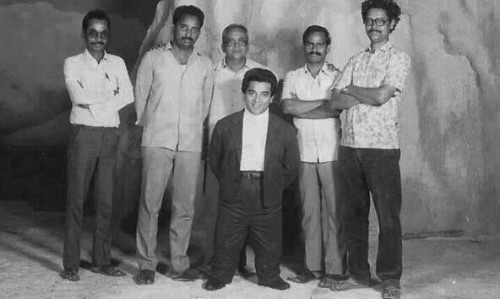
I have asked a few celebrities questions in my life, which is already more than I would have predicted for myself, and almost all of them have been answered with admirable patience. There was one exception.
This was during the shooting of Guna. I was twelve, maybe thirteen, which is the age at which you are old enough to be curious and young enough to be completely unembarrassed about how badly you express that curiosity. He had just finished a shot. People moved around him with that quiet efficiency that suggests everyone knows exactly what to do except the people who don’t. He didn’t need to say much. Things seemed to arrange themselves.
His car was waiting. A Contessa, which at the time felt like the official vehicle of people whose lives were going much better than yours. A small crowd gathered. Autographs began. Notebooks appeared from nowhere. Someone produced a piece of paper that looked like it had once been part of something else and was now being promoted. And then I asked my question. It was not about the film he was shooting that day, which would have been sensible. Not about anything that could be answered quickly while a man is halfway between work and leaving. I asked him how he had done that role. How he had acted as a dwarf. It was not a good question. It was not even a complete one. It was the kind of question that arrives whole in the mind and falls apart on the way out.
He looked at me. Not kindly or unkindly. Just… accurately. And then he reached out, gave a light tap on my cheek, and moved on. No answer. Not even the courtesy of a vague sentence that sounds like an answer but isn’t. Just a gesture that, at the time, I took to mean something like: this is not a question you can ask this way. The car door closed. The Contessa left. I have told this story to an unreasonable number of people ever since, which is how you know it stayed.
You eventually find yourself returning to that question in the only place it can be answered. In watching.
When you start to watch a movie these days, it usually begins with a small act of caution. You turn on subtitles, not because you absolutely need them, but because it feels like the sensible thing to do. The language moves quickly. The voice has edges. This, you tell yourself, is temporary. A light assist. The cinematic equivalent of holding the railing on the way down a staircase you probably don’t need help with. The subtitles appear, dutiful and slightly officious. And then, somewhere in the middle of a scene, you realize you haven’t looked at them in a while. They have simply stopped being useful. A few minutes later, something else disappears. You are no longer thinking about anything. Not the actor or their reputation. Not even the faint internal checklist that usually accompanies a familiar face. There is no running commentary saying this is very good acting, or look at that choice, or this must have been difficult. There is just a person, in a situation, behaving in a way that makes sense.
And then, like a delayed echo, the question returns, slightly rearranged: What does the actor’s real voice even sound like.
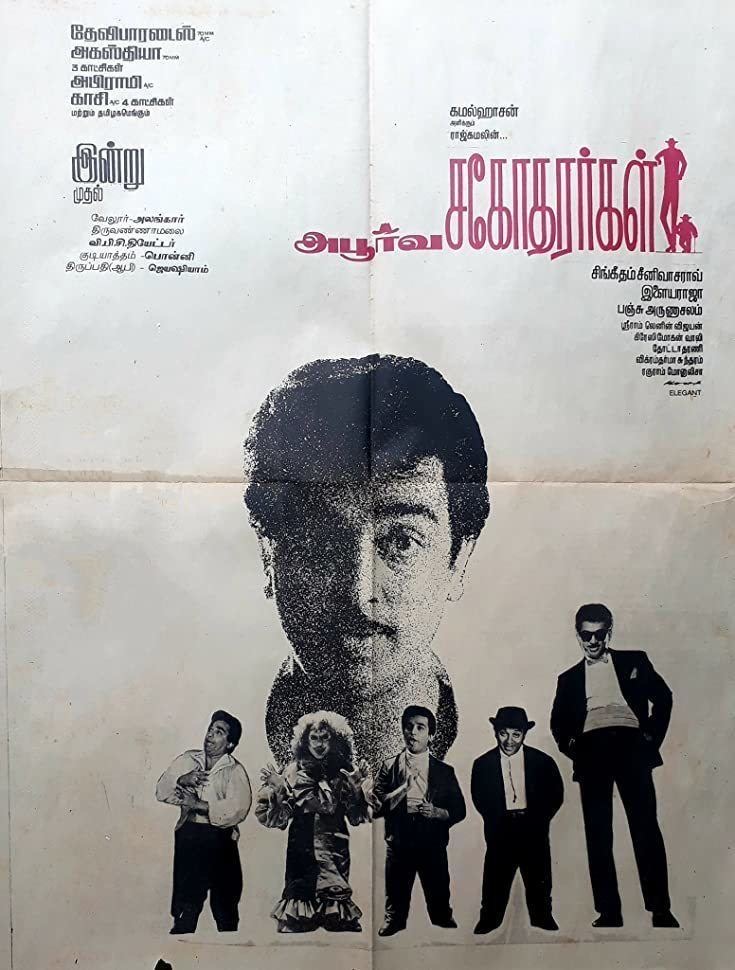
The film is Apoorva Sagodharargal, a Tamil film from the late 1980s in which Kamal Haasan plays twin brothers, one of whom is a character with dwarfism and also, somewhat inconveniently for the production, the emotional and structural center of the story.
This is not a cameo or a novelty. He is not appearing briefly to demonstrate that such a thing can be done. He carries the film. He moves through it constantly. He walks, reacts, jokes, falls in love, suffers, plans revenge, and occasionally dances, all while existing in a body that the frame has to accept without argument. One brother moves through the world at full height. Doors behave. Tables meet him where they should. Conversations require no adjustment. The other brother negotiates. The world sits slightly higher than expected. Faces require a tilt upward. Movement has to be recalibrated. Even standing still involves a small, ongoing correction that you are not supposed to notice. Both brothers share the same frame, but not the same physics.
This is the late 1980s. There is no digital safety net waiting quietly in the background. No one is going to fix this later. No software is going to politely correct proportions or clean up a shadow that reveals too much. If something feels off, it stays off. If something breaks, it breaks permanently and for everyone.
Which is why, at first, you watch carefully. Of course you do. You notice the eyelines. You notice the framing. You notice how space is being managed. You are, in a very reasonable and slightly suspicious way, checking whether this is going to hold. And then, quite suddenly, you stop checking. It’s not because the problem has gone away. Because you no longer feel responsible for it.
What makes this work is not one trick, but the refusal to allow even a single ordinary moment to fail.
In frontal shots, Kamal Hassan moved on his knees, feet folded under, with specially built shoes strapped to them so that the walk had weight and rhythm instead of suggestion. In profile shots, where the illusion is least forgiving, trenches were dug into the studio floor so his real legs could disappear while the camera remained at a normal height. He practiced walking in those trenches until it no longer looked like balance, but movement. When the ground could not be cut, platforms were built. When he sat, his legs vanished into pits or were replaced with articulated ones controlled just out of frame. Eyelines were adjusted with boxes. Shadows were controlled with the kind of attention usually reserved for things audiences actually notice.
All of this, so that nothing would be noticed.
What’s unusual is not that the illusion holds. Many films manage that for a moment, and often very well. What’s unusual is that it becomes the only version of reality available to you. There is nothing left to compare it against. No alternative frame, no small inconsistency that invites inspection. The world behaves with enough internal consistency that the mind stops asking whether it is real and begins treating it as given.
At that point, it stops behaving like a performance. And this is not what most performances attempt, and not what most could sustain. The difficulty is not in creating the illusion, but in maintaining it through the ordinary moments where attention drifts and systems usually reveal themselves. Here, those moments do not arrive. Once accepted, the question of how does not return.
Because films do not live in their cleverest moments. They live in the in-between. In the walk that is not meant to impress you. In the reaction that happens before anyone has time to perform it. In the small, forgettable actions that quietly hold everything together. That is where belief is tested. And that is where it usually fails.
A slight hesitation. A gesture that feels just a little too explained. A movement that seems to remember its instructions. These are small things, and pointing them out feels faintly rude, like noticing someone checking their reflection. But they accumulate. And once you see them, you are no longer inside the story. You are watching the effort.
Which is when something slightly uncomfortable becomes clear. Most of the time, you are helping the film work. You overlook things. You smooth edges. You fill in gaps that are small enough to ignore but real enough to exist. You accept a convenient cut. You forgive a moment that arrives a little too neatly. You allow the film to become what it is trying to be.
We call this watching. But it is, quietly, participation. In most films, belief is a shared responsibility. The filmmaker builds, the actor performs, and the audience completes. The system works because you are doing part of the work.
What Kamal Haasan does here is remove your role from that system. Instead of making the problem smaller, he does it by absorbing it completely. His performance does not ask for your cooperation. It does not signal where you should be generous. It does not leave small gaps for you to bridge. It simply proceeds, as though nothing unusual is happening. And somewhere along the way, your job disappears.
Which, in a way, answers the question I asked that day. Not with anything that could have been explained between autographs and a waiting car. But with something much less convenient. There isn’t a trick. There is only the work, done so completely that it leaves nothing behind for you to do.
Some performances are impressive. Some leave you with nothing left to do.
Epilogue
In hindsight, my timing was spectacular in its incompetence. He was shooting the ‘Pentothal’ scene that day. The one where he circles the room in a state of manic, jagged prayer, banging on the walls as if the bricks themselves owed him an explanation. It is a scene that requires an actor to essentially unspool his own nervous system for the camera. To approach a man who has spent the last six hours vibrating with that kind of professional haunting and ask for a technical breakdown of a different movie is not just a bad question, it is a minor accidental cruelty. It is like asking a man who has just escaped a burning building whether he has any thoughts on the courtyard design of the Taj Mahal.
The tap, I now understand, was gentler than I deserved.
 kirukkal.com
Leave a comment