It is the first weekend of March, which means that sometime tonight the nation will once again participate in its biannual ritual of arguing with the clock.
On the East Coast, the last respectable piles of snow are receding into damp resignation. In Seattle, we have already endured the annual forecast that confidently predicted snow and then reconsidered. The light lingers a little longer in the evening. “Here Comes the Sun” begins to feel less like a Beatles classic and more like a scheduling suggestion.
And then, without consulting us, time will change.
Sometime between Saturday night and Sunday morning, millions of us will stand in kitchens squinting at ovens and performing mental arithmetic that would trouble a reasonably confident fifth grader. My phone will glide forward automatically, smug and luminous. The microwave will refuse to cooperate. The clock in the car will stage what can only be described as passive resistance. Somewhere in the house there is an analog clock whose only purpose, as far as I can tell, is to test whether I still remember how to move small plastic hands without snapping one off.
Twice a year we do this. We grumble. We miscalculate. We open search engines and ask, with impressive urgency, whether this is finally the year daylight saving time becomes permanent. We consult language models as though they might have insider access to the relevant timekeeping authorities. They do not. They are very polite about it.
What fascinates me is not that the clocks change. It is that they agree to change.
Noon, in particular, carries an effortless authority. It feels backed by a star. If someone suggests meeting at noon, no one asks which one.
Noon does not sound like a proposal. It sounds like physics.
This is a flattering assumption.
Because for most of human history, noon was not physics. It was opinion.
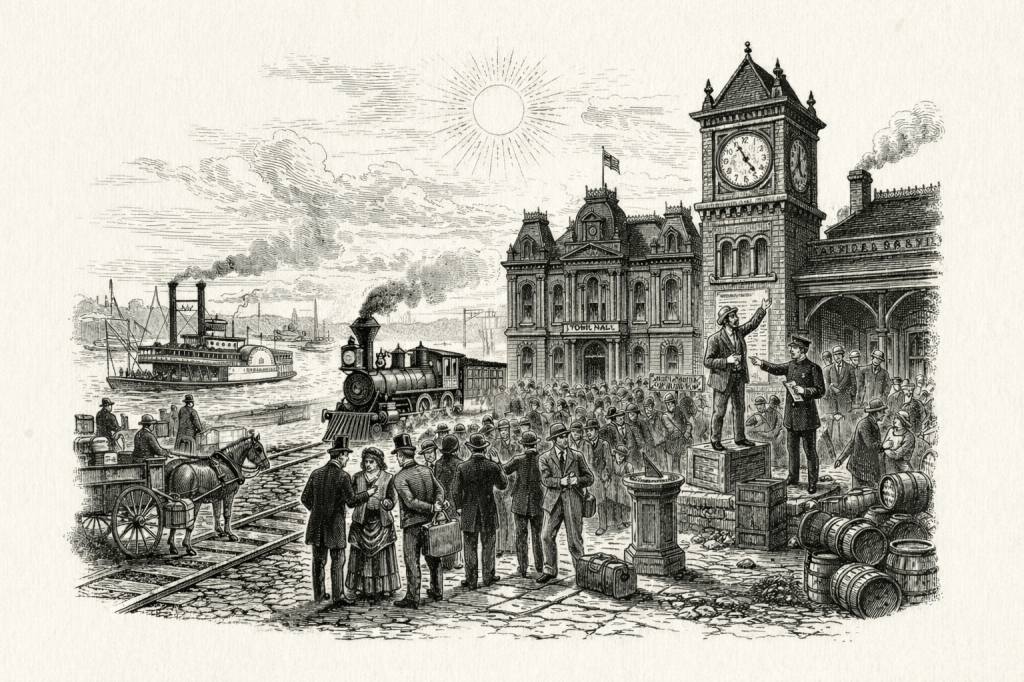
Imagine, for a moment, a stretch of railway somewhere in the United States in the late nineteenth century. A single track cuts across the countryside. A train is approaching from the east. Another is approaching from the west. They are scheduled to meet at a siding where one will politely step aside and allow the other to pass. This arrangement works beautifully provided both engineers agree on what time it is. Unfortunately, in the nineteenth century, they often did not.
By the middle of the century American railroads had already accumulated a respectable collection of mishaps. Between the 1830s and early 1850s there were dozens upon dozens of major train wrecks as rail traffic expanded across the country. In 1853, two passenger trains in Rhode Island collided head-on near Valley Falls after crews misread their timetable. Fourteen people died. The trains had followed the schedule as they understood it. The difficulty was that the schedule depended on time.
And time, in the 1880s, was something the country possessed in generous variety. At that moment the United States was operating on something like three hundred different local times. Every town set its clocks by the sun above it. When the sun reached its highest point, it was noon. Church bells rang. Shopkeepers adjusted their watches. The sky had spoken.
The difficulty was that the sky did not speak with a single voice. Louisville’s noon was not Cincinnati’s noon. The difference was only a handful of minutes, small enough that it hardly mattered to anyone traveling by horse or riverboat. A merchant leaving Louisville at eleven in the morning could arrive in Cincinnati in time for lunch even if Cincinnati insisted it was already eleven-oh-six.
For most of the nineteenth century this arrangement worked perfectly well. A horse does not particularly care if the next town believes it is six minutes later. A train does. Railroads ran largely on single-track lines, which meant trains traveling in opposite directions shared the same strip of steel. They passed one another at carefully scheduled sidings. If both crews agreed on the time, the choreography worked beautifully. One train would pull aside, the other would glide past, and everyone would continue their day. If the clocks disagreed by a few minutes, however, the choreography developed a rather unfortunate improvisational element.
Trains, it turns out, are magnificent machines but poor conversationalists. Once committed to a track they have no steering wheel, limited braking enthusiasm, and absolutely no interest in negotiating whose noon is correct. Time, in other words, had quietly become a safety system. This is not the sort of responsibility anyone originally imagined giving to a pocket watch. And safety systems are famously intolerant of six-minute disagreements.
The railroads attempted, at first, to solve the problem the way organizations often do: with paperwork. Conductors carried conversion tables. Station masters kept charts translating one town’s noon into another town’s almost-noon. Railroad companies adopted their own internal clocks, which sometimes disagreed cheerfully with the clock tower in the center of town. For a while the system limped along.
But railroads were expanding with the enthusiasm of a technology that had discovered it was useful. Tracks spread westward. Schedules thickened. More trains began sharing the same lines, each relying on clocks that were only approximately in agreement. And approximate agreement is not the ideal foundation for a safety protocol involving several hundred tons of moving steel. The country did not lack precision. It lacked agreement.
Railroad managers eventually arrived at the sort of conclusion that seems obvious only after someone has suffered through the alternative. If trains were going to move across an entire continent on coordinated schedules, the country could not continue operating on hundreds of local suns. The sky, as admirable as it was, had proven to be a somewhat unreliable administrator. So the railroads did something rather bold. They changed time.
On November 18, 1883, the major American railroads quietly adopted a new system dividing the country into four standardized zones: Eastern, Central, Mountain, and Pacific. At a predetermined moment that Sunday, clocks across the rail network were reset simultaneously. The day became known, with admirable understatement, as the Day of Two Noons.
In Louisville, Kentucky, the adjustment amounted to eighteen minutes. Eighteen minutes is not particularly dramatic until it is attached to the word noon.
On that morning, Louisville experienced noon once by the authority of the sun and then again by the authority of the railroad timetable. For centuries noon had been an observation. Now noon was a decision. Standard time later made daylight saving time possible, but the real revolution had already happened. Noon had quietly changed from observation into decision. And the decision held.
For a time, this new arrangement applied mainly to railroads. Trains ran on standardized time. Telegraph lines transmitted the official hour. Station clocks were adjusted with impressive seriousness. The rest of the country watched with mild curiosity. Cities, however, quickly discovered that the railroad clock was inconvenient to ignore. Businesses depended on train schedules. Newspapers reported arrival times. Court proceedings, market openings, shipping manifests, and the general choreography of commerce gradually began aligning themselves with the same hours the railroads were using.
It is one of the quieter revolutions in American history. No act of Congress imposed the change that Sunday morning. No national referendum was held. The railroads simply announced how time would work, and the country, after a brief moment of confusion, discovered that life was easier if it agreed.
Reality, at scale, often begins that way.
A practical inconvenience becomes a coordination problem. The coordination problem becomes a shared rule. And the rule, repeated often enough, begins to feel inevitable.
Within a few decades the federal government formalized what the railroads had already built. Time zones entered law. Telegraph signals synchronized clocks across cities. Noon, which had once belonged to whichever town square you happened to be standing in, now arrived simultaneously across hundreds of miles. Astronomically speaking, solar noon still drifts slightly from town to town. If you stand in western Indiana at the moment your clock declares noon, the sun will not necessarily be at its highest point. The sky has not adjusted itself to the timetable. We have adjusted ourselves to the timetable.
Sometime before dawn on Sunday, the country will quietly renegotiate the hour once again. Millions of clocks will shift within the span of a few hours. Offices will open. Markets will trade. Schools will ring bells. Trains will depart. Flights will leave runways at precisely scheduled minutes agreed upon by people who may never meet one another but who share a quiet assumption about the meaning of noon.
We will complain, as we do every March. But we will also comply. The argument about noon, in other words, ended a long time ago. It ended the day railroads decided that the sun was no longer the only authority on time. At the center of our solar system, hydrogen will continue fusing with majestic unconcern. And here on Earth, we will continue pretending that noon was inevitable.
 kirukkal.com
Leave a comment