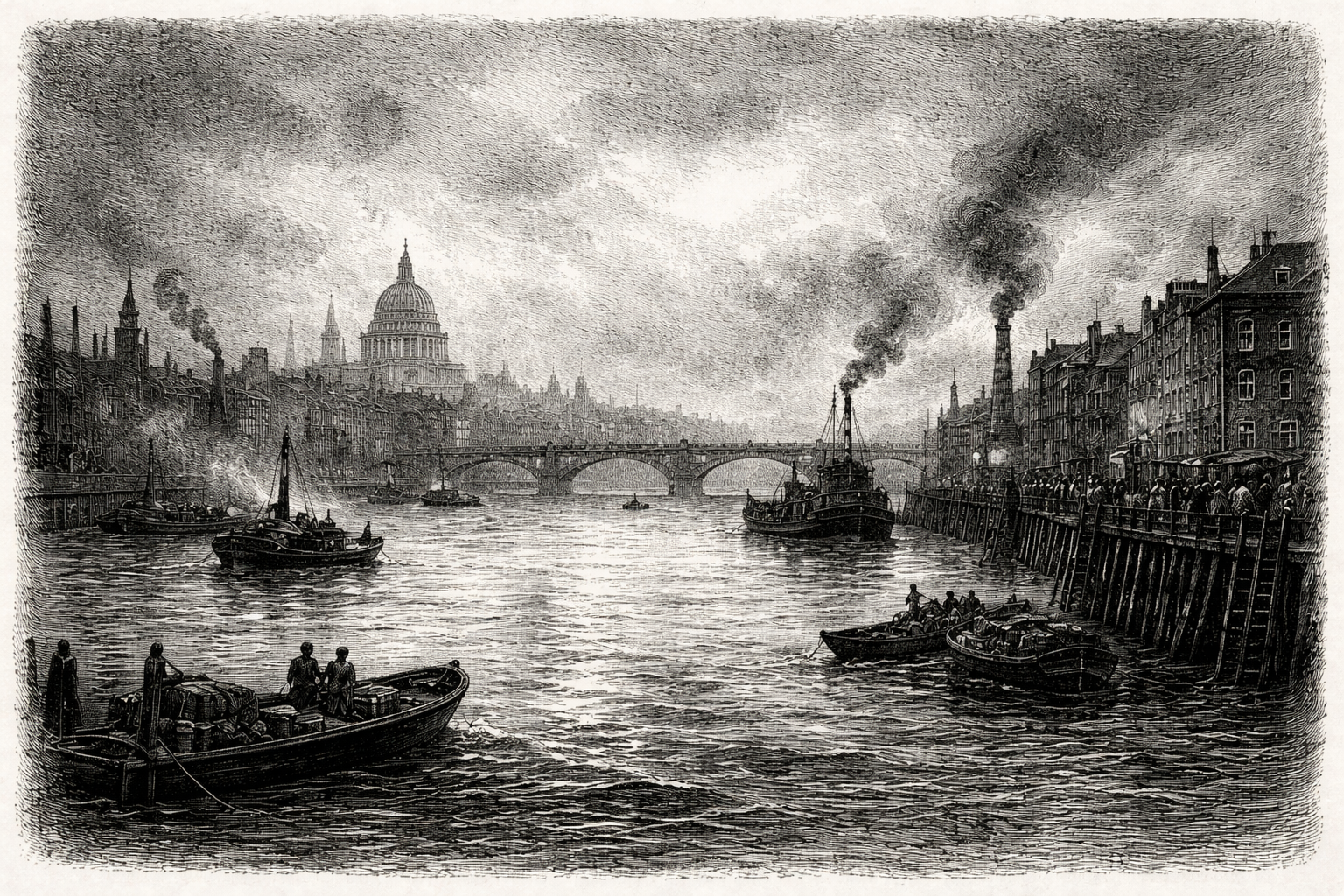
London in the summer of 1854 was not a place you would have chosen for a restorative weekend. The Thames had developed ambitions beyond being a river and was attempting, with some success, to become a broth. Parliament conducted affairs of state within polite strolling distance of what was essentially a moving archive of human waste. The prevailing scent suggested that civilization was still very much a draft.
When cholera swept into Soho that August, it did so with unnerving briskness. People who were perfectly healthy at breakfast were frequently beyond improvement by dinner. Entire families vanished. The explanation, happily, was already in place. The air was bad. Everyone agreed on this. London’s air had been bad for years. It was almost reassuring to discover that the smell was not merely unpleasant but medically consequential.
The dominant theory of disease was miasma, a word that sounds precisely like something you wouldn’t want near your lungs. Poisonous vapors, rising from filth, entered the body and did what poisonous vapors are known to do. It was tidy. It was intuitive. It was unfortunately wrong.
Officials responded with admirable seriousness. They discussed ventilation and sanitation and odor control. They held meetings. They considered improvements. What they did not consider, at least not seriously, was the possibility that the air was innocent.
Into this smelly crisis stepped John Snow. This John Snow had no dragons, no brooding monologues, and no urgent need to defend the North. He bought a map.
When someone died, Snow wrote down the address and marked it. One dot became five. Five became twenty. Soon Soho began to resemble a constellation whose theme was mortality. The dots were not evenly sprinkled across London’s famously democratic foulness. They clustered, with quiet insistence, around a public water pump on Broad Street.
A brewery nearby experienced remarkably few deaths, largely because its employees drank beer rather than pump water. A workhouse with its own well also fared better. The air, rather inconveniently for the miasma enthusiasts, was the same everywhere. The water was not.
Snow did not have the advantage of germ theory. He could not produce a microscopic villain and point to it with a flourish. What he possessed instead was something both less glamorous and more dangerous: a pattern. If the deaths cluster around the pump, perhaps the pump is the problem. It seems obvious now, in the way that most important inferences eventually do. At the time, it bordered on impolite.
Snow persuaded local authorities to remove the pump handle. People stopped drawing water from Broad Street. The outbreak subsided. The Thames continued being itself. The air retained its character. What changed was the conclusion.
The bodies had been visible. The streets had been visible. The pump had been visible. What had not been visible was the line connecting them.
History, when tidied up for textbooks, looks like a succession of discoveries. In practice, it is more often a succession of inferences. The facts sit around patiently, like some guests waiting to be introduced. Someone eventually notices that two of them belong together. For most of human history, making that introduction was expensive. You needed time to gather information, tools to organize it, and sufficient standing to persuade others that your line between the dots was not a decoration. Inference required infrastructure. Intelligence appeared rare partly because drawing conclusions required effort and, occasionally, courage.
Then something rather astonishing happened. We made inference cheap.
Inference
noun
	1.	A conclusion reached on the basis of evidence and reasoning.
	2.	The act of deriving a logical judgment from known facts.

In machine learning, inference has a more technical meaning. It refers to the process by which a trained model applies what it has learned to new data. You feed the system an input. It produces an output. It estimates what is most likely true.

This is, in effect, what happens each time you prompt a large language model and wait for it to reply.

The word sounds modest. Procedural. Almost bureaucratic. It is anything but.
Today, you can sit at a kitchen table and do something that would have caused John Snow to blink repeatedly. You can ask a machine to scan thousands of pages of text and extract patterns in seconds. You can compare arguments, surface contradictions, generate counterpoints, and summarize complexity before your tea cools. It feels, at first encounter, faintly sorcerous. It is statistical pattern recognition operating at an industrial scale. It is automated inference.
We have, in short, reduced the friction around the first connection. When something becomes cheap, it ceases to be the bottleneck. Electricity was once a spectacle; now it is background. Computation was once a laboratory curiosity; now it runs your refrigerator. Inference, which once required weeks of reading and considerable stamina, now arrives on demand.
This is more destabilizing than it sounds.
Most people treat language models as answer machines. They ask a question, receive a response, and lean back as though a minor oracle has spoken. The machine produces structure; the human consumes it. The exchange feels complete.
John Snow did not stop at the map. He noticed clustering. Then he inferred causation. Then he inferred transmission. Then he inferred intervention. Each inference leaned on the one before it. The map was not the breakthrough. The sequence was.
This is what might be called inference stacking, though Snow would likely have preferred a quieter phrase. The first inference reveals a pattern. The second explains it. The third predicts what happens next. The fourth suggests what to do about it.
Language models now hand you the first inference at negligible cost. They will summarize. They will compare. They will identify trends with admirable diligence. And then they will stop. What follows is up to you.
If this pattern is real, what else must be true? If this explanation holds, where does it fail? If this assumption is correct, what collapses under it? The difference between someone who feels submerged in information and someone who moves through it with clarity is often one additional inference. And then another.
For centuries, institutions dominated not because they possessed superior brains but because they controlled the machinery of inference. Now that machinery hums quietly inside your browser. The first step toward clarity no longer requires permission.
The revolution, contrary to some breathless commentary, is not that machines have become intelligent. The revolution is that inference is no longer scarce.
Retrieving information is no longer impressive. Generating a plausible explanation is no longer rare. What becomes valuable is the willingness to extend the chain, to press further, to remove the metaphorical pump handle when the dots suggest you should.
John Snow did not rebuild London’s sewers. He removed a handle. The act was modest. The inference behind it altered history.
We have spent centuries making information abundant. Now inference is abundant as well. The machine will show you the dots. It will sketch the first line. It will not decide what follows.
Intelligence is one inference away.
The question is whether you will make the next one.
 kirukkal.com
Leave a comment