listen to this chapter now on youtube!
He saved the file before he could think better of it.
set my world on fire.txt
It sat on his Windows desktop among things that pretended to matter: resume, induction notes, a folder called Java that he hadn’t yet opened properly. The clock in the corner of the screen glowed a patient blue, 5:48 p.m., Friday, Feb. 4, 2000, already leaning toward evening. The first weekend of February, the new millennium barely underway. He stared at the title for a moment, then opened it again. Notepad filled the screen with its blank white rectangle, black letters aligned obediently to the left. No fonts to choose. No margins to hide behind. Lowercase, as always. He preferred it that way. It felt humbler. Less sure of itself. Words that didn’t raise their voices or ask to be noticed.
He read it once on the screen. Considered changing a line. Decided against it. Read it again anyway.
set my world on fire

i didn’t mean
to be careful

that came later
with bruises
and apologies
and learning how to stand
still

this was before that

this was when everything
felt possible
because nothing
had failed yet
not once
not even a little

i woke up
already running
too much blood
for one body
too many thoughts
tripping over each other
all day
all afternoon
all night

your name
was a spark
i picked up
with bare hands

every street
looked like it was waiting
every corner
like it had been rehearsing
for us
every red light
felt personal
every green light
felt like permission

songs came on
and finally told the truth
the loud one
the kind you shout
out of windows
like somebody had written them
years ago
just for this
and hid them
until now

i wanted to tell strangers
i wanted to stop traffic
grab people by the arm
say
do you feel this
do you see this
do you see
how alive
everything is

i wasn’t thinking
about consequences
or endings
or what people would say
or who would be disappointed
or who would be right

i was thinking
we could change things
just by standing too close
that the air would move
that the world would have to
make room

that maybe this
this feeling
was the beginning
of something
the world had been missing
and didn’t even know
to ask for

i didn’t know
fire could hurt
i didn’t know
it could leave marks
or take things back

i only knew
it was warm
and bright
and loud
and mine

and i would have burned
every rule
every warning
every voice in my head
every future version of myself
that tried to slow me down

just to keep it burning
just one more minute
He didn’t linger. He wasn’t sure what one did with a poem like that. He didn’t decide. He closed Notepad and shut the computer down, the screen collapsing into darkness. Outside his room, the building had already begun to empty itself. The elevator arrived. He stepped in, pressed the button, watched the numbers descend.
Madras had begun its daily act of shedding skin. Offices exhaled clerks. Pavements filled with people who walked as if they had appointments with destiny but were really only going home. Anna Salai, that old tongue of the metropolis, spoke in horns and exhaust and the jingling coins of conductors. He came out of Shakti Towers with the slightly stunned posture of a man who has only recently been granted entry into adulthood’s waiting room. First job. First ID card. First time a security guard nodded at him as if he belonged to a category. He swung a leg over his Hero Puch, his two-gear austerity machine, his saintly petrol-sipper, the little pony that could carry a young man across Madras. Eighty-five kilometres to the litre, he told himself, as if thrift were a virtue that might protect him from everything else.
He rode into the city’s face. Spencer Plaza drifted by like a tired promise of modernity, smelling faintly of damp carpets and aftershave. The median grills flashed yellow, declaring Chennai Managaratchi with new paint and old authority, as if a coat of colour could discipline a city that had never been disciplined by anything except heat. Tamil movie posters shouted from walls and hoardings, heroes larger than traffic, heroines painted in perpetual astonishment, villains with oversized moustaches. Love stories everywhere, entering, exiting, colliding, surviving intermissions, while he, in his tucked-in shirt and earnest trousers, rode toward a meeting that insisted on calling itself a date.
Near Gemini, the bronze man clung to his rearing horse, frozen mid-command. He circled that statue the way people circle their own thoughts when they do not want to look straight at them. Then, almost without deciding, he turned into Woodlands Drive-In, that bright, cold republic of coffee and cigarettes and parked cars.
Woodlands Drive-In was doing what it always did at that hour: pretending to be temporary while quietly becoming permanent. Cars lined up like a patient ration queue. Maruti 800s with cracked dashboards and yesterday’s newspapers. An Omni with its sliding door half-open, breathing out cigarette smoke and half-heard film gossip. A Contessa parked slightly apart, arrogant by design, convinced that size alone matters. He threaded his Hero Puch into the margins, his small, faithful animal nosing its way between giants, and killed the engine. The silence that followed was brief and immediately filled by spoons clinking, coffee hissing, voices leaning into one another.
Inside, the air was heavy. Coffee boiled too long. Oil that had fried a thousand evenings. Ketchup sweetness lingering on steel tables wiped so often they had developed a shine that wasn’t quite cleanliness. The waiter saw him, nodded once, already reaching for a cup. “Coffee,” he said, not asking. It was the kind of recognition that mattered more than conversation. He took the cup, felt the heat travel through ceramic into his palms, and stood there a second longer than necessary, as if warmth could be stored for later use.
The washroom mirror gave him back a version of himself that seemed faintly provisional. Fluorescent light flattened ambition. He ran water over his face, watched droplets cling to his eyelashes, thought briefly of nothing, which was a relief. When he came back out, the cars were still there, the arguments still ongoing, the city still rehearsing itself for night. He swung back onto the Hero Puch and rejoined Anna Salai, that endless sentence that never quite found its full stop.
The Taj Coromandel passed on his left, wearing its wealth lightly, pretending that comfort was a moral achievement. Beyond it, the city shifted again. As Nungambakkam appeared, NIIT centre flashed by, its signboard blinking with the anxious optimism of a place that promised futures in computer science modules and instalments. Nine to twelve, it reminded him, already. Java would wait. Logic would wait. Tonight, even inevitability would have to wait its turn.
He took the right into Valluvarkottam High Road, the turn precise, the road immediately narrowing its voice. This was a different Madras now. Less noise, more assertion. Sterling Road was just ahead with its confident houses and guarded silences, balconies that had seen generations of afternoons and now preferred not to comment. College Road opened itself toward the women’s college, releasing a spill of young women into the evening, bags slung low, laughter unlicensed, futures still plural. He slowed without deciding to. Youth does that to you when you’ve only just begun to notice its edges.
And there, exactly where the roads negotiated their uneasy truce at Sterling, Valluvarkottam, and College Road, Pizza Hut waited.
It did not shout. It did not need to. Glass front, lights steady, air-conditioned confidence on display. It had been there only a few months, new enough that the city was still learning how to sit inside it, still getting used to the idea of pizza as a meal rather than a curiosity. Pizza Corner had made it familiar, but this felt different. As if a small, glossy piece of America had arrived in Nungambakkam and decided to stay. He pulled in, dismounted, helmet under his arm, and stood for a moment, watching his own reflection mingle with passing traffic.
She was there.
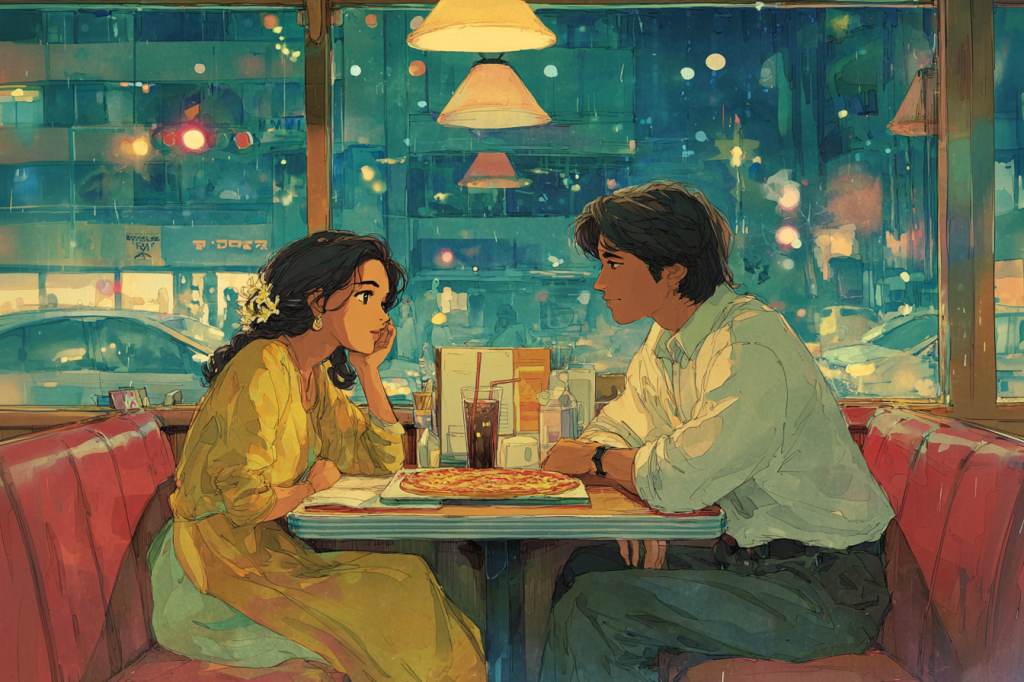
Yellow first. Always yellow first. The colour arriving ahead of form, announcing itself before permission was granted. Then her, assembled effortlessly, as if the city had been expecting her. Scooty angled with casual defiance. Jasmine pinned into her hair with care, already softening, releasing that particular sweetness that meant it had been chosen. The long bag hanging low across her shoulder, swinging slightly as she shifted her weight, patient, unhurried, entirely at ease with being waited for.
He felt the city recede a fraction. Traffic softened. Noise lost its edge. The air seemed to hesitate, not because it had to, but because it wanted to. She looked up and smiled.
It was not a large smile. It did not ask to be noticed. It arrived the way light does when a door is opened suddenly, filling corners you did not know were dark. Something inside him loosened. Something else tightened. The afternoon, which had been moving forward obediently until then, slipped sideways, as if time itself had briefly forgotten what it was meant to do.
She lifted her hand. He lifted his. They walked toward each other through a pocket of space that felt briefly sheltered, as though the city had leaned back to let them pass.
“Hi,” she said.
Inside Pizza Hut the cold arrived first, aggressive and immediate. The kind of cold that made people sit up straighter. Red booths. Plastic menus that stuck slightly to the fingers. A low roar of voices. Laughter bouncing off glass.
A waiter appeared.
“Table for two?”
She said, “Sixteen.”
The waiter paused.
He said, “Two.”
She smiled, quick. “We’re expecting ghosts.”
The waiter nodded like this was not the strangest thing he’d heard all day and led them to a booth near the window.
They sat opposite each other. He noticed this immediately and pretended he hadn’t. She put her bag down beside her, then nudged it closer with her arm, then nudged it back again, never quite satisfied.
“You look like you’re about to give a presentation,” she said.
“I am sitting,” he said.
“You’re sitting very formally.”
“I’ve been trained.”
“By whom?”
“Life.”
She laughed, leaned forward, elbows briefly on the table before remembering herself and pulling them back.
“So,” she said.
“So,” he said.
She grinned. “We’re good at this.”
He picked up the menu, held it with both hands. She watched him, amused.
“You don’t have to read it like that,” she said.
“Like what?”
“Like it’s going to ask you questions.”
“It might.”
She tilted her head. “You’re nervous.”
“I’m thinking.”
“That’s the same thing.”
He scanned the page, frowned.
“What’s capsicum?”
She froze. “You’re kidding.”
“I’m not.”
“You are.”
“It sounds medicinal.”
She stared at him for a second, then laughed. Not polite laughter. Real laughter. Loud enough that the boy at the next table looked over.
“It’s kudamilagai,” she said.
“Oh, I thought it was gulab jamun.”
“Why would you think it’s gulab jamun?”
“In English,” he said, weakly.
She shook her head, still smiling. “You’re impossible.”
“You knew this.”
“Subbu, I knew you were nerdy. I didn’t know you were this nerdy.”
The waiter came back.
“One Veggie Supreme,” she said without looking at the menu.
“Medium,” he said quickly.
“Large,” she said at the same time.
They both stopped.
He glanced at her. “We don’t need a large.”
She shrugged. “It’s the new millennium. Go big.”
He smiled despite himself. “That’s not how budgets work.”
She leaned back, crossed her arms. “This is not about budgets. This is about optimism.”
The waiter waited.
He sighed. “Large.”
She smiled, satisfied.
“And one Coke,” she said. “Two straws.”
“One straw,” he said.
She raised an eyebrow. “Why?”
“I don’t like straws.”
“You drink Coke like you’re mad at it.”
“I am disciplined.”
She laughed. “You’re ridiculous.”
“Two straws,” she told the waiter.
He considered this. “Fine. Two straws. But I get first sip.”
She smiled. “Negotiation. You’re learning.”
When the waiter left, there was a brief silence. Not awkward. Just new.
She picked at the edge of her napkin, tore a tiny piece off, rolled it between her fingers without noticing she was doing it.
“This is our first time,” she said, lightly. “Actually sitting like this.”
He nodded. “I keep thinking that.”
“Does it look weird?”
“No.”
“Because it feels a little weird.”
“Good weird,” he said.
She looked up at him then, something softer passing across her face before she caught it and smiled again.
“Yeah,” she said. “Good weird.”
“Are you nervous?” she asked.
“I’m thinking.”
“That’s a synonym.”
“I’m thinking about how the word girlfriend still feels like stolen property.”
“You didn’t steal it.”
“I borrowed it irresponsibly.”
“Intent matters,” she said. “Even in theft.”
The Coke arrived. Condensation already racing down the glass. She pushed the straw toward him. He resisted. She pushed again. He surrendered.
She grinned. “Small victories.”
“You’re dangerous.”
“I’m efficient.”
He traced a finger through the moisture on the glass, watched the line disappear almost immediately.
“You know,” she said, “everything feels possible right now.”
“Everything?” he asked, still looking at the glass.
She nodded. “It’s 2000. New century. New rules.”
He looked up. “Some rules don’t change.”
She didn’t answer immediately. Took a sip of Coke instead. When she spoke again, her voice was the same, but a little quieter.
“Yeah,” she said. “I know.”
Then she smiled, brighter, like she’d just fixed something.
From somewhere behind them came the sound of metal against metal, a tray being negotiated through a narrow space. Then she appeared. Not a waiter, not yet. A girl, younger than both of them, hair tied back too tightly, wearing an apron that still believed in neatness. She carried the pizza like something that mattered.
She set it down between them on a thick cork mat, the kind that looked vaguely scientific, as if heat were a problem that needed engineering.
“Hot, sir,” she said, already pulling her hand back. “Careful.”
Steam rose. Cheese shifted. The smell expanded its borders.
She placed the slicer beside the plate, the handle facing outward, professional, practiced.
“Anything else?” she asked.
“No,” she said, smiling. “This is good.”
The girl nodded and disappeared back into the kitchen, carrying their attention with her for a second longer than necessary. They leaned in instinctively, both of them, drawn toward the center.
She pointed immediately. “That,” she said, tapping one of the green pieces with her finger, “is capsicum.”
He leaned closer. “So that’s what it looks like.”
She laughed. “You were expecting something round?”
“I don’t know,” he said. “Brown. Sweet. Respectable.”
She shook her head. “You thought capsicum was gulab jamun.”
“In English,” he said again, stubborn.
“And this,” she said, moving her finger to a small black ring, “is olive.”
“Olive?” he repeated.
“Yes.”
“Like olive oil?”
“Yes.”
He frowned. “Why is it solid?”
She stared at him. “You don’t know olives.”
“I know coconut oil,” he said. “Groundnut oil. Gingelly. Oil that behaves.”
She laughed, delighted now. “You’re impossible.”
“I’m local.”
She picked up the slicer, then paused, held it up like a prop. “Watch carefully. This is my kind of technology.”
She pressed down. The slicer resisted for a second, then yielded.
He watched, intent. “You’re very confident.”
She cut the pizza with surgical calm. Eight pieces. No drama.
“Symmetry,” she said. “Like a family where everyone pretends.”
“Dark,” he said.
“Accurate.”
“There,” she said. “No fights later.”
He took the first slice, held it awkwardly, the tip sagging under its own weight.
“Fold it,” she said.
“Why?”
“So it doesn’t collapse on you.”
“I don’t like folding food.”
“You like eating it, don’t you?”
He folded it. Cheese threatened again.
She laughed. “Commit to it.”
He took a bite, too quickly, and hissed.
“Hot,” she said, satisfied.
She paused. The restaurant noise dimmed briefly, as if listening.
“Don’t philosophize until after the second slice,” she said.
They ate. At first, quietly.
“So,” she said. “Tell me again why you won’t eat chicken pizza.”
He smiled. “You already know.”
She wiped her fingers carefully on the napkin, folding it once, then unfolding it again, as if checking its obedience.
“You know what still surprises me?” she said.
“What?” he asked, mouth full.
She looked him over deliberately, head tilted, eyes narrowing in mock inspection. “This.”
“This what?”
“You.” She gestured vaguely. “This version.”
He glanced down at himself. The tucked-in shirt. The belt. The shoes that were trying very hard to look serious.
“I’ve always known you as…” She paused, smiling. “You know. kurta. jolna bag. rubber sandal. Walking everywhere with a book like you’re about to invent something.”
He laughed. “That was a phase.”
“That was your personality.”
“I work now,” he said. “I have responsibilities.”
She raised an eyebrow. “You?”
“Yes,” he said, offended. “I write SQL now.”
She blinked. “You just said that like it’s impressive.”
“Relational databases are impressive,” he said. “Tables. Relationships. Constraints.”
She shook her head, laughing. “You’re still the same.”
“No, I’m not,” he said. “I tuck my shirt in now.”
“That’s tragic.”
“I have an ID card,” he added.
“Stop.”
“I have a chair.”
She laughed harder at that, leaning forward, hand briefly touching the edge of the table to steady herself. “A chair.”
“With wheels.”
“Oh my god.”
“I spin sometimes when no one’s looking.”
She wiped at the corner of her eye. “I cannot believe you.”
“Beans, you loved me in kurta,” he said. “This is growth.”
She looked at him then, softer. “I didn’t know you like that then.”
“I know.”
“But I noticed you,” she said quickly, as if correcting something. “Just… differently.”
He nodded. He understood the difference.
She picked at a piece of crust, then pushed it aside.
“I always thought you were very chill but serious,” she said.
“I am both.”
“No,” she said. “You’re intense. You look like you’re always thinking three thoughts ahead.”
“I am.”
“That’s exhausting.”
“It’s efficient.”
She laughed. “You make life sound like a program.”
“It has inputs,” he said. “And outputs.”
“And errors,” she said.
He smiled. “Especially errors.”
They ate again. The pizza was almost gone now. The plate marked with grease and fingerprints. The cork mat darkened in places where oil had escaped.
“You know,” she said, lowering her voice a little, “for a long time, you were just… around in the college.”
“Around?”
“Yes. In the background. Always there.”
“I was waiting.”
She nodded. “I didn’t know that then.”
“I know.”
“I thought you were quiet.”
“I am quiet.”
“No,” she said. “You observe. Quiet people disappear. You didn’t.”
He shrugged. “You were easy to observe.”
She smiled at that, pleased despite herself. “I didn’t really know you until recently.”
“Recently,” he repeated.
“Last year, maybe,” she said. “You started talking more.”
“I ran out of patience.”
She laughed. “That explains it.”
She took a long sip of Coke, eyes drifting to the window for a moment, watching a bus struggle past traffic. When she spoke again, her voice was the same, but there was a half-second delay that hadn’t been there before.
“It’s strange,” she said. “We’ve known each other for years. And then suddenly…”
“Suddenly,” he said.
“Suddenly everything happened very fast.”
“It didn’t feel fast to me,” he said.
She nodded. “Of course it didn’t.”
Her foot tapped once under the table. Stopped. She folded her hands together, then separated them again.
“I still can’t believe you said it,” she said lightly.
“Said what?”
She looked at him. “You know.”
He traced the edge of the Coke glass with his finger, watching moisture gather and slip away.
“I’ve been saying it for a long time,” he said. “Just not aloud.”
She smiled, but her eyes stayed on the table. “You always do things thoroughly.”
“I don’t like half measures.”
She looked up at him then. “That’s what scares me.”
The sentence landed softly. No emphasis. No accusation.
He didn’t answer immediately. Took a bite of the last remaining slice instead, chewed slowly.
“You make it sound dangerous,” he said.
She shrugged. “Everything good is.”
She reached up, touched the jasmine briefly, as if checking it was still there.
“I like this,” she said, gesturing between them. “This sitting. This talking.”
“So do I.”
“It feels… grown-up,” she said.
He smiled. “We are grown-up.”
She laughed. “Don’t push it.”
They shared the last bite without discussing it. He held the slice steady while she tore off a piece. Their fingers brushed again. Neither apologized. For a moment, neither spoke. The music changed overhead. A song they both recognized but did not name.
Outside, evening settled further into itself. Inside, something delicate held.
They sat back as the plate was cleared, the cork mat lifted and taken away, leaving behind a faint ring where the pizza had been. The table looked suddenly larger, emptier, like a room after furniture has been moved. The Coke glass remained between them, half-full now, ice thinning, bubbles losing conviction.
She stirred the straw without drinking.
“My mother asked today,” she said, casually, as if mentioning weather.
He looked up. “About?”
“Nothing,” she said quickly. “Just… asking.”
“Asking what?”
She smiled. “Everything.”
He nodded. He understood the category.
“What did you tell her?” he asked.
“The truth,” she said. Then corrected herself. “A version of it.”
He traced the rim of the glass with his finger. “You’re good at versions.”
“You have to be,” she said. “In my house.”
“In mine too.”
She glanced at him. “Did you tell yours?”
He hesitated. “I told them I was going out this evening.”
“That’s not telling.”
“That’s surviving.”
She laughed softly, then stopped. Folded her hands together.
“You know they’ll ask eventually,” she said.
“I know.”
“And they won’t ask gently.”
“I know.”
She leaned back, crossed her arms, then uncrossed them again, as if trying positions on for comfort. “They’ll want details.”
“What kind of details?”
She ticked them off with her fingers, half joking. “Who. From where. Why. Food. Church. Language. Relatives.”
“Horoscope” he added.
“Not in my family.”
He nodded. “Horoscope always comes last.”
“Because it confirms what they already want to hear.”
They sat quietly for a moment. The music overhead shifted to something slower, more deliberate.
“Do you ever think,” she said, “that maybe we just started too late?”
He frowned. “It’s been twenty days.”
“Exactly,” she said. “Twenty days and already we sound like people from a black-and-white movie.”
“Maybe that’s romantic.”
“Maybe that’s doomed.”
He stared at the Coke bubbles. “Families.”
“Religions.”
“Food.”
“Language.”
He sighed. “You think it’ll get easier?”
“I think we already know the answer,” she said.
He smiled. “You’d make a terrible politician.”
“And you’d vote for me anyway.”
“In a heartbeat.”
“You ever think about how many people are involved in a marriage?” she said.
“Too many,” he said.
“My aunt alone could run a small country.”
“My athimber thinks he already does.”
She smiled, then sighed. “It’s strange, isn’t it?”
“What?”
“That we’re sitting here talking about this like we’re planning a trip.”
He looked at her. “We plan everything.”
“That’s a problem,” she said again, softer this time.
He didn’t respond immediately. Looked out the window instead, watched a man argue with an auto driver, both of them certain of their righteousness.
“You know,” he said finally, “I never thought this far.”
She raised an eyebrow. “You?”
He smiled. “I thought about you. That was it.”
She looked down at her hands. Picked at her nail with her thumb.
“I think about further,” she said. “That’s my problem.”
“That’s not a problem.”
“It is when the further looks… complicated.”
He nodded slowly. “You think it would get easier?”
She didn’t answer right away. Took a sip of Coke. Grimaced slightly at how flat it had become.
“I think,” she said carefully, “we would get tired.”
“Tired?”
“Of explaining,” she said. “Of defending. Of translating ourselves.”
He considered that. “I don’t mind.”
“I know you don’t,” she said. “You’d fight.”
“Yes.”
She looked up. “And I don’t want you to.”
He frowned. “Why?”
“Because you’d lose something,” she said. “Even if you won.”
He opened his mouth, then closed it again.
“My brother may get married in the next two years,” she said, suddenly.
“Oh.”
“And my sister,” he said. “Same two years.”
She nodded. “Everything starts lining up.”
“Against us?”
She shook her head. “Not against. Just… around.”
He smiled sadly. “The world has good timing.”
“Too good,” she said.
She reached for the Coke glass again, then stopped, pushing it away slightly, as if distance might clarify something.
“You know what I hate?” she said.
“What?”
“That this makes sense.”
He nodded. “That’s the worst part.”
They sat there, both of them quiet now, not touching anything. Outside, a horn blared, impatient. Inside, someone laughed too loudly at another table.
“I don’t want to stop liking you,” she said, very simply.
He looked at her. “Neither do I.”
She swallowed. “But liking and living aren’t always on the same side.”
He held her gaze. “We don’t have to decide now.”
She smiled, grateful and sad at the same time. “We already are.”
Neither of them moved.
The Coke melted itself into water.
He watched her for a long second before speaking, as if rearranging his thoughts into something that could pass for lightness.
“You know,” he said, attempting a smile, “we could also choose to be wildly irresponsible.”
She laughed, but it didn’t travel very far. “You already are.”
“I mean it,” he said. “Ignore everything. Religion. Language. Food. Aunties. Uncles. All of it. Just… decide.”
She leaned back, crossed her arms, then let them fall again. The jasmine in her hair had loosened slightly, one petal clinging stubbornly near her ear.
“That sounds very heroic,” she said. “And very exhausting.”
“I don’t mind exhausting.”
“I know you don’t,” she said. “That’s the problem.”
He frowned gently. “Why is that a problem?”
“Because you’d keep going,” she said. “Even when it starts hurting. Even when it stops making sense.”
He opened his mouth, closed it, tried again. “Things don’t have to make sense all the time.”
“They do if they involve other people,” she said. “Families. Siblings. Futures. We won’t just hurt ourselves. We’ll hurt everyone. And then we’ll still end up here.”
“Here where?”
She gestured around them. The empty plate. The thinning Coke. The table that now felt too wide.
“At the end,” she said.
He looked down, then up again. “You’re saying our first date is also our last.”
She nodded. “That’s exactly what I’m saying.”
He absorbed that. Let it move through him slowly.
“I don’t even know what a date is,” he said finally. “It sounds like something invented by restaurants.”
She smiled, then her smile broke just a little. “For me, if this is ending badly, I want it to be forgettable.”
He shook his head. “That won’t work.”
“Why not?”
“Because this,” he said, gesturing between them, “isn’t forgettable.”
She sighed. “You always do this.”
“Do what?”
“Turn everything into meaning.”
“I’ll probably write it into a book someday,” he said, half joking.
She rolled her eyes affectionately. “You and your books.”
He smiled. “You like that about me.”
“I do,” she said. Then, quieter, “Which is why I don’t want to watch it break.”
There it was. The sentence that closed the door without slamming it.
He shut his eyes for a moment. Just long enough for the city to pass behind his eyelids. When he opened them again, the optimism was still there, but it had learned its limits.
“I don’t agree. At least we should have given it a shot,” he said quietly. “But I hear you.”
“Okay,” he said.
She looked at him. “Okay?”
He nodded. “Okay.”
They stood. The chairs scraped. The sound was ordinary, and somehow unbearable.
He reached into his pocket, felt for the folded notes he had been carrying all evening without counting. He left them on the table, more than necessary, pressed flat with care. As they walked out, he paused, called the girl back, and added a little more, the kind of gesture that wasn’t about generosity so much as order.
She nodded, surprised. “Thank you, sir.”
He nodded back.
Outside, the night had fully claimed the street. Headlights cut through warm air. The city moved on, generously indifferent.
They stepped out together.
“Happy birthday,” he said.
She smiled, thin but real. “Say it again.”
“Happy birthday.”
This time the words fell gently, like something being put down rather than offered.
He hesitated. The idea of a hug rose in him, fully formed, already aching. Too public. Too new. Too late.
So he held out his hand.
She took it.
And in that single, ordinary touch, time lost its discipline.
In the instant their palms met, a future burst open.
They were married in a small government office with peeling paint and a bored clerk who stamped their names without looking up. They argued over curtains. They had children who ran barefoot through a Madras afternoon. He walked with a slight stoop now, a cane tapping rhythm into the pavement. She wore yellow still, always yellow, laughing at him for forgetting where he left his glasses. They grew old the way people always think they will. Gently. Together.
Then it vanished. The street returned. The noise. The rules.
She let go.
“Take care,” she said.
“You too,” he said.
She put on her visor. Mounted her Scooty, looked back once, lifted a hand, not smiling this time.
He sat on his Hero Puch, helmet resting on the handle, watching as she drove away. Watched her take the right at College Road. Watched until yellow became distance. Until distance became nothing.
Only then did he straighten, place the helmet on his head, and ease the engine awake. The little pony answered. And carrying with it everything that had not happened and everything that somehow still had, it took him back into the long sentence of the city.
(to be continued…)
 kirukkal.com
Leave a comment