
Written as part of the Pesum Padam – Mani Ratnam Retrospective Series, this piece revisits Mouna Ragam. Click to watch the Mouna Ragam retrospective.
A girl, a boy, an arranged marriage, the ghost of a lost love, the divorce papers, the heart that will not quit. That is Mouna Ragam in six beats, Mani Ratnam’s 1986 film that grabs you and does not let go.
There is a moment in the movie, a top-angle shot where Divya, played by a luminous Revathi, sits on a terrace next to the thulasi maadam, on her wedding evening, and asks her mother a question that stops you cold. “How am I supposed to share a room with a stranger? Would you have let this happen two days ago?” It is not loud or filmy. It is soft, almost like she is talking to herself. But it lands like a thunderbolt. At his sharpest, Mani transforms a single line into a mirror for every Tamil girl who has ever felt the weight of an arranged marriage. Nearly forty years later, Mouna Ragam still feels like a punch to the gut, a movie that is as much about love as it is about fighting for your own space.
The film starts in Divya’s room, plastered with childhood photos, real ones of Revathi, not some art department trick. It is a small touch, but it pulls you in, makes you feel like you are flipping through her family album. Then comes the morning chaos. Divya begging for bed coffee, her mother scolding her to shower first because “Appa will get mad.” It is so 1980s Tamil Nadu, so real, you can almost smell the filter kaapi and whatever is cooking on their stove. Mani does not waste time with big hero entries or over-the-top drama. He gives us a home, a family, a girl who is mischievous but rooted.
And that is the thing about Mouna Ragam. It is different because it dares to ask questions. Divya is not just saying no to Chandrakumar(Mohan), the decent-and-mellow guy her parents pick. She is saying no to the whole idea that a girl’s life gets decided in one evening. When she tells Chandrakumar, “Please reject me, I will not be a good wife”, and he just smiles and says he likes her, you see her panic. Her family is thrilled, her father slaps her when she fights back, her mother guilt-trips her with a heart-attack sob story. It is all so familiar, so suffocating. Mani does not judge. He shows it like it is, and that is what makes it hit home.

But here is where he flips the script. Mani refuses to turn this into a sob story. It is a love story, just not the kind we are used to. Chandrakumar is not your typical hero. He sleeps on a mattress on the floor, reads Tell Me Why books, listens to Vivaldi on vinyl and respects Divya’s no when she pushes him away on their first night. “It feels like a caterpillar crawling on me”, she snaps when he touches her hand, and he backs off, no ego bruised.
Then comes the flashback, Divya’s past with Manohar(Karthik), the rebel who steals her heart. He is all fire and charm, beating up a politician’s son, winking at her after she bails him out, parking his bike in front of a Pallavan bus just to mess with her. It is the kind of energy Mani later gave Surya in Aayitha Ezhuthu, but when Manohar gets shot running to marry her, it is not just tragedy. It is the reason Divya is so broken. Mani does not milk it with slow-mo tears. He lets the pain sit there, real and raw.
Back in Delhi, the film turns into this beautiful push and pull. Their Delhi house, with its wooden vibe and funky rolling staircase, feels like a Mani trademark, cozy yet cool, a space where two strangers slowly figure each other out. Chandrakumar takes Divya to see the Taj Mahal, and instead of some big dance number, we get Panivizhum Iravu, Ilaiyaraaja’s magic weaving through shots of college kids(!!) dancing while Divya and Chandrakumar sit by a campfire, the Taj peeking through trees. It is not in-your-face romantic. It is gentle, like they are both scared to admit what is growing. P.C.Sreeram’s camera makes it look like a painting, and you can’t help but think Mani read that Aadhavan’s shortstory, Taj Mahalil Oru Pournami Iravu, because the mood’s so similar..
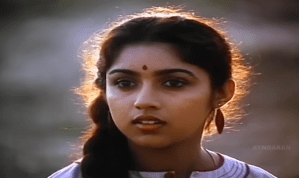
P.C is the guy behind the lens. He paints it alive. Delhi streets, the Taj Mahal’s outline, they are like a quiet friend in the story, all warm glows and soft edges that carry Divya’s tug-of-war inside. He grabs the small stuff, a tiny Tamil Nadu bedroom, that Delhi house, and makes it feel full of life, light hitting just right. Every shot is holding something back, waiting. Mani leans on him for a reason. PC does not flex, he shows you what is there, a world where love takes its own sweet time.
In addition to delivering a smash hit album, Ilaiyaraaja is the one giving Divya and Manohar their own beating heart. For Divya, it is this tender restless theme, Manohar’s music is all heat. His music peaks in that crazy symphonic rush when he tries to outrun the police, their bullets flying as he races to reach her, horns and strings smashing like his life is slipping away. And it is. Raaja gets them, wild for Manohar’s rush, gentle for Divya’s hurt, every note theirs alone.
When Chandrakumar is left bloodied by union goons, Divya rushes him to the hospital. And when the hospital receptionist asks her who she is, the answer escapes her before she can stop it, “I am his wife.” It is not a plot twist, it is the moment she finally sees him. By the time she’s tearing up divorce papers at the railway station, yelling, “I love you,” and he’s chasing the train, pulling the chain to carry her off, you’re cheering because it’s real. Mani takes these two people, stuck together by fate, and makes you believe they choose each other.
In Mani’s telling of this love story, everything collides with a raw, unfiltered energy. PC’s backlit angles, soft yet sharp, the cast, Revathi, Mohan, Karthik, living every second, those costumes, flowing saris and simple shirts that look natural but are not, the production design making every room a home, Raaja’s music tearing through your chest, the themes of love and fight weaving it tight. Mani makes it feel so easy, so human, like you could touch it, but you cannot. Meticulously crafted yet just beyond grasp, this is the essence of big-screen magic. It’s not all that perfect, but pulsating with life, it unsettles, and that is its power.
Mani had made four films before, sure, but this quiet movie, with its understated title hiding its seismic impact, put him on the map as an artist you could not ignore. Drawing from Mahendran’s Nenjathai Killathe, it felt like a new arrival, blending sharp storytelling with a visual style that sets the stage for everything he would do next, from Roja to Iruvar to OK Kanmani. He showed Tamil cinema a new way. Dialogues that sound like real people talking, not heroes shouting. A heroine who is not a doormat or a goddess, just a girl figuring things out. A hero who is strong because he waits.
Mouna Ragam is not flashy, it is deep. It is not about love at first sight but about love that resists, questions, and ultimately chooses. When Divya, sitting in the front seat of their Premier Padmini, turns to Chandrakumar and asks for a divorce in a calm, firm, and an unsentimental tone, the film delivers its most radical moment. It is not a plea, not an outburst, just an unshaken declaration of what she wants. In that instant, Tamil cinema’s idea of marriage shudders. This is Mani Ratnam making his mark, not with noise, but with certainty. He changed the game. And decades later, we are still playing by his rules.
 kirukkal.com
Leave a comment