listen to this chapter now on youtube!
No one had consulted him when they changed the name. Not a single government official had sought his opinion, no minister had sent him a courteous letter of inquiry—Dear Sir, do let us know at your earliest convenience if we may proceed with this renaming business?—nothing. One fine day, the newspapers simply declared that Madras, his Madras, had been quietly replaced with a more domesticated, government-approved, slightly less colonial Chennai. And just like that, without his permission, without even the basic courtesy of a memo, the city of his childhood, of his movie posters and second-hand bookstores, of his grandmother’s whispered stories, had been edited out of existence.
He took personal offense to this. Not the kind of offense that leads men to the streets in protest, no—he was far too lazy for that—but the kind that settles deep into the bones, the way a misplaced childhood grudge lingers against a long-forgotten teacher. He still called it Madras, stubbornly, gleefully, his own little act of defiance, as though by sheer force of habit, he could will the old name back into currency.
And so, on that humid July morning when Madras—betrayed, rebranded, and wholly unconsulted—woke up to find itself answering to the name Chennai, he kick-started his Hero Puch, the engine sputtering to life like an old man grumbling about a world that no longer made sense. Clad in worn jeans and unassuming sandals, his khadi kurta—a handcrafted jibba—fluttered slightly, an oddity amidst the tide of tight T-shirts and denim. His jolna bag, slung cross-body, sagged against his hip, a rumpled, overburdened companion, making him look less like a college student and more like a prematurely middle-aged poet who had misplaced his first book deal.
The roads of KK Nagar were already alive with the day’s theatrics. Newspaper stands shouted of politics—Jayalalithaa’s latest triumphs and tribulations, Rajinikanth’s upcoming cinematic revolution, DMK and AIADMK still locked in their eternal, operatic war. The scent of fresh agarbathis mixed with that of jasmine garlands, sold by flower vendors who sat cross-legged on the pavement, their hands moving faster than time itself.
MGR Nagar unfolded before him in a riot of color and sound—fruit sellers stacking their pyramids of mangoes with architectural precision, tea shops clinking with glass cups, auto drivers arguing over fares with the aggressive diplomacy of international negotiators. He turned into the ESI Hospital parking lot, nodding at the parking attendant with the easy familiarity of a man who had been handing over two-rupee coins in exchange for a safe spot for his moped since the beginning of time.
From there, a short walk took him to the Udayam Theatre bus stop, where Kamal Hassan’s larger-than-life gaze peered down at him from freshly pasted posters of the movie Indian. The D70 arrived, overflowing with passengers in the way only Madras—Chennai!—buses could manage, an alchemy of space and human elasticity. Inside, men clung to the overhead bars with one hand while flipping newspapers with the other. The air was thick with unspoken rules—who must move for whom, how far an elbow could be tolerated before it became an offense, the strategic placement of feet to minimize unwanted entanglements.
Through Ashok Nagar, Guindy, past the never-ending bridge construction that had taken on an almost mythical quality—like some ancient project abandoned by the gods—he finally reached Velachery. The SPIC stop expelled a gaggle of Chellamaal college girls in cotton dupattas, their bangles jingling as they disappeared into the crowd.
Just before Velacheri, he stepped off the bus and into the welcoming aroma of the Honest Tea Stall. His friends were already there, cigarettes dangling, single chaaya cups in hand, debating the day’s irrelevancies. He waved but did not stop. Hunger dictated his next move.
The college canteen, a temple of cheap idlis and indifferent sambar, greeted him with the clatter of steel plates. He ate in silence, washing it all down with a cup of tea so thin it could have doubled as dishwater.
And then, at last, came the first period. He sat through it, as was expected of him, endured the lecture like a soldier endures war—stoically, with a touch of exaggerated suffering. But the real story of the day, the only one that mattered, began when he emerged from the classroom, stepping into the corridor, leaning against the balcony, humming under his breath.
It was the second week of college, a morning already humid with the sun’s early insistence. The day sprawled ahead like a yawning field of endless periods and half-hearted lessons, the kind he imagined might blur into one another until only the tedium remained.
He lingered outside his classroom on the second floor, leaning against the railing of an open balcony, waiting for Professor Sukanya Mam to arrive and begin the dance of microeconomics. He wasn’t sure why he was alone—his friends were usually nearby, filling the spaces between classes with laughter and petty arguments about nothing in particular. But today, the silence belonged to him.
He was humming softly under his breath, the notes of a melody that had lodged itself in his soul. “Enai Kaana Vilaiye”—I’ve been missing since yesterday—a line that seemed to embody the wistful romance of A R Rahman’s genius. It was a song about searching, about absence and longing, though at the time, he had no one to long for. Or so he thought.
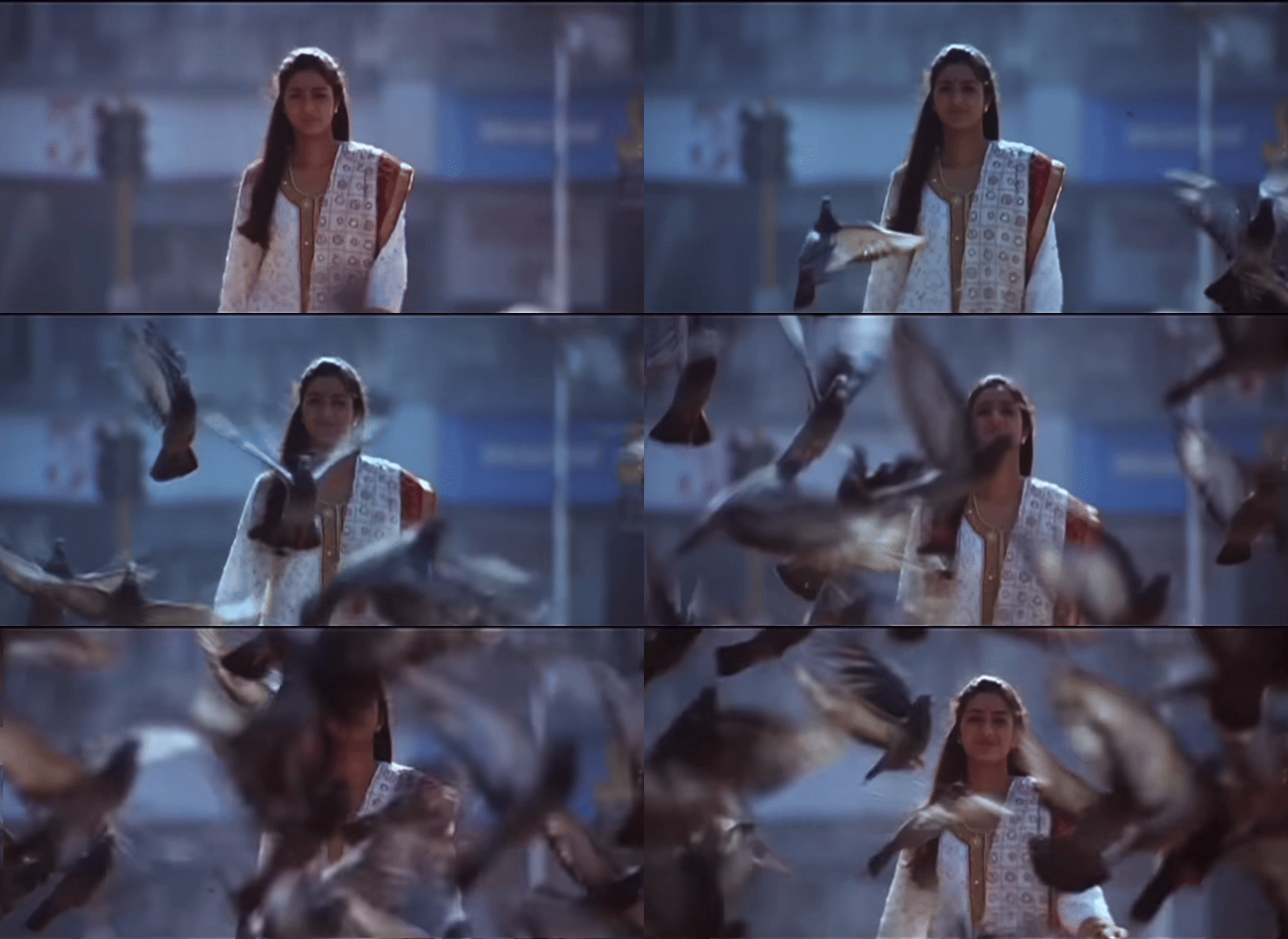
The songs of Kadhal Desam had already become a part of his life, like an old habit. The movie itself was just a month away from release, waiting to take its place in the world. And now, humming a tune from this new film, he had no idea that life was about to shift beneath his feet. In just moments, everything would change.
And then, the world held its breath. Something—he would never be able to explain what—shifted in the air. The silence around him, once comfortable, now felt different, weighted, as if the day itself had stopped to take notice. The heat, the hum of distant voices, the rhythmic clang of a metal shutter being pulled down—all of it dulled, receded.
He straightened slightly, his humming faltering. A strange, inexplicable awareness prickled at the edge of his senses.
And then—
The spiral staircase, an outdoor structure that twisted its way up like a giant’s idle doodle, came into view at the edge of his peripheral vision.
He turned his head, and there she was.
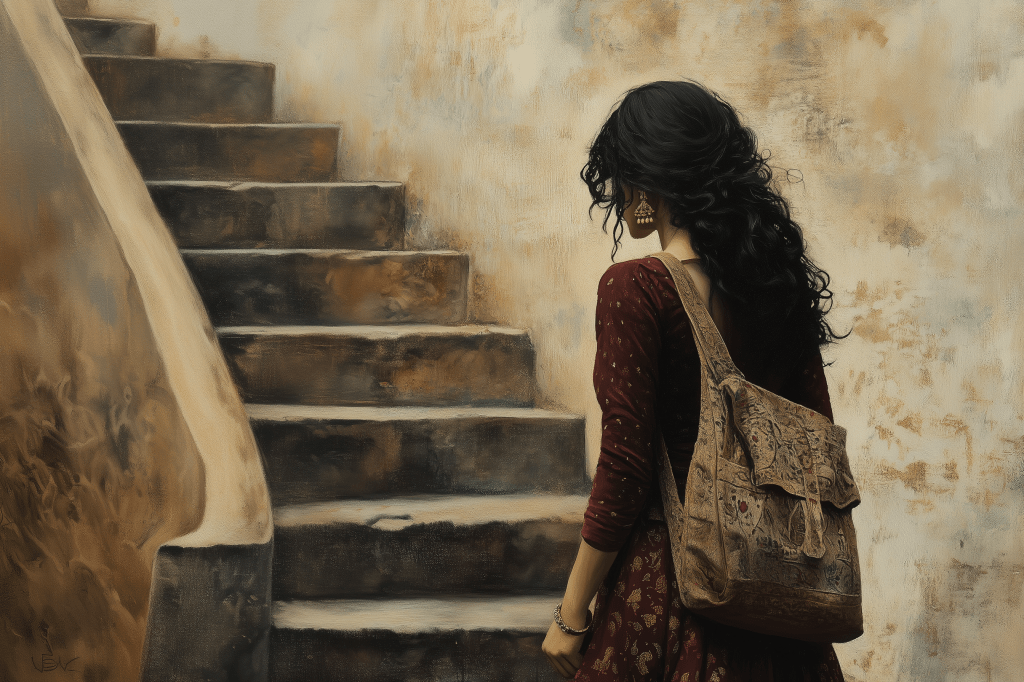
She emerged from the final turn of the stairs as if conjured by some capricious deity, her steps neither hurried nor hesitant. Her hair, oh, her hair. A glorious rebellion of black curls, caught the light in such a way that it seemed less a collection of strands and more a declaration of war against order itself. A single clip held it at bay for a brief moment before surrendering to the chaos that unfolded beneath it.
She wore a printed maroon churidar, its colors and patterns chosen with a deliberateness that hinted at both elegance and restraint. Her earrings swung with each step, oversized and gleaming, like tiny golden pendulums marking the passage of time that had now slowed to a crawl.
In her hand, she carried a Rajasthani cloth backpack slung casually over one shoulder. It was not remarkable, yet it captivated him in its utility, as though it held not books or pens but pieces of her personality, fragments of a life he would never know but desperately wanted to. She walked with the poise of someone accustomed to being observed yet blissfully unaware of the spell she cast on him.
He had no belief in love at first sight. If someone had asked him just moments earlier, he would have laughed at the absurdity of it. And yet, in those six seconds—perhaps eight, no more than ten—his world tilted. He could not explain it, then or now, but something in her—her elegance, her ease, the quiet poetry of her presence—spoke to a part of him he had not known existed.
It wasn’t her beauty, though she was undoubtedly beautiful; it was the way she seemed to belong entirely to herself, carrying her being as if it were a rare and fragile artifact she alone had the right to hold.
She reached the landing, her steps bringing her closer to the doorway of her classroom, which was directly opposite his. Perhaps she glanced at him—he couldn’t say for certain.
All he knew was that in those moments, as she crossed the threshold of her classroom and disappeared from view, he felt a certainty so profound it frightened him. She was his. Or he was hers. The distinction blurred into irrelevance.
The day went on. He sat through Sukanya Mam’s lecture, the words of microeconomics bouncing off him like pebbles skimming the surface of a lake. He did not speak of her to anyone; the experience felt too sacred, too fragile to share.
After class, he took the D70 again, the old warhorse of the Pallavan Transport Corporation, its metal body groaning under the weight of a hundred impatient passengers. The bus weaved through Ashok Nagar, where outside Udayam Theatre, the restless tide of moviegoers surged, desperate for Indian tickets. Men craned their necks over counters, black-ticket sellers whispered sweet illicit deals, and posters of Kamal Haasan loomed over the chaos, his mustached revolution gazing sternly down upon them all.
He stepped off and walked back to the ESI Hospital parking lot, where his Hero Puch sat in the scorching sun, waiting with the unwavering patience of an old, underappreciated friend. He swung a leg over, kick-started it with a practiced flick, and decided—home could wait.
Ramesh and Senthil will be at Woodlands Drive-In, where a good filter coffee awaited, a place where afternoons stretched long beneath the canopy of ancient trees. But then he remembered the books—those accursed, overdue books from British Council Library.
So he charted a new path: lunch first, library later.
From Ashok Nagar, he took the Arya Gowda Road of West Mambalam, which was never silent, never still. Midday brought with it the fervor of devotion at Ayodhya Mandapam, where a harikatha was underway—some saintly man in ochre robes narrating Krishna’s escapades to a rapturous audience, their voices rising in collective chants. The loudspeakers crackled, broadcasting divinity to everyone, including unsuspecting commuters like him. He rode past, and still, the city sang Krishna’s name.
Then came the Doraiswamy Bridge, where the world narrowed, where the old bridge grumbled under the weight of Madras’ eternal traffic. And just beyond it—T. Nagar.
There was no logic to T. Nagar—only instinct. The streets bulged with saree-clad shoppers, gold-seekers headed toward GRT and Saravana Stores, men haggling, women balancing bags heavier than their patience, auto-rickshaws zigzagging in suicide pacts. Today, however, something was different.
No, not different—transformed.
Somewhere between Ayodhya Mandapam and this sea of humanity, Madras had become pink. The sky, the buildings, the faces—everything was softer, warmer, bathed in some rose-tinted light that existed only in fever dreams and bad romantic films.
Pondy Bazaar, that eternal battlefield of consumerism, now looked like a parade of happy, grinning people—not the usual tired, irritable, elbow-throwing masses. Had the world suddenly acquired a background score? Enai Kaana Vilaiye played somewhere—no, wait, he was humming it again.
Through Teynampet, he rode on, the city still aglow in its strange, lovestruck haze. And then—Gemini Flyover.
Wide open.
Impossible.
This was Chennai, a city where roads did not exist without traffic, where red signals were decorative suggestions, where every square foot was occupied by someone going somewhere. And yet, the bridge was his alone.
He sang—loudly—as he sped up the incline. The sun blazed overhead, and yet, he did not feel its heat. The world had become a film set, the bridge a runway leading to destiny.
Enai Kaana Vilaiye—he bellowed, as though the song itself would summon the universe’s secrets.
And then, the descent.
The road curled toward Woodlands Drive-In, that oasis of slow afternoons. As he entered, the world saturated itself—the green of the trees deepened, the air thickened with the sacred perfume of filter coffee, the dull hum of conversation blending with the occasional clink of stainless steel tumblers.
He had never believed in destiny, in Tamil astrology or cosmic alignments, but he wondered—was this the universe’s way of laughing at him? To orchestrate such a collision, only to leave him standing there, mute and powerless, with no plan, no path forward?
He could still see her in his mind’s eye: her hair, wild and untamable; her churidar, modest yet enchanting; her stride, steady and self-assured. He thought about her eyes—eyes he could not possibly have seen in such detail from a distance of twenty feet. And yet he swore he had glimpsed something in them, something infinite.
Years later, he would ask himself if it had all been invented, a fiction spun by a mind desperate for significance. Had she really glanced at him? Was she even as poised, as magnetic, as he remembered?
It didn’t matter.
The truth, as he had come to understand it, was not in the details but in the moment’s power. He had stood there, humming a song about longing, and in the span of a heartbeat, he had found something he didn’t know he had been searching for. He would never know if it was love at first sight, or if he had simply collided with a moment that refused to let him go. But something had shifted. A center of gravity had moved.
The world had tilted, imperceptibly but irreversibly, and he—whether he realized it or not—had begun to fall.
A fall without end. Without a bottom. Without permission.
He would never again stand on solid ground.
(to be continued…)
 kirukkal.com
Leave a comment