
listen to this chapter now on youtube!
There was, of course, only one type of bus that wandered, rattling and roaring, across the endless sprawl of Tamil Nadu’s roads. No matter what name it carried—Thiruvalluvar or otherwise—each was the same: rusted seats that had borne years of passengers, windows that insisted on staying half-open, and a ride that swayed and jolted with the curves of the road. Inside, the air was thick with the familiar blend of sweat, diesel, and the lingering smell of food from distant stalls. The heat, the dampness, the closeness of it all—it was simply part of the bus, as inseparable from the journey as the honking horns and the endless stretch of national highway ahead.
On this particular morning, he and his father were on their way to Mayavaram, a rare trip by bus instead of train. Slightly after Chengalpat, near the small town of Maamandur, the bus hissed to a stop like an old serpent, disgorging its passengers into the world of makeshift restaurants designed purely for the fleeting, the transient, the lost. The drizzle from some distant cloud had sent rivulets down the road, while the smell of wet dust mingled with the pungent aroma of fermenting dosa batter.
Inside the restaurant, the noise of the road didn’t stop—it followed them in, the bus drivers outside honking like impatient gods, reminding you that time didn’t belong to you here. The honks were relentless, a part of the rhythm of the place. People learned, over time, to sit where they could see the bus, where they could bolt the moment the driver’s patience wore thin. He and his father did the same, perched at the edge of their seats, eyes always on the door, scanning the buses outside as though they might vanish if not watched carefully. The food arrived—steaming idlis, crisp dosas that shattered at the edges, and filter coffee so strong it could shake you awake from a hundred lifetimes.
And then it came—the honk, louder this time, the signal that it was time to go. Coins were quickly thrown on the table, the last bite of dosa unfinished, as they hurried back to the bus, moving with the practiced ease of those who knew the rhythm of these journeys, the road pulling them onward once again.
The bus rattled on, weaving its familiar path through towns and villages—Pondicherry, Cuddalore, Chidambaram, Sirkazhi, Vaitheeswaran Koil—names that hummed in the mind like a familiar tune, marking the slow but steady progress toward Mayavaram. For him, this was a well-known route, though most of his memories of it were from train journeys. Today, with the bus offering little more than its jolting rhythm and the changing scenery, he found himself doing what most kids of that time did on long trips—lifting his head every now and then to look out the window, counting the towns and stations as they passed by. He wasn’t reading a comic this time, but the thought crossed his mind more than once. In a different world, on a private bus, he might have been listening to Ilaiyaraaja’s melodies or maybe, if luck had it, something from that new musician everyone was talking about—A.R. Rahman, whose Roja soundtrack was already being whispered about. But these government buses didn’t come with radios, let alone anything so modern. So he sat, the landscape drifting by like pages of an unfinished book.
They arrived in Mayavaram just past 10 a.m., the heat of the morning already settling into the air, heavy and unrelenting. His father walked briskly, as he always did—flat-front pants with no creases, straight pockets instead of side, and a slight bell-bottom flare. His full-sleeve shirt, folded three or four times up the arm to reveal elbows, carried the faint smell of grease no matter how often it was washed, and bore stubborn stains from the machines he engineered with. A pair of Sandak sandals slapped loudly against the road, their molded rubber echoing with each step. His dad was always five steps ahead, always in a rush, while he trailed behind, trying to catch up, his shorter legs working hard to close the distance. He usually matched his dad’s speed only after alternating between walking and running. If his mother had been there, she would have been a good 100 feet behind, moving at her own pace, unconcerned by the hurry.
The street was busy with the usual morning hustle, people moving about, the shops just opening their doors. The sound of vendors calling out mingled with the distant drone of passing vehicles. Patta Mangalam Street, less than half a kilometer from the bus stand, was key to the town, bustling with activity despite Mayavaram being a rural town in the 1990s, with not much traffic yet. The heat pressed down on everything, making the air shimmer slightly. He glanced around, still hoping to spot a bookshop, but his father’s pace left little time for distractions. The familiar sense of both anticipation and exhaustion settled in as they approached the house—an old brick structure with large windows and a wide thinnai platform outside, the kind you sit on in the evenings, watching the world go by. The roof was tiled with red bricks, glowing faintly in the sunlight.
They reached the house, and his father, without hesitation, knocked on the door. It creaked open to reveal a woman of short stature, barely reaching five feet. She stood in a faded sari, her wide eyes momentarily surprised at the sight of him and his father, though her voice betrayed little emotion. “Vaanga, vaanga,” she said, ushering them in with the same neutrality that colored her expression. There was no warmth in the invitation, no excitement—just the kind of routine politeness that came with the territory. She turned almost instantly, retreating to the chair she’d clearly been sitting in before their arrival, as if their presence was just another passing event in the day.
The house itself was a familiar sight, typical of the rural homes he had visited in places like Thanjavur or Kumbakonam. At its heart was the miththam, the open courtyard at the center of the house, where the sky peeked through, indifferent to the activity below. The house was built around it, three sides forming a U-shape, the fourth side a plain wall that framed the space. Scattered across the miththam were old vessels waiting to be washed, their dull metal glinting in the soft light. A large earthen pot sat to one side, filled with water for washing feet, the surface still except for the occasional ripple from a passing breeze.
He and his father bent down to wash their legs, hands, and faces, the cool water a relief after the dusty journey from Madras. His fingers felt the grime slipping away, replaced by the freshness of the moment. He reached for a towel, hanging limply on a line stretched across the courtyard, its fabric worn but functional. As he wiped his face dry, his eyes wandered to the corner of the large room next to the courtyard.
There, lying quietly under a blanket, was the woman he had lovingly called poonapaati. She wasn’t his direct grandmother, but the elder sister of his father’s mother. Frail and silent, she was curled toward the wall, the back of her head visible, the unruly tufts of her white and gray hair spilling from beneath the blanket. Her form seemed almost delicate, swaddled in layers of fabric, as if the blanket itself was holding her together. He could see her breathing, slow and steady, but she didn’t stir. The house was still around her, the only sound the soft shuffle of feet and the occasional clink of vessels in the miththam.
This house, with its red-bricked roof and sprawling miththam, was more than just a stop on this journey—it was the place they returned to every summer, a waypoint etched in his memory as clearly as the names of the towns themselves. It had always been the midpoint, the place they’d rest for a few days before diving into the temple trails of Kumbakonam. It wasn’t just a house; it was a ritual. The pause before the deeper pilgrimage. And he remembered it vividly—not for its walls or the miththam—but for the cats. There had always been cats.
Ever since he was old enough to walk, there were three or four of them, all in the same orange-white color pattern, darting between rooms, brushing against ankles, lounging on sun-warmed platforms. He’d chase them, lift them up, or cradle them like his greatest treasures. The house had become synonymous with those cats, so much so that even his child-mind, barely three or four, had named his grandmother poonapaati. Paati for grandmother, and poona for the cats that roamed freely, as if they owned the place as much as she did. And his family, amused by the childish association, began calling her poonapaati too, a name that stuck, full of love, full of tenderness. It was as if the name captured everything she was to him—a symbol of simple joys, of boundless affection.
His father moved closer to where paati lay, resting on a thin, woven mat, the kind that offered little comfort against the hardness of the floor. A small steel bowl filled with water sat near her head, with an overturned tumbler balancing on top. Beside it, the remnants of a mosquito coil, long burned out, left a trail of ash like a lifeline that had run its course. His father knelt beside her, the weight of the years evident in the way he addressed her, his voice gentle but firm. “Perimma, Perimma, I’m Keerthi. Can you hear me?” he asked softly, bending toward her motionless form.
But poonapaati didn’t stir, didn’t even blink at the sound of his voice. She remained curled inward, her frail body still as stone. He stood by his father, watching her, his heart heavy with the sight of her small, shriveled frame. His father turned to poonapaati’s daughter, the woman who had opened the door, and asked what had happened. Her words floated through the air like distant murmurs—he didn’t catch most of it. All he could hear was the sadness underneath, the weight of months stretched thin, as she explained that paati had been lying there, on that mat, for weeks. “She hasn’t gotten up,” the daughter said, her voice tinged with exhaustion, “not for months.”
As they talked, poonapaati shifted ever so slightly, her body rolling just enough for him to catch a glimpse of her face. His breath caught in his throat. There were small, crimson spots on her face, scattered like tiny wounds, and he couldn’t understand why. The daughter, her voice steady despite the strain, reached over and pulled the blanket away. What he saw next sent a shiver down his spine—bedsores, angry and red, spread across her body. Blood crusted around the raw skin, the open wounds a testament to her long confinement. He could see them on her neck, her arms, her frail hands. She was barely covered by the sari that clung loosely to her, as if the fabric itself had given up, unable to protect her from the relentless heat or the coolness of the night. A small table fan, old and barely spinning, did little to ease her suffering. It was as if the world around her had stopped caring, the air heavy with a kind of neglect that made his heart ache.
“Paati, Paati, do you remember me?” he asked, stepping forward, his voice trembling. “I’m Guru, Paati,” he whispered, hoping that she would recognize him, would open her eyes and smile the way she always did. But she didn’t respond. Her eyes remained shut, her body unmoving. He stood there, helpless, as his father continued to talk to her daughter. They spoke of the neighbors who brought food, of how poonapaati had always been the one who cooked, who managed everything, but now could barely lift a hand. He could hear the sadness in his father’s voice, the guilt that hung between them like an invisible weight.
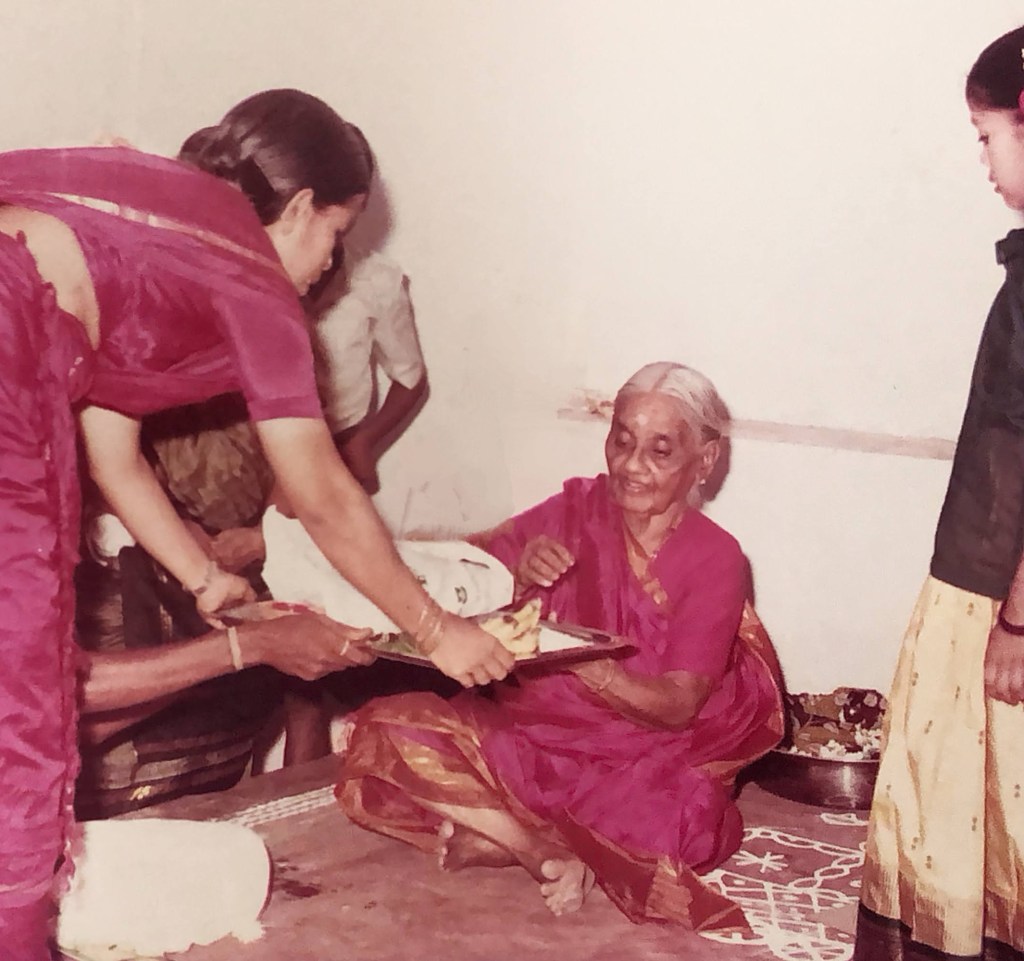
Poonapaati, or Mangalam Paati to the adults, was more than just his grandmother’s elder sister. She was kindness made flesh. A soft-spoken woman, whose eyes always crinkled at the corners in warmth, though she said little. Every visit, without fail, she would take him to the kadaitheru, the bazaar of Mayavaram, or the local temple. She never seemed hurried, never impatient, just steady, gentle, always with a small smile tugging at the edge of her lips. Her daughter, the woman who opened the door, was the opposite—efficient, practical, the kind of person who kept her thoughts hidden behind a neutral expression. A schoolteacher, she was known for her strictness, but poonapaati never seemed to mind. She moved at her own pace, not bound by the rigidity of rules.
He remembered the small, almost secret acts of kindness that poonapaati performed, those little gestures that stayed with him long after he left. Like that one summer evening, when they had come to Mayavaram for a wedding, and he had plans to go see Amman Kovil Kizhakale movie with his cousins. The excitement of the movie had already lit up his mind, but something else happened that night that he would remember forever. Her daughter, ever cautious, had a firm grip on the purse strings, never allowing her mother to give money to the relatives staying over. But poonapaati, with her quiet rebellion, had her ways. That evening, as he walked toward the theater, she found him, half a mile from the house, her small frame almost invisible in the fading light. She slipped five rupees into his hand, her fingers brushing his palm in a way that felt both clandestine and deeply caring. “Have an ice-cream during the break,” she whispered, a soft smile playing at the edge of her lips, her eyes crinkling just so. It was a gesture so small, yet it moved him in ways he couldn’t explain. No one had ever done anything like that for him before—an act of love so unspoken yet profound.
From that moment, grandmothers, any grandmothers, became his soft spot. Whether they were his own or someone else’s, he saw them through the lens of that memory—of poonapaati, sneaking a coin into his hand, breaking the rules to bring a smile to his face. Much later, in Saravana Perumal street of Madras, as he passed by an old woman running a small batter shop, her toothless smile beaming at customers, he would feel the same tug at his heart. She was tiny, barely noticeable, but her quiet presence reminded him of the grandmothers he had loved—his ammamma and poonapaati. She, too, became a symbol of that quiet, enduring love, the kind that doesn’t need words or grand gestures to make itself known.
And now, to see her like this, covered in sores, unable to even lift her head, her body frail and trembling—it broke something inside him. The woman who had once been the quiet orchestrator of family events was now barely holding on. Her jewelry was gone. The small gold earrings she used to wear, the chain around her neck, the bangles that clinked softly as she moved—they were all missing. Even in her sleep, her hands shook, the slight tremor of a body that had given too much and could take no more.
They stayed for a few hours, talking in hushed tones, though he barely heard what was said. His eyes remained fixed on poonapaati, on the frail figure lying motionless on the mat. It hurt to see her like this, hurt in a way he couldn’t quite describe. She had been such a vital part of his childhood, and now, as they prepared to leave, the memory of her as she once was lingered in his mind, clashing with the reality of her fragile form lying on the floor.
By noon, they left the house, the sun high in the sky, and made their way onward to Nannilam town, where his uncle worked. Near the Mayavaram bus stand, he had managed to coax his father into stopping by a small shop, where he found what he had been hoping for: a Lion Comics book. The brightly colored cover with its promise of adventure kept him going for the rest of the day. He devoured the comic once, then again, and again after that, the pages worn smooth under his fingers by the time they boarded the next bus. He was already thinking about the upcoming bonanza edition—a double issue to mark the anniversary. It would cost five rupees, and he couldn’t wait for the next month’s release. The visit to Nannilam was brief, just long enough to exchange greetings and have a good lunch.
As they rode back toward Cuddalore, the bus made another stop in Mayavaram, this time around 6 p.m. The town had transformed under the falling light. The streets, which had seemed drowsy and sun-baked earlier, now buzzed with evening life. Mayavaram in the day and Mayavaram in the evening were two entirely different places, and as he looked out the window, he found himself thinking about poonapaati, lying on her mat not far from where they were. He couldn’t shake the image of her frail body, the sores, the blanket draped over her like a second skin. The thought weighed heavy on him, but the bus continued to move, carrying them further and further away.
They arrived in Cuddalore late in the evening, settling into his aunt’s house. After dinner, as the family prepared for bed, the neighbor came by with a message—there had been a phone call from his uncle. His aunt hurried off to answer, and in the meantime, he found himself in the middle of a game of Snakes and Ladders with his cousins, their laughter and chatter filling the small room.
His aunt returned, her face pale and quiet. She stood in the doorway for a moment before speaking. Poonapaati had passed away an hour after they left that afternoon. The cremation had taken place that same evening.
As the news sank in, he thought he saw an orange-and-white cat leap across the narrow street, its tail flicking mid-air. He watched it disappear into the shadows of the next house, and for a moment, he almost called out to it. But then, the room was still again. Poonapaati was gone, the cremation finished, just as their bus had rolled through Mayavaram.

 kirukkal.com
Leave a comment